
Last letters from the living dead man
David Patterson (Spirit) Hatch
THE CLASSIC COLLECTION · 1894
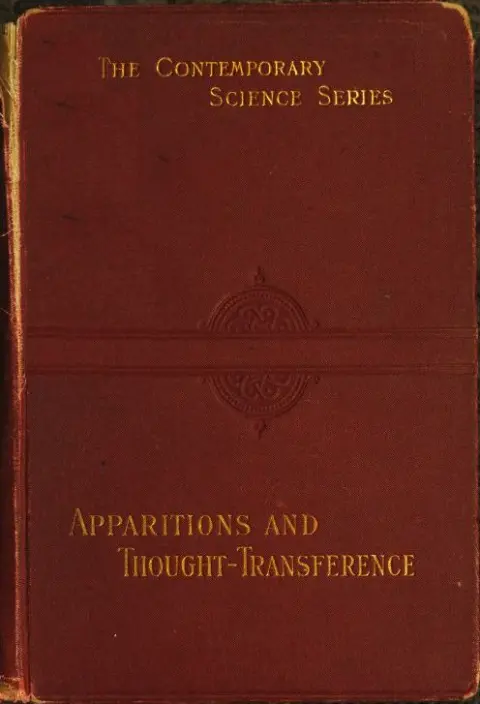
"Apparitions and Thought-Transference: An Examination of the Evidence for Telepathy" by Frank Podmore is a scientific publication written in the late 19th century. This work delves into the topic of telepathy, presenting a detailed examination and critique of various experimental evidence and case studies concerning thought transfer and associated phenomena. The book aims to provide the reader with a clearer understanding of telepathic communication that occurs outside the known sensory channels, while also acknowledging the complexities and challenges in achieving conclusive proof. The opening of the book introduces the context for the ongoing study of psychical research, pointing to the emergence of the Society for Psychical Research and the foundations laid by previous scientific inquiries. Podmore discusses the historical perspectives on supernatural phenomena, particularly apparitions and clairvoyance, and underscores the skepticism that comes from both the scientific community and the general public. He outlines fundamental challenges in the research, such as defining telepathy, potential errors in observation, common misconceptions, and the need for rigorous experimentation to validate the phenomena observed. Overall, the introduction sets a tone of inquiry, caution, and a commitment to applying scientific rigor in exploring the enigmatic territory of thought-transference.
Introduction adapted from the source catalogue; source summaries may be automatically generated.
Free to read · English · 144,986 words · No account needed
MAKE TIME FOR A GOOD BOOK
On by default. Untick to stop anonymous reading totals. Each page counts after 10 seconds in view. How this works.
Anonymous counting is on unless you have switched it off.
[Writing on June 24th, 1891, the percipient explains that in February 1889 she and her sister made the acquaintance at Talta of a Mr. P., who was at that time in an advanced stage of consumption. On one occasion, in the course of conversation, Mr. P. promised Countess Ina Kapnist, in the presence of the narrator, that should he die before her he would endeavour to appear to her. The Countess and her sister met Mr. P. occasionally after this conversation, and frequently saw him walking about in a nut-brown overcoat, which caused them some amusement. They left Talta, however, in May 1889, and in the course of a few months had completely forgotten Mr. P. and his wife, whom they regarded merely in the light of ordinary acquaintances. On the 12th March 1890 the two ladies, on their way home from the theatre, drove to the railway station with a friend who was to return at 1 A.M. to Tsarskoé.]
"On leaving the station," the Countess writes, "our servant went on before to find the carriage, so that on reaching the steps we found it had driven up and was waiting for us. My sister was the first to take her seat; I kept her waiting, as I descended the steps more slowly; the servant held the door of the landau open. With one foot on the step I suddenly stood still, arrested in the act of entering the carriage, and stunned with surprise. It was dark inside the carriage, and nevertheless, facing my sister and looking at her, I saw in a faint grey light which seemed unnatural, and which was clearest at the point on which my eyes were fixed, a face in profile, not so much vague as soft and transparent. This vision only lasted an instant, during which, however, my eyes noted the smallest details of the face, which seemed familiar to me; the rather sharp features, the hair parted a little on one side, the prominent nose, the sharp chin with its sparse, light brown beard. What strikes me when I think of it now is the fact that I could distinguish the different colours, though the greyish light which scarcely revealed the stranger would have been insufficient to enable me to distinguish them in ordinary circumstances. He had no hat, but wore a top-coat, such as is worn in the South, in colour a rather light nut-brown. His whole person had an air of great weariness and emaciation. The servant, much surprised that I did not enter the carriage but remained petrified on the step, thought I had trodden on my gown, and helped me to seat myself, while I asked my sister, as I took my place beside her, if it was really our carriage, so much was I confused and stupefied by seeing a stranger seated opposite her. It had not occurred to me that if a real person had been sitting there, neither my sister nor the footman would have remained so quietly face to face with him. When I was seated I no longer saw anything, and I asked my sister, 'Did you see nothing opposite you?' 'Nothing whatever, and what possessed you to ask as you got in if it was really our carriage?' she answered laughing. Then I told her what I have related above, describing my vision minutely. 'That familiar face,' said she, 'the hair parted at the side, the nut-brown coat, where have we seen it? Certainly nothing here answers to your description,' and we racked our brains without finding any clue. After we got home we related the incident to our mother; my description made her also remember vaguely a similar face. The next evening (March 12th) a young man of our acquaintance, Mr. Solovovo, came to see us. I told him also what had just occurred. We discussed it at some length, but fruitlessly. I still could not find the right name for the man of my vision, though I remembered quite well having seen a face exactly similar among my numerous acquaintances, but when and where? I could remember nothing, with my bad memory, which often fails me in this fashion. Some days later we were calling on Mr. Solovovo's grandmother. 'Do you know,' she said, 'what sad news I have just received from Talta? Mr. P. has just died, but I have heard no details.' My sister and I looked at each other. At the mention of this name the pointed face and the nut-brown top-coat found their possessor. My sister recognised him at the same time as myself, thanks to my minute description. When Mr. Solovovo entered I begged him to find the exact date of the death in the newspapers. The date of the death was given as the 14th of March, that is to say two days after my vision. I wrote to Talta for information, and learned that Mr. P. was confined to bed from the 24th November, and that from that time he was in a very feeble state, but sleep never left him. He slept so long and so profoundly, even during the last night of his life, that hopes were entertained of his improvement.
Your reading position is saved on this browser. Take it to another device with a library code. Reading pages adapt to text, rather than matching a printed edition.
BEHIND THE BOOK
This eBook is for the use of anyone anywhere in the United States and most other parts of the world at no cost and with almost no restrictions whatsoever. You may copy it, give it away or re-use it under the terms of the Project Gutenberg License included with this eBook or online at www.gutenberg.org. If you are not located in the United States, you will have to check the laws of the country where you are located before using this eBook. Read the source licence.
The original source file, including credits and licence, is retained by this library. Request an original-format copy at no charge. Please include the book title and Project Gutenberg identifier #56489.
KEEP YOUR CURIOSITY GOING
David Patterson (Spirit) Hatch
Coulson Kernahan

Ralph Waldo Emerson
Frances Wright

Edwin Abbott Abbott

Joseph Droz