
Last letters from the living dead man
David Patterson (Spirit) Hatch
THE CLASSIC COLLECTION · 1894
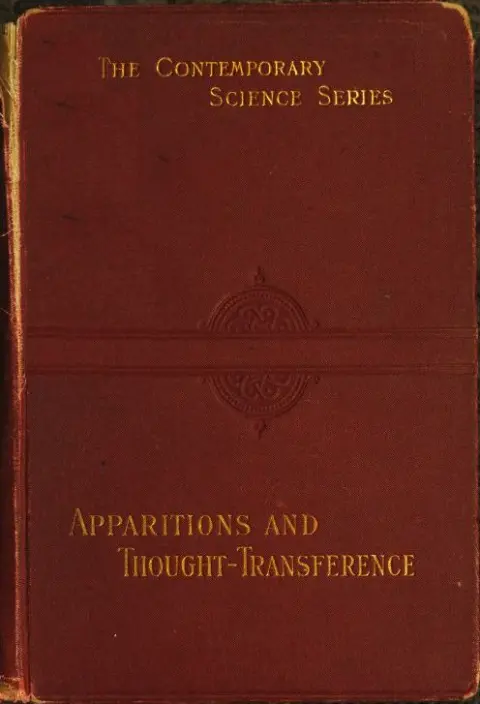
"Apparitions and Thought-Transference: An Examination of the Evidence for Telepathy" by Frank Podmore is a scientific publication written in the late 19th century. This work delves into the topic of telepathy, presenting a detailed examination and critique of various experimental evidence and case studies concerning thought transfer and associated phenomena. The book aims to provide the reader with a clearer understanding of telepathic communication that occurs outside the known sensory channels, while also acknowledging the complexities and challenges in achieving conclusive proof. The opening of the book introduces the context for the ongoing study of psychical research, pointing to the emergence of the Society for Psychical Research and the foundations laid by previous scientific inquiries. Podmore discusses the historical perspectives on supernatural phenomena, particularly apparitions and clairvoyance, and underscores the skepticism that comes from both the scientific community and the general public. He outlines fundamental challenges in the research, such as defining telepathy, potential errors in observation, common misconceptions, and the need for rigorous experimentation to validate the phenomena observed. Overall, the introduction sets a tone of inquiry, caution, and a commitment to applying scientific rigor in exploring the enigmatic territory of thought-transference.
Introduction adapted from the source catalogue; source summaries may be automatically generated.
Free to read · English · 144,986 words · No account needed
MAKE TIME FOR A GOOD BOOK
On by default. Untick to stop anonymous reading totals. Each page counts after 10 seconds in view. How this works.
Anonymous counting is on unless you have switched it off.
(The cover of this letter has been preserved, and bears the postmark, "Spilsby, Aug. 22nd, 1888.")
"Tuesday Evening, Aug. 21st, 1888.
"On Sunday we went to see Wroxham Broad. We had an immense amount of walking to do altogether, and I think I got a little cold in my face in the morning, and all night I suffered with it, and my face is swelled still."
In a second letter Miss Maughan writes:--
"Thursday, August 23rd, 11 P.M.
"I am putting poultices on my gums. I have never had such a huge swelling before, and it won't go down. It is so horribly uncomfortable."
"Saturday Afternoon.
"Thanks for letter. Yes, I was crying on Sunday night; only on account of the pain. It was awful, but I only cried quietly, as Edith was asleep...."
From MISS CLARK.
"Monday, August 27th, 1888, 10.30 A.M.
"Thanks for your letter. I am sorry it was you crying. You don't seem at all struck. I was very much so. It was a subdued sort (sic) I heard, and thought H. was trying not to let it be heard. I shall always be afraid now of hearing things."
The sound here was of an inarticulate kind, nor was it immediately referred to the actual agent, and both these facts must be held to detract from the evidential value of the coincidence. In the next case, however, the voice, it will be seen, was at once recognised. The voice in this case awoke the percipient, and the impression should therefore be classed as a hallucination rather than as a dream, but it was of the "borderland" type. The uneasiness caused to the percipient, as attested by the letter and telegram sent, is sufficient proof that the impression was of a kind unusual in his experience.
No. 69.--From MR. WILLIAM TUDOR.
"AUBURNDALE, MASS., July 11th, 1890.
"Your favour[115] of the 30th ult., addressed to Mrs. Tudor, I will answer, as the incident more directly concerned me.
"Late in the evening of Monday, March 17th, near midnight, my nephew, Frederic Tudor, Jun., fell in front of an electric car going to Cambridge, was dragged some distance and so badly injured that for a time his life was in doubt, though he recovered with the loss of a foot. My wife heard of the accident on Tuesday afternoon and was much distressed all the night of Tuesday, and quite restless and wakeful.
Your reading position is saved on this browser. Take it to another device with a library code. Reading pages adapt to text, rather than matching a printed edition.
BEHIND THE BOOK
This eBook is for the use of anyone anywhere in the United States and most other parts of the world at no cost and with almost no restrictions whatsoever. You may copy it, give it away or re-use it under the terms of the Project Gutenberg License included with this eBook or online at www.gutenberg.org. If you are not located in the United States, you will have to check the laws of the country where you are located before using this eBook. Read the source licence.
The original source file, including credits and licence, is retained by this library. Request an original-format copy at no charge. Please include the book title and Project Gutenberg identifier #56489.
KEEP YOUR CURIOSITY GOING
David Patterson (Spirit) Hatch
Coulson Kernahan

Ralph Waldo Emerson
Frances Wright

Edwin Abbott Abbott

Joseph Droz