
Last letters from the living dead man
David Patterson (Spirit) Hatch
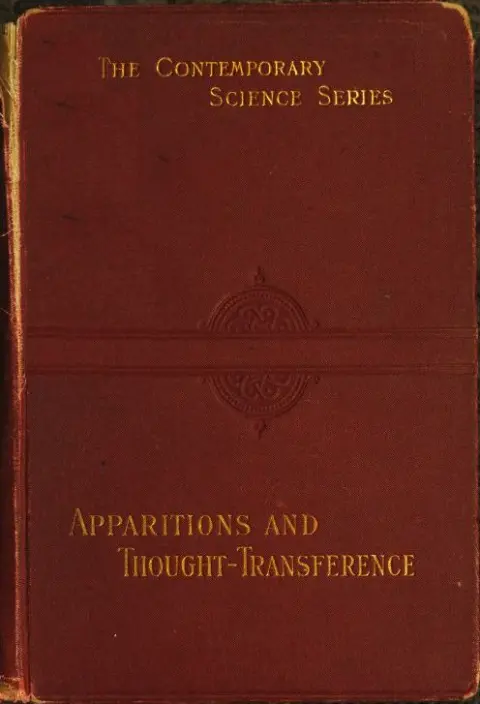
THE CLASSIC COLLECTION · 1894
"Apparitions and Thought-Transference: An Examination of the Evidence for Telepathy" by Frank Podmore is a scientific publication written in the late 19th century. This work delves into the topic of telepathy, presenting a detailed examination and critique of various experimental evidence and case studies concerning thought transfer and associated phenomena. The book aims to provide the reader with a clearer understanding of telepathic communication that occurs outside the known sensory channels, while also acknowledging the complexities and challenges in achieving conclusive proof. The opening of the book introduces the context for the ongoing study of psychical research, pointing to the emergence of the Society for Psychical Research and the foundations laid by previous scientific inquiries. Podmore discusses the historical perspectives on supernatural phenomena, particularly apparitions and clairvoyance, and underscores the skepticism that comes from both the scientific community and the general public. He outlines fundamental challenges in the research, such as defining telepathy, potential errors in observation, common misconceptions, and the need for rigorous experimentation to validate the phenomena observed. Overall, the introduction sets a tone of inquiry, caution, and a commitment to applying scientific rigor in exploring the enigmatic territory of thought-transference.
Introduction adapted from the source catalogue; source summaries may be automatically generated.
Free to read · English · 144,986 words · No account needed
MAKE TIME FOR A GOOD BOOK
On by default. Untick to stop anonymous reading totals. Each page counts after 10 seconds in view. How this works.
Anonymous counting is on unless you have switched it off.
It is important to note that in cases of this kind there is no discoverable point de repère, at least in the sense in which the phrase is understood by its authors; and the nature of the effect produced--a moving figure, apparently occupying a position in solid space--makes it very difficult to suppose that the hallucination is attached to any external object, which must necessarily be fixed. But the whole discussion about the necessity of external excitation or of points de repère seems beside the mark in such cases as these. For there can be no question that what in the first instance excites the hallucination is not a present sensation, but a memory. Whether for the full development of a sensory hallucination some external stimulus to the sense-organ is necessary is here a question of quite minor importance. The really interesting fact in its bearing on the question of telepathic hallucination is that some hallucinations are shown to be centrally, not peripherally, initiated. It should be further remarked that Zillah's astonishment at seeing the figure is typical, since in the case of post-hypnotic hallucinations in general neither the injunction to see the figure, nor indeed any other incident of his trance life, is remembered by the percipient in the normal state; and he is therefore entirely ignorant of the chain of events which led up to the hallucination, and can only by inquiry and reflection ascertain that the apparition which he has seen is of his own manufacture.
From these experimental cases we may pass to the consideration of spontaneous hallucinations, and amongst them to that class with which we are more directly concerned, the occasional hallucinations of sane and healthy persons. Owing, amongst other causes, to their comparative infrequency, and to the difficulty of obtaining accurate contemporary records (since their occurrence cannot, as in the hallucinations of disease, be foreseen), phenomena of this class have hitherto attracted little attention amongst psychologists.[98] Mr. Edmund Gurney, however, in 1884 and onwards conducted an inquiry, by means of a printed schedule of questions, amongst a circle of some 6000 persons; and during the last four years, at the request of the Congress of Experimental Psychology which met at Paris in 1889, Professor Henry Sidgwick, with the aid of a Committee of members of the S.P.R., has carried on a similar investigation on a larger scale. 17,000 adult persons, for the most part resident in the United Kingdom, have been questioned as to their experience of sensory hallucinations.[99] In the result it appeared that 1684 out of 17,000, or 9.9 per cent.--to wit, 655 out of 8372 men, and 1029 out of 8628 women--had experienced a sensory hallucination at some time in their lives. In about one-third of the cases the percipient had more than one experience of the kind. The phenomenon, therefore, though not so common as dreaming, is less rare than is generally supposed, seeing that about one in every ten educated persons has such an experience in the course of his life. The inquiries of the Committee have revealed no general cause for the greater number of these isolated hallucinations. In a small proportion of the cases there was a slight degree of ill-health, and in a rather greater number there was a certain amount of anxiety or other emotional excitement, to which the hallucinatory experience might with some plausibility be attributed.[100] But in the great majority of the cases there was no obvious antecedent to be discovered either in the condition of the percipient or in the surrounding circumstances, and we are led to the conclusion that an isolated hallucination of this kind is as little incompatible with ordinary health as a blush or a hiccough. At the same time we are entitled to infer, from the relatively large proportion of cases occurring when the percipient is in bed, or alone, that quiescence and freedom from external stimuli are favourable conditions for the genesis of hallucinations.[101] They may, in short, be regarded as unusually vivid dreams, and have for the most part just so much interest and significance. The nature and variety of these casual hallucinations may be gathered from the table on the following page.
Your reading position is saved on this browser. Take it to another device with a library code. Reading pages adapt to text, rather than matching a printed edition.
BEHIND THE BOOK
This eBook is for the use of anyone anywhere in the United States and most other parts of the world at no cost and with almost no restrictions whatsoever. You may copy it, give it away or re-use it under the terms of the Project Gutenberg License included with this eBook or online at www.gutenberg.org. If you are not located in the United States, you will have to check the laws of the country where you are located before using this eBook. Read the source licence.
The original source file, including credits and licence, is retained by this library. Request an original-format copy at no charge. Please include the book title and Project Gutenberg identifier #56489.
KEEP YOUR CURIOSITY GOING
David Patterson (Spirit) Hatch
Coulson Kernahan

Ralph Waldo Emerson
Frances Wright

Edwin Abbott Abbott

Joseph Droz