
Last letters from the living dead man
David Patterson (Spirit) Hatch
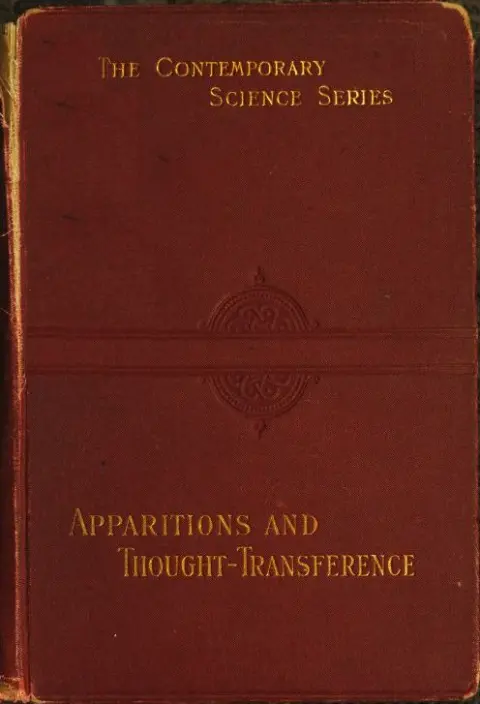
THE CLASSIC COLLECTION · 1894
"Apparitions and Thought-Transference: An Examination of the Evidence for Telepathy" by Frank Podmore is a scientific publication written in the late 19th century. This work delves into the topic of telepathy, presenting a detailed examination and critique of various experimental evidence and case studies concerning thought transfer and associated phenomena. The book aims to provide the reader with a clearer understanding of telepathic communication that occurs outside the known sensory channels, while also acknowledging the complexities and challenges in achieving conclusive proof. The opening of the book introduces the context for the ongoing study of psychical research, pointing to the emergence of the Society for Psychical Research and the foundations laid by previous scientific inquiries. Podmore discusses the historical perspectives on supernatural phenomena, particularly apparitions and clairvoyance, and underscores the skepticism that comes from both the scientific community and the general public. He outlines fundamental challenges in the research, such as defining telepathy, potential errors in observation, common misconceptions, and the need for rigorous experimentation to validate the phenomena observed. Overall, the introduction sets a tone of inquiry, caution, and a commitment to applying scientific rigor in exploring the enigmatic territory of thought-transference.
Introduction adapted from the source catalogue; source summaries may be automatically generated.
Free to read · English · 144,986 words · No account needed
MAKE TIME FOR A GOOD BOOK
On by default. Untick to stop anonymous reading totals. Each page counts after 10 seconds in view. How this works.
Anonymous counting is on unless you have switched it off.
Precautions against Error.
We have now to consider by what methods the various defects incident to testimony on these matters may be best eliminated. As the evidence upon which reliance is placed will be illustrated by the examples quoted hereafter, it will not be necessary to dwell at length here upon the precautions taken. The testimony at first-hand of the actual witnesses, it need hardly be said, is to be desired in any investigation; but in the case of phenomena which are at once stimulating to the imagination, and, as being novel, have no recognised standard of probability by which narrator or auditor can check deviations from the truth, no other evidence is worthy of consideration.[79] It will be seen that in all the cases here quoted the witness, or one of the witnesses, has furnished an account of his experience written by himself;[80] and it is worth noting that the very act of writing such an account to serve the purpose of a systematic inquiry is calculated to inspire the percipient with a sense of responsibility, and to lead him to weigh his words with precision. I may add that by the courtesy of our informants we have in most cases been enabled to question them orally on the details of their experience.[81]
But, for reasons already given, no case should be suffered to rest upon a single memory. It is of the highest importance, therefore, to obtain the corroborative testimony of persons who were cognisant of the occurrence of the impression before the news of the corresponding event. When this is not to be obtained, evidence of some unusual action on the part of the percipient, such as the taking of a journey, or the putting on of mourning, may be accepted as collateral proof of the reality of his impression. But, as we have already seen, the evidence of the attesting witnesses is liable to the same errors which affect the testimony of the percipient; and the evidence most to be desired is of a kind exempt from these weaknesses--that of a letter or memorandum written before the news. In a large proportion of the narratives dealt with, it is asserted that such a letter was written, or such a memorandum made. Unfortunately, this alleged documentary evidence is rarely forthcoming. It is possible that in some cases this statement is merely a conventional dramatic tag,--an addition made unconsciously and in perfect good faith to round off the story.[82] It cannot, however, I think, be regarded as surprising either that a letter or note was not written at the time, or that, if written, it should not have been preserved. Sensory hallucinations--to take the most striking instance--though unusual are not extremely rare experiences; most educated persons are perfectly familiar with the fact of their occurrence and regard them (in most cases rightly) as purely subjective, the products of some transient cerebral disturbance, as little worthy of record as a headache or a bilious attack. Often, probably, the telepathic hallucination is indistinguishable from the mass of purely subjective experiences of the same kind; and even should it be recognised at the time as exceptional, the want of leisure, the fear of ridicule, even the dislike of seeming to admit to himself the possibility of his experience having a sinister significance, would probably deter the percipient from writing about it.[83] It is much more likely that he would speak of it to an intimate friend, should opportunity occur. And when in the rare conjunction of an exceptional experience, adequate leisure, and a sympathetic correspondent, or the habit of writing a diary, the letter is actually written or the note made, the chances which militate against its preservation are many. Few persons will take a general and impersonal (in other words, a scientific) interest in occurrences of this kind. Their own isolated experience may possess a deep and abiding interest for themselves, and, less certainly, for their friends; an interest, however, which is quite compatible with the treatment of the attesting record as waste paper. But unless it can be used to illustrate or support a theory of a future life, they seldom regard a "ghost story" as having any value other than that derived from the personal environment. It appears, indeed, to possess for most little more significance than the recital of an extraordinary run of luck at cards, or a fortunate escape from a railway accident, between which it is commonly sandwiched. Again, few persons realise the high value of contemporary documentary evidence in matters of the kind; there are many who would probably share the views of a courteous correspondent, who, after sending me condensed copies of some contemporary memoranda, wrote in answer to my inquiries:--"I have not got the originals; I destroyed them immediately I sent them (i.e., the copies) to you, because I knew they would be more permanently preserved and recorded; being authenticated to Professor Barrett and you, there was no further need of them." And even when they escape immediate destruction the letters may, as in cases reported to us, be "washed out" or burnt; or may survive the perils of flood and fire only to be mislaid, so that they cannot be found without a more thorough search than the courtesy of our correspondents can induce them to make. Notwithstanding these various adverse chances, it will be found that many of the narratives which follow are actually attested by contemporary documentary evidence.
Your reading position is saved on this browser. Take it to another device with a library code. Reading pages adapt to text, rather than matching a printed edition.
BEHIND THE BOOK
This eBook is for the use of anyone anywhere in the United States and most other parts of the world at no cost and with almost no restrictions whatsoever. You may copy it, give it away or re-use it under the terms of the Project Gutenberg License included with this eBook or online at www.gutenberg.org. If you are not located in the United States, you will have to check the laws of the country where you are located before using this eBook. Read the source licence.
The original source file, including credits and licence, is retained by this library. Request an original-format copy at no charge. Please include the book title and Project Gutenberg identifier #56489.
KEEP YOUR CURIOSITY GOING
David Patterson (Spirit) Hatch
Coulson Kernahan

Ralph Waldo Emerson
Frances Wright

Edwin Abbott Abbott

Joseph Droz