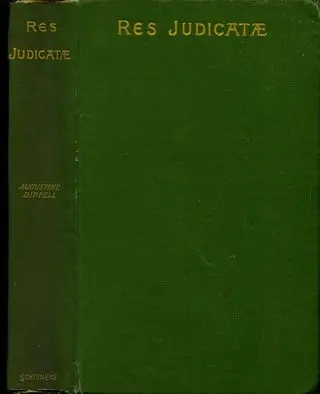
Res Judicatæ: Papers and Essays
Augustine Birrell
THE CLASSIC COLLECTION · 1905
"Andrew Marvell" by Augustine Birrell is a biographical account written in the early 20th century. This work delves into the life and legacy of Andrew Marvell, a prominent poet, politician, and contemporary of Milton, who played an influential role during the English Commonwealth and Restoration periods. The biography explores Marvell's multifaceted character as a writer, scholar, and civil servant, focusing on his contributions to poetry and politics. The opening of the biography introduces Marvell's early life, highlighting his upbringing in a scholarly household and his education, which laid the foundation for his future pursuits. Augustine Birrell reflects on Marvell's elusive nature as a historical figure, noting that while many details of his life, such as his education at Cambridge, his poetry, and his political endeavors, are well-documented, there remains a profound lack of personal insight into Marvell's character. Birrell presents the poignant context of Marvell's life against the backdrop of 17th-century England, setting the stage for a detailed exploration of his influential works and political involvement as the narrative unfolds.
Introduction adapted from the source catalogue; source summaries may be automatically generated.
Free to read · English · 75,195 words · No account needed
MAKE TIME FOR A GOOD BOOK
On by default. Untick to stop anonymous reading totals. Each page counts after 10 seconds in view. How this works.
Anonymous counting is on unless you have switched it off.
Charing Cross. Then England, rejoice, thy redemption draws nigh; Thy oppression together with kingship shall die.
Chorus. A Commonwealth, a Commonwealth we proclaim to the nation, For the gods have repented the King's restoration."
These probably are the lines which spread the popular, but mistaken, belief that Marvell was a Republican.
Andrew Marvell died in his lodgings in London on the 16th of August 1678. Colonel Grosvenor, writing to George Treby, M.P. (afterwards Chief of the Common Pleas), on the 17th of August, reports "Andrew Marvell died yesterday of apoplexy." Parliament was not sitting at the time. What was said of the elder Andrew may also be said of the younger: he was happy in the moment of his death. The one just escaped the Civil War, the other the Popish Plot.
Marvell was thought to have been poisoned. Such a suspicion in those bad times was not far-fetched. His satires, rough but moving, had been widely read, and his fears for the Constitution, his dread of
"The grim Monster, Arbitrary Power,
The ugliest Giant ever trod the earth,"
infested many breasts, and bred terror.
"Marvell, the Island's watchful sentinel,
Stood in the gap and bravely kept his post."
The post was one of obvious danger, and
"Whether Fate or Art untwin'd his thread
Remains in doubt."[220:1]
The doubt has now been dissipated by the research of an accomplished physician, Dr. Gee, who in 1874 communicated to the Athenaeum (March 7, 1874) an extract from Richard Morton's {Greek: Pyretologia} (1692), containing a full account of Marvell's sickness and death. Art "untwin'd his thread," but it was the doctor's art. Dr. Gee's translation of Morton's medical Latin is as follows:--
"In this manner was that most famous man Andrew Marvell carried off from amongst the living before his time, to the great loss of the republic, and especially the republic of letters; through the ignorance of an old conceited doctor, who was in the habit on all occasions of raving excessively against Peruvian bark, as if it were a common plague. Howbeit, without any clear indication, in the interval after a third fit of regular tertian ague, and by way of preparation (so that all things might seem to be done most methodically), blood was copiously drawn from the patient, who was advanced in years." [Here follow more details of treatment, which I pass over.] "The way having been made ready after this fashion, at the beginning of the next fit, a great febrifuge was given, a draught, that is to say, of Venice treacle, etc. By the doctor's orders, the patient was covered up close with blankets, say rather, was buried under them; and composed himself to sleep and sweat, so that he might escape the cold shivers which are wont to accompany the onset of the ague-fit. He was seized with the deepest sleep and colliquative sweats, and in the short space of twenty-four hours from the time of the ague-fit, he died comatose. He died, who, had a single ounce of Peruvian bark been properly given, might easily have escaped, in twenty-four hours, from the jaws of the grave and the disease: and so burning with anger, I informed the doctor, when he told me this story without any sense of shame."
Your reading position is saved on this browser. Take it to another device with a library code. Reading pages adapt to text, rather than matching a printed edition.
Augustine Birrell
Augustine Birrell
Augustine Birrell
Augustine Birrell
BEHIND THE BOOK
This eBook is for the use of anyone anywhere in the United States and most other parts of the world at no cost and with almost no restrictions whatsoever. You may copy it, give it away or re-use it under the terms of the Project Gutenberg License included with this eBook or online at www.gutenberg.org. If you are not located in the United States, you will have to check the laws of the country where you are located before using this eBook. Read the source licence.
The original source file, including credits and licence, is retained by this library. Request an original-format copy at no charge. Please include the book title and Project Gutenberg identifier #17388.
KEEP YOUR CURIOSITY GOING
John L. Ransom

Herman W. Mudgett

Harriet Monroe
Daniel Dulany Addison
Charles Lanman

Harold Rosher