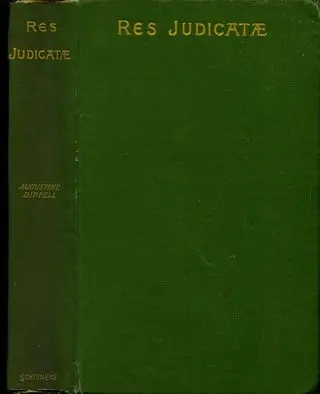
Res Judicatæ: Papers and Essays
Augustine Birrell
THE CLASSIC COLLECTION · 1905
"Andrew Marvell" by Augustine Birrell is a biographical account written in the early 20th century. This work delves into the life and legacy of Andrew Marvell, a prominent poet, politician, and contemporary of Milton, who played an influential role during the English Commonwealth and Restoration periods. The biography explores Marvell's multifaceted character as a writer, scholar, and civil servant, focusing on his contributions to poetry and politics. The opening of the biography introduces Marvell's early life, highlighting his upbringing in a scholarly household and his education, which laid the foundation for his future pursuits. Augustine Birrell reflects on Marvell's elusive nature as a historical figure, noting that while many details of his life, such as his education at Cambridge, his poetry, and his political endeavors, are well-documented, there remains a profound lack of personal insight into Marvell's character. Birrell presents the poignant context of Marvell's life against the backdrop of 17th-century England, setting the stage for a detailed exploration of his influential works and political involvement as the narrative unfolds.
Introduction adapted from the source catalogue; source summaries may be automatically generated.
Free to read · English · 75,195 words · No account needed
MAKE TIME FOR A GOOD BOOK
On by default. Untick to stop anonymous reading totals. Each page counts after 10 seconds in view. How this works.
Anonymous counting is on unless you have switched it off.
Macaulay, 70, 92.
"MacFlecknoe" (quoted), 21.
Manton, Dr., 162.
Mariae Marvell relictae et Johni Greni Creditori, 222.
Marlborough, Earl of, 115.
Martin Marprelate, 24.
Marvell, Andrew, born 1621, 4;
ancestry, 4-5;
Hull Grammar School, 8;
school days, 8-9;
goes to Trinity College, Cambridge, 10;
life at Cambridge, 11-12;
becomes a Roman Catholic, 12;
recantation and return to Trinity, 14;
life at Cambridge ends, 17;
death of mother, 17;
abroad in France, Spain, Holland, and Italy, 19;
acquainted with French, Dutch, and Spanish languages, 19;
poet, parliamentarian, and controversialist, 20;
in Rome (1645), 20;
invites Flecknoe to dinner, 22;
neither a Republican nor a Puritan, 23;
a Protestant and a member of the Reformed Church of England, 23;
stood for both King and Parliament, 23;
considered by Collier a dissenter, 24 n.;
civil servant during Commonwealth, 24;
rejoices at Restoration, 25;
keeps Royalist company (1646-50), 25;
contributes commendatory lines to Richard Lovelace in poems published
1649, 25;
defends Lovelace, 26;
loved to be alone with his friends, lived for the most part in a hired
lodging, 26;
one of thirty-three poets who wept for the early death of Lord H.
Hastings, 27;
went to live with Lord Fairfax at Nunappleton House as tutor to only
child and daughter of the house (1650), 27;
anonymity of verses, 34;
small volume containing "The Garden Poetry" (1681), 34;
tells story of Nunappleton House, 36-45;
applies to Secretary for Foreign Tongues for a testimonial, 48;
recommended by Milton to Bradshaw for post of Latin Secretary, 50;
appointed four years later, 51:
frequently visits Eton, 51;
Milton intrusts him with a letter and copy of Secunda defensio to
Bradshaw, 52;
appointed by the Lord-Protector tutor to Mr. Dutton, 54;
resides with Oxenbridges, 54;
letters, 53, 54-5, 85-7, 92-3, 94-6, 99, 100-1, 104, 105, 109-12, 121,
122, 140, 141-3, 145-7, 148-50, 189-91, 191 seq., 210;
begins his career as anonymous political poet and satirist (1653), 56;
dislike of the Dutch, 56;
impregnated with the new ideas about sea power, 59;
reported to have been among crowd which witnessed Charles I.'s death, 64;
first collected edition of works, verse and prose, produced by
subscription in three volumes, 64;
became Milton's assistant (1657), 68;
friendship with Milton, 69;
takes Milton's place in receptions at foreign embassies, 69;
plays part of Laureate during Protector's life, 71;
produces two songs on marriage of Lady Mary Cromwell, 72-3;
attends Cromwell's funeral, 73;
is keenly interested in public affairs, 75;
becomes a civil servant for a year, 75;
M.P. for Hull, 75;
friend of Milton and Harrington, 76;
well disposed towards Charles II., 77;
remains in office till end of year (1659), 77;
elected with Ramsden M.P. for Kingston-upon-Hull, 78;
attended opening of Parliament (1659), 80;
is not a "Rumper," 84;
again elected for Hull (1660), 84;
begins his remarkable correspondence with the Corporation of Hull, 84;
a satirist, not an enthusiast, 85;
lines on Restoration, 90;
complains to House of exaction of L150 for release of Milton, 91;
elected for third, and last, time member for Hull, 95;
receives fee from Corporation of Hull for attendance at House, 96;
reviled by Parker for taking this payment, 96;
Flagellum Parliamentum attributed to, 97;
goes to Holland, 100;
is recalled, 101;
while in Holland writes to Trinity House and to the Corporation of Hull
on business matters, 101;
goes as secretary to Lord Carlisle on an embassy to Sweden and
Denmark, 106;
public entry into Moscow, 108;
assists at formal reception of Lord Carlisle as English ambassador, 109;
renders oration to Czar into Latin, 109;
Russians object to terms of oration, 109;
replies, 109-12;
returns from embassy, 113;
reaches London, 113;
attends Parliament at Oxford, 116;
The Last Instructions to a Painter about the Dutch Wars, 129-35;
bitter enemy of Hyde, 136;
lines upon Clarendon House, 138;
inquires into "miscarriages of the late war," 139;
The Rehearsal Transprosed, 151;
its great success, 152;
literary method described by Parker, 162;
called "a droll," "a buffoon," 163;
replies to Parker, 163 seq.;
intercedes, 168;
abused by Parker in History of His Own Time, 170 n.;
The Rehearsall Transpros'd (second part), 171-2;
pictures Parker, 172 seq.;
latterly fears subversion of Protestant faith, 179;
his famous pamphlet, An Account of the Growth of Popery and Arbitrary
Government in England, 180-1, 203-5, 206-8;
gives account of quarrel with Dutch, 186-7;
commendatory verses on "Mr. Milton's Paradise Lost" (1674), 199 n.;
mock speech, His Majesty's Most Gracious Speech to Both Houses of
Parliament, 200-2;
story of proffered bribe, 209-10;
last letter to constituents, 210;
rarely speaks in the House of Commons, 211;
longest reported speech, 211;
speech reported in Parliamentary History (1677), 211;
"Debate on Mr. Andrew Marvell's striking Sir Philip Harcourt,"
etc., 212-14;
friend of Prince Rupert, 214;
lines on setting up of king's statue, 214-15;
"Britannia and Raleigh," 216-19;
dies, 219;
thought to have been poisoned, 219;
this suspicion dissipated, 220;
account of sickness and death, 220-1;
burial, 221;
obsequies, 223;
epitaph, 221;
humour and wit, 163;
not a fanatic, 179;
insatiable curiosity, 182;
power of self-repression, 211;
as poet, 225-30;
as satirist, 228, 230-1;
as prose writer, 231-2;
love of gardens, 227;
appearance described, 232;
Hull's most famous member, 223;
enemies, 224;
portraits of, 224;
statue of, 224;
editions of works, 229.
Your reading position is saved on this browser. Take it to another device with a library code. Reading pages adapt to text, rather than matching a printed edition.
Augustine Birrell
Augustine Birrell
Augustine Birrell
Augustine Birrell
BEHIND THE BOOK
This eBook is for the use of anyone anywhere in the United States and most other parts of the world at no cost and with almost no restrictions whatsoever. You may copy it, give it away or re-use it under the terms of the Project Gutenberg License included with this eBook or online at www.gutenberg.org. If you are not located in the United States, you will have to check the laws of the country where you are located before using this eBook. Read the source licence.
The original source file, including credits and licence, is retained by this library. Request an original-format copy at no charge. Please include the book title and Project Gutenberg identifier #17388.
KEEP YOUR CURIOSITY GOING
John L. Ransom

Herman W. Mudgett

Harriet Monroe
Daniel Dulany Addison
Charles Lanman

Harold Rosher