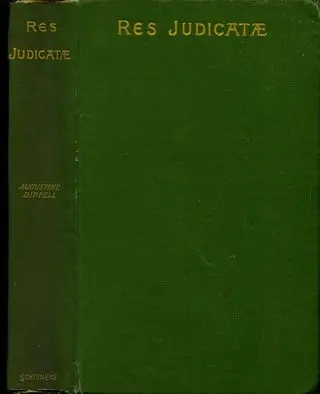
Res Judicatæ: Papers and Essays
Augustine Birrell
THE CLASSIC COLLECTION · 1905
"Andrew Marvell" by Augustine Birrell is a biographical account written in the early 20th century. This work delves into the life and legacy of Andrew Marvell, a prominent poet, politician, and contemporary of Milton, who played an influential role during the English Commonwealth and Restoration periods. The biography explores Marvell's multifaceted character as a writer, scholar, and civil servant, focusing on his contributions to poetry and politics. The opening of the biography introduces Marvell's early life, highlighting his upbringing in a scholarly household and his education, which laid the foundation for his future pursuits. Augustine Birrell reflects on Marvell's elusive nature as a historical figure, noting that while many details of his life, such as his education at Cambridge, his poetry, and his political endeavors, are well-documented, there remains a profound lack of personal insight into Marvell's character. Birrell presents the poignant context of Marvell's life against the backdrop of 17th-century England, setting the stage for a detailed exploration of his influential works and political involvement as the narrative unfolds.
Introduction adapted from the source catalogue; source summaries may be automatically generated.
Free to read · English · 75,195 words · No account needed
MAKE TIME FOR A GOOD BOOK
On by default. Untick to stop anonymous reading totals. Each page counts after 10 seconds in view. How this works.
Anonymous counting is on unless you have switched it off.
To the serene Venetian state I'll go, From her sage mouth famed principles to know; With her the prudence of the ancients read, To teach my people in their steps to tread; By their great pattern such a state I'll frame, Shall eternize a glorious lasting name. Till then, my Raleigh, teach our noble youth To love sobriety, and holy truth; Watch and preside over their tender age, Lest court corruption should their souls engage; Teach them how arts, and arms, in thy young days, Employed our youth--not taverns, stews, and plays; Tell them the generous scorn their race does owe To flattery, pimping, and a gaudy show; Teach them to scorn the Carwells, Portsmouths, Nells, The Clevelands, Osbornes, Berties, Lauderdales: Poppaea, Tigelline, and Arteria's name, All yield to these in lewdness, lust, and fame. Make them admire the Talbots, Sydneys, Veres, Drake, Cavendish, Blake, men void of slavish fears, True sons of glory, pillars of the state, On whose famed deeds all tongues and writers wait. When with fierce ardour their bright souls do burn, Back to my dearest country I'll return."
The dialogue between the two horses, which bore upon their respective backs the stone effigies of Charles the First at Charing Cross and Charles the Second at Wool-Church, is, in its own rough way, masterly satire for the popular ear.
"If the Roman Church, good Christians, oblige ye To believe man and beast have spoken in effigy, Why should we not credit the public discourses, In a dialogue between two inanimate horses? The horses I mean of Wool-Church and Charing, Who told many truths worth any man's hearing, Since Viner and Osborn did buy and provide 'em For the two mighty monarchs who now do bestride 'em. The stately brass stallion, and the white marble steed, The night came together, by all 'tis agreed; When both kings were weary of sitting all day, They stole off, incognito, each his own way; And then the two jades, after mutual salutes, Not only discoursed, but fell to disputes."
The dialogue is too long to be quoted. Charles the Second's steed
boldly declares:--
"De Witt and Cromwell had each a brave soul,
I freely declare it, I am for old Noll;
Though his government did a tyrant resemble,
He made England great, and his enemies tremble."
Mr. Hollis, when he sent the picture of Cromwell by Cooper to Sidney
Sussex College, is said to have written beneath it the lines just
quoted.
The satire ends thus:--
"Charing Cross. But canst them devise when things will be mended?
Wool-Church. When the reign of the line of the Stuarts is ended.
Your reading position is saved on this browser. Take it to another device with a library code. Reading pages adapt to text, rather than matching a printed edition.
Augustine Birrell
Augustine Birrell
Augustine Birrell
Augustine Birrell
BEHIND THE BOOK
This eBook is for the use of anyone anywhere in the United States and most other parts of the world at no cost and with almost no restrictions whatsoever. You may copy it, give it away or re-use it under the terms of the Project Gutenberg License included with this eBook or online at www.gutenberg.org. If you are not located in the United States, you will have to check the laws of the country where you are located before using this eBook. Read the source licence.
The original source file, including credits and licence, is retained by this library. Request an original-format copy at no charge. Please include the book title and Project Gutenberg identifier #17388.
KEEP YOUR CURIOSITY GOING
John L. Ransom

Herman W. Mudgett

Harriet Monroe
Daniel Dulany Addison
Charles Lanman

Harold Rosher