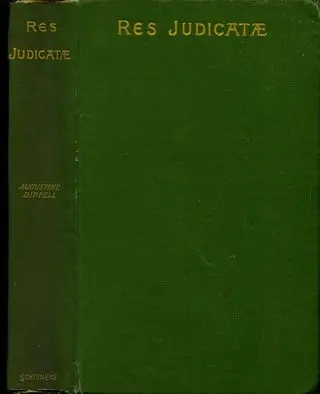
Res Judicatæ: Papers and Essays
Augustine Birrell
THE CLASSIC COLLECTION · 1905
"Andrew Marvell" by Augustine Birrell is a biographical account written in the early 20th century. This work delves into the life and legacy of Andrew Marvell, a prominent poet, politician, and contemporary of Milton, who played an influential role during the English Commonwealth and Restoration periods. The biography explores Marvell's multifaceted character as a writer, scholar, and civil servant, focusing on his contributions to poetry and politics. The opening of the biography introduces Marvell's early life, highlighting his upbringing in a scholarly household and his education, which laid the foundation for his future pursuits. Augustine Birrell reflects on Marvell's elusive nature as a historical figure, noting that while many details of his life, such as his education at Cambridge, his poetry, and his political endeavors, are well-documented, there remains a profound lack of personal insight into Marvell's character. Birrell presents the poignant context of Marvell's life against the backdrop of 17th-century England, setting the stage for a detailed exploration of his influential works and political involvement as the narrative unfolds.
Introduction adapted from the source catalogue; source summaries may be automatically generated.
Free to read · English · 75,195 words · No account needed
MAKE TIME FOR A GOOD BOOK
On by default. Untick to stop anonymous reading totals. Each page counts after 10 seconds in view. How this works.
Anonymous counting is on unless you have switched it off.
To William Ramsden, Esq. "June 1672.
"DEAR WILL,--Affairs begin to alter, and men talk of a peace with Holland, and taking them into our protection; and it is my opinion it will be before Michaelmas, for some reasons, not fit to write. We cannot have a peace with France and Holland both. The Dutch are now brought very low; but Amsterdam, and some other provinces, are resolved to stand out till the last. De-wit is stabbed, and dead of his wounds. It was at twelve a clock at night, the 11th of this month, as he came from the council at the Hague. Four men wounded him with their swords. But his own letter next morning to the States says nothing appeared mortal. The whole Province of Utrecht is yielding up. No man can conceive the condition of the State of Holland, in this juncture, unless he can at the same time conceive an earthquake, an hurricane, and the deluge. France is potent and subtle. Here have been several fires of late. One at St. Catherine's, which burned about six score or two hundred houses, and some seven or eight ships. Another in Bishopsgate-street. Another in Crichet Fryars. Another in Southwark; and some elsewhere. You may be sure all the old talk is hereupon revived. There was the other day, though not on this occasion, a severe proclamation issued out against all who shall vent false news, or discourse ill concerning affairs of state. So that in writing to you I run the risque of making a breech in the commandment.--Yours," etc.
The following letter deals with another matter of human concern than
politics, for it seeks to condole with a father who has lost an only
son.
To Sir John Trott
(Undated.)
"HONOURED SIR,--I have not that vanity to believe, if you weigh your late loss by the common ballance, that any thing I can write to you should lighten your resentments: nor if you measure things by the rules of christianity, do I think it needful to comfort you in your duty and your son's happyness. Only having a great esteem and affection for you, and the grateful memory of him that is departed being still green and fresh upon my spirit, I cannot forbear to inquire, how you have stood the second shock at your sad meeting of friends in the country. I know that the very sight of those who have been witnesses of our better fortune, doth but serve to reinforce a calamity. I know the contagion of grief and infection of tears, and especially when it runs in a blood. And I myself could sooner imitate than blame those innocent relentings of nature, so that they spring from tenderness only and humanity, not from an implacable sorrow. The tears of a family may flow together like those little drops that compact the rainbow, and if they be placed with the same advantage towards Heaven as those are to the sun, they too have their splendour; and like that bow, while they unbend into seasonable showers, yet they promise, that there shall not be a second flood. But the dissoluteness of grief, the prodigality of sorrow, is neither to be indulged in a man's self, nor complyed with in others. If that were allowable in these cases, Eli's was the readyest way and highest compliment of mourning, who fell back from his seat and broke his neck. But neither does that precedent hold. For though he had been Chancellor, and in effect King of Israel, for so many years (and such men value, as themselves, their losses at an higher rate than others), yet, when he heard that Israel was overcome, that his two sons Hophni and Phineas were slain in one day, and saw himself so without hope of issue, and which imbittered it farther, without succession to the government, yet he fell not till the news that the ark of God was taken. I pray God that we may never have the same parallel perfected in our publick concernments. Then we shall need all the strength of grace and nature to support us. But on a private loss, and sweetened with so many circumstances as yours, to be impatient, to be uncomfortable would be to dispute with God. Though an only son be inestimable, yet it is like Jonah's sin, to be angry at God for the withering of his shadow. Zipporah, though the delay had almost cost her husband his life, yet, when he did but circumcise her son, in a womanish peevishness reproached Moses as a bloody husband. But if God take the son himself, but spare the father, shall we say that He is a bloody God? He that gave His own son, may He not take ours? It is pride that makes a rebel; and nothing but the over-weening of ourselves and our own things that raises us against Divine Providence. Whereas Abraham's obedience was better than sacrifice. And if God please to accept both, it is indeed a farther tryal, but a greater honour. I could say over upon this beaten occasion most of those lessons of morality and religion which have been so often repeated, and are as soon forgotten. We abound with precept, but we want examples. You, sir, that have all these things in your memory, and the clearness of whose judgment is not to be obscured by any greater interposition, should be exemplary to others in your own practice. 'Tis true, it is an hard task to learn and teach at the same time. And, where yourselves are the experiment, it is as if a man should dissect his own body, and read the anatomy lecture. But I will not heighten the difficulty while I advise the attempt. Only, as in difficult things, you would do well to make use of all that may strengthen and assist you; the word of God; the society of good men; and the books of the ancients; there is one way more, which is by diversion, business, and activity; which are also necessary to be used in their season. But I myself, who live to so little purpose, can have little authority or ability to advise you in it, who are a person that are and may be much more so, generally useful. All that I have been able to do since, hath been to write this sorry Elogy of your son, which if it be as good as I could wish, it is as yet no indecent employment. However, I know you will take any thing kindly from your very affectionate friend, and most humble servant."
Your reading position is saved on this browser. Take it to another device with a library code. Reading pages adapt to text, rather than matching a printed edition.
Augustine Birrell
Augustine Birrell
Augustine Birrell
Augustine Birrell
BEHIND THE BOOK
This eBook is for the use of anyone anywhere in the United States and most other parts of the world at no cost and with almost no restrictions whatsoever. You may copy it, give it away or re-use it under the terms of the Project Gutenberg License included with this eBook or online at www.gutenberg.org. If you are not located in the United States, you will have to check the laws of the country where you are located before using this eBook. Read the source licence.
The original source file, including credits and licence, is retained by this library. Request an original-format copy at no charge. Please include the book title and Project Gutenberg identifier #17388.
KEEP YOUR CURIOSITY GOING
John L. Ransom

Herman W. Mudgett

Harriet Monroe
Daniel Dulany Addison
Charles Lanman

Harold Rosher