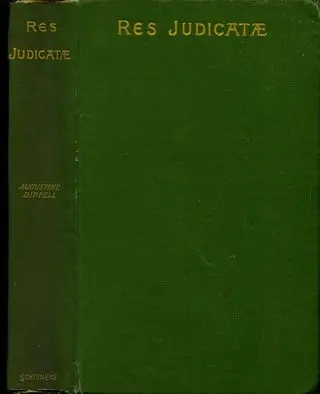
Res Judicatæ: Papers and Essays
Augustine Birrell
THE CLASSIC COLLECTION · 1905
"Andrew Marvell" by Augustine Birrell is a biographical account written in the early 20th century. This work delves into the life and legacy of Andrew Marvell, a prominent poet, politician, and contemporary of Milton, who played an influential role during the English Commonwealth and Restoration periods. The biography explores Marvell's multifaceted character as a writer, scholar, and civil servant, focusing on his contributions to poetry and politics. The opening of the biography introduces Marvell's early life, highlighting his upbringing in a scholarly household and his education, which laid the foundation for his future pursuits. Augustine Birrell reflects on Marvell's elusive nature as a historical figure, noting that while many details of his life, such as his education at Cambridge, his poetry, and his political endeavors, are well-documented, there remains a profound lack of personal insight into Marvell's character. Birrell presents the poignant context of Marvell's life against the backdrop of 17th-century England, setting the stage for a detailed exploration of his influential works and political involvement as the narrative unfolds.
Introduction adapted from the source catalogue; source summaries may be automatically generated.
Free to read · English · 75,195 words · No account needed
MAKE TIME FOR A GOOD BOOK
On by default. Untick to stop anonymous reading totals. Each page counts after 10 seconds in view. How this works.
Anonymous counting is on unless you have switched it off.
"DEAR SIR,--I have yours of the 12th of October 1670, which was in all respects most welcome to me, except when I considered that to write it you endured some pain, for you say your hand is not yet recovered. If I could say any thing to you towards the advancement of your affairs, I could, with a better conscience, admit you should spend so much of your precious time, as you do, upon me. But you know how far those things are out of my road, tho', otherwise, most desirous in all things to be serviceable to you. God's good providence, which hath through so dangerous a disease and so many difficultys preserved and restored you, will, I doubt not, conduct you to a prosperous issue, and the perfection of your so laudable undertakings. And, under that, your own good genius, in conjunction with your brother here, will, I hope, though at the distance of England and Persia, in good time operate extraordinary effects; for the magnetism of two souls, rightly touched, works beyond all natural limits, and it would be indeed too unequal, if good nature should not have at least as large a sphere of activity, as malice, envy, and detraction, which are, it seems, part of the returns from Gombroon and Surat. All I can say to you in that matter is, that you must, seeing it will not be better, stand upon your guard; for in this world a good cause signifys little, unless it be as well defended. A man may starve at the feast of good conscience. My fencing master in Spain, after he had instructed me all he could, told me, I remember, there was yet one secret, against which there was no defence, and that was, to give the first blow. I know your maxim, Qui festinat ditescere, non erit innocens. Indeed while you preserve that mind, you will have the blessing both of God and man. In general I perceive, and am very glad of it, that by your good management, your friends here get ground, and the flint in your adversarys' hearts begins to be mollifyed. Now after my usual method, leaving to others what relates to busyness, I address myself, which is all I am good for, to be your gazettier. I am sorry to perceive that mine by the Armenian miscarryed. Tho' there was nothing material in it, the thoughts of friends are too valuable to fall into the hands of a stranger. I wrote the last February at large, and wish it a better passage. In this perhaps I may interfere something with that, chusing rather to repeat than omit. The King having, upon pretence of the great preparations of his neighbours, demanded three hundred thousand pounds for his navy (though in conclusion he hath not set out any) and that the Parliament should pay his debts, which the ministers would never particularize to the House of Commons, our House gave several bills. You see how far things were stretched, though beyond reason, there being no satisfaction how those debts were contracted, and all men foreseeing that what was given would not be applyed to discharge the debts, which I hear are at this day risen to four millions, but diverted as formerly. Nevertheless such was the number of the constant courtiers increased by the apostate patriots, who were bought off, for that turn, some at six, others ten, one at fifteen thousand pounds in money, besides what offices, lands, and reversions, to others, that it is a mercy they gave not away the whole land, and liberty, of England. The Earl of Clare made a very bold and rational harangue, the King being present, against the King's sitting among the Lords, contrary to former precedents, during their debates; but he was not seconded. The King had this April prorogued, upon the Houses cavilling, and their harsh conferences concerning some bills, the Parliament from this April till the 16th of April 1672. Sir John Coventry's Bill against Cutting Noses passed, and O'Brian and Sir Thomas Sands, not appearing at the Old Baily by the time limited, stand attainted and outlawed, without possibility of pardon. The Duke of Buckingham is again one hundred and forty thousand pounds in debt, and, by this prorogation, his creditors have time to tear all his lands in pieces. The House of Commons has run almost to the end of their line, and are grown extreme chargeable to the King, and odious to the people. Lord St. John, Marquess of Westminster's son, one of the House of Commons, Sir Robert Howard, Sir John Benet, Lord Arlington's brother, Sir William Bucknoll, the brewer, all of the House, in fellowship with some others of the city, have farmed the old customs, with the new act of Imposition upon Wines, and the Wine Licenses, at six hundred thousand pounds a year, to begin this Michaelmas. You may be sure they have covenants not to be losers. They have signed and sealed ten thousand pounds a year more to the Duchess of Cleveland, who has likewise near ten thousand pounds a year out of the new farm of the country excise of Beer and Ale, five thousand pounds a year out of the Post Office, and, they say, the reversion of all the King's leases, the reversion of places all in the Custom House, the green wax, and indeed, what not? All promotions, spiritual and temporal, pass under her cognizance. Buckingham runs out of all with the Lady Shrewsbury, by whom he believes he had a son, to whom the King stood godfather; it dyed, young Earl of Coventry, and was buryed in the sepulchre of his fathers. The King of France made a warlike progresse this summer through his conquests of Flanders, but kept the peace there, and detains still the Dutchy of Lorain, and has stired up the German Princes against the free towns. The Duke of Brunswick has taken the town of Brunswick; and now the Bishop of Cullen is attacking the city of Colen. We truckle to France in all things, to the prejudice of our honour. Barclay is still Lieutenant of Ireland; but he was forced to come over to pay ten thousand pounds rent to his Landlady Cleveland. My Lord Angier, who bought of Sir George Carteret for eleven thousand pounds, the Vice-treasurership of Ireland, worth five thousand pounds a year, is, betwixt knavery and foolery, turned out. Dutchess of York and Prince Edgar, dead. None left but daughters. One Blud, outlawed for a plot to take Dublin Castle, and who seized on the Duke of Ormond here last year, and might have killed him, a most bold, and yet sober fellow, some months ago seized the crown and sceptre in the Tower, took them away, and if he had killed the keeper, might have carried them clear off. He, being taken, astonished the King and Court, with the generosity, and wisdom, of his answers. He, and all his accomplices, for his sake, are discharged by the King, to the wonder of all.--Yours," etc.
Your reading position is saved on this browser. Take it to another device with a library code. Reading pages adapt to text, rather than matching a printed edition.
Augustine Birrell
Augustine Birrell
Augustine Birrell
Augustine Birrell
BEHIND THE BOOK
This eBook is for the use of anyone anywhere in the United States and most other parts of the world at no cost and with almost no restrictions whatsoever. You may copy it, give it away or re-use it under the terms of the Project Gutenberg License included with this eBook or online at www.gutenberg.org. If you are not located in the United States, you will have to check the laws of the country where you are located before using this eBook. Read the source licence.
The original source file, including credits and licence, is retained by this library. Request an original-format copy at no charge. Please include the book title and Project Gutenberg identifier #17388.
KEEP YOUR CURIOSITY GOING
John L. Ransom

Herman W. Mudgett

Harriet Monroe
Daniel Dulany Addison
Charles Lanman

Harold Rosher