THE CLASSIC COLLECTION✦My diaries, being a personal narrative of events 1888-1914, Part 2 (1900-1914)CLASSIC FREE BOOKS
My diaries, being a personal narrative of events 1888-1914, Part 2 (1900-1914)
Wilfrid Scawen Blunt
THE CLASSIC COLLECTION · 1877
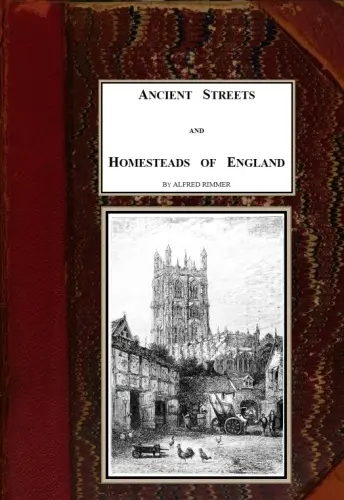
"Ancient Streets and Homesteads of England" by Alfred Rimmer is a historical account written in the late 19th century. The work explores the architectural heritage of England's towns and villages, focusing on ancient street designs and homesteads that encapsulate the country's history and culture. With a strong emphasis on preservation, Rimmer highlights the beauty and historical significance of lesser-known buildings and streets that often go unnoticed. At the start of the book, Rimmer discusses the importance of "minor monumental history," referring to the forgotten architectural treasures of England that reflect its rich past. The author hints at the gradual erosion of this heritage through modern development and expresses concern for the preservation of these historical sites. Through detailed commentary and illustrations, Rimmer introduces readers to various towns, beginning with Chester, where he describes its unique street architecture, including the famous Rows, and shares anecdotes connecting these structures to pivotal moments in England's history. He not only aims to document these architectural features but also encourages readers to appreciate the stories and aesthetic qualities of England's historic spaces.
Introduction adapted from the source catalogue; source summaries may be automatically generated.
Free to read · English · 60,014 words · No account needed
MAKE TIME FOR A GOOD BOOK
On by default. Untick to stop anonymous reading totals. Each page counts after 10 seconds in view. How this works.
Anonymous counting is on unless you have switched it off.
There is nothing so bald or unsatisfactory as a Grecian building, such as has been erected in England since the so-called “revival” of Classic architecture. The cold Doric façades, or Ionic as the case may be, give one a sensation of intense dreariness. The stuccoed front of a conventicle strictly copied from the Parthenon, or more probably from the Gate of the Agora, is a thing to wonder at; and too often we form our ideas of Grecian art from modern revivals. Surely we might have expected that the principal seat of classic learning in England might boast of a proper Greek building, if the Professor of Architecture to the Royal Academy, who had made Greek design the study of his life, were employed; but no one can contemplate the Taylor and Randolph Institution at Oxford without feeling humiliated at the idea that it was erected under such circumstances. The Acropolis at Athens is an abrupt hill with a flat surface of perhaps ten acres on the top. The Eastern aspect rises in a kind of bluff, and is crowned by the Parthenon and the Propylæa. The Parthenon was an oblong temple surrounded by forty-six vast marble columns. These seen from below give at once the idea of lightness and strength, and it exhibits in the most perfect form the “entasis” or swelling that a cylinder requires; this alone would show the true eye for form of the ancient Greek architect. The Erechtheum is a vast building on the northern side of the Acropolis; and, according to Pausanias, the table-land of the Acropolis was absolutely crowded with works of art; indeed at the present time there are remains at every stride. Lamartine, in his Voyage en Orient, gives a vivid description of the impression the ruins of Athens made upon him, and concludes his rhapsody with reflections, of which the following is a translation:--“When again shall we find such a people and such an epoch? Nothing announces their coming. The Propylæa and the Temple of Erechtheus, or of the Caryatides, stand at the side of the Parthenon--masterpieces in themselves, but lost in the proximity of a grander masterpiece. The soul, overpowered by the sight of the latter, has no longer any power to admire the others--one must gaze and then depart!--lamenting not so much the devastation of this glorious handiwork of man, as the impossibility that man should ever equal its sublimity and harmony.” Chateaubriand eulogises Athens in a similar strain, and neither of them say one word too much perhaps; but let us fairly ask ourselves what we admire so in the classic architecture of Greece. I would say without hesitation that we fail to see the real excellence but too often. A Greek temple transported into England, yes the Parthenon itself, is barbarous and hideous. We pass it by as we would Demosthenes on a doorstep inveighing against Philip, relieved to be out of the way. There is no mysterious beauty in a column six or eight diameters high--a ruler is often of the same proportions, and we do not become enthusiastic over it; yet, so much are we influenced by prejudice, that the rude colouring of the Greek temples which the Turks plastered over the buildings they occupied during the seventeenth century, is supposed to be correct taste. Even yet it is commonly, very commonly, believed, that the colouring belongs to the Greek period, and the plaints of even so great an authority as Stuart are touching. I was astonished to find in his preface to the careful volume on Athens, the following:--“Yet there is one circumstance of comparatively recent discovery, and still more recently ascertained to its full extent, which gives a strange contradiction to our cherished notions concerning the purity of Grecian taste, and its antipathy to all coarseness and exaggeration. It should seem that the Greeks painted their temples, not merely in chiaroscuro, or in subdued tints, for the purpose of giving relief to projections or expressiveness to ornamental details, but with glaring colours,--reds, blues, and yellows, with violent contrasts; the columns one hue, and the entablature another. Nay,” he says, “there is shrewd suspicion that the sculptures were painted like the figure-head of a man-of-war, and that the pillars were striped, and unluckily the evidences of these incredibilities is most exasperatingly clear; the statements of the German architects employed by King Otho leave no doubt whatever,” etc. etc.; and I once saw a devout student of Greek art poring over one of those revived temples--the columns and entablature a bright coffee colour, and the triglyphs blue--trying to admire it; he humbly thought he must be wrong, and the Greeks must be right.’ Why, the Turks did all this during their possession. The colours here indicated would be about the Turkman’s idea of correct taste, savouring of the bazaar and booth. They trailed their cannon up the Propylæa, and broke down the carved work thereof with axes and hammers, and soon they set up their banners for tokens. Mnesthenes never coloured the Erechtheum, or Pausanias would have said so in the account of his ramble over it; and Phidias and Praxiteles may fairly be left alone--they never daubed the Parthenon with ochre. The architecture of the Acropolis, great as it is in its own merits, requires a Greek eye and Greek modes of thought to understand thoroughly and to appreciate. Its great and grand idea is calm and dignified repose. It is the repose of the Sphynx or an Egyptian pyramid refined into beauty; and among the rocks of Attica, which are rugged and rough, a Gothic building, such as Strasbourg or Cologne, would be out of place; the crockets and pinnacles would be dwarfed by the igneous rocks that are about, and the Greek well knew how a calm flat surface would harmonise and contrast with the country round.
Your reading position is saved on this browser. Take it to another device with a library code. Reading pages adapt to text, rather than matching a printed edition.
BEHIND THE BOOK
This eBook is for the use of anyone anywhere in the United States and most other parts of the world at no cost and with almost no restrictions whatsoever. You may copy it, give it away or re-use it under the terms of the Project Gutenberg License included with this eBook or online at www.gutenberg.org. If you are not located in the United States, you will have to check the laws of the country where you are located before using this eBook. Read the source licence.
The original source file, including credits and licence, is retained by this library. Request an original-format copy at no charge. Please include the book title and Project Gutenberg identifier #53230.
KEEP YOUR CURIOSITY GOING
Wilfrid Scawen Blunt
Wilfrid Scawen Blunt

E. W. (Edgar Watson) Howe
Cécile Tormay

Moritz Busch
John L. Ransom