THE CLASSIC COLLECTION✦My diaries, being a personal narrative of events 1888-1914, Part 2 (1900-1914)CLASSIC FREE BOOKS
My diaries, being a personal narrative of events 1888-1914, Part 2 (1900-1914)
Wilfrid Scawen Blunt
THE CLASSIC COLLECTION · 1877
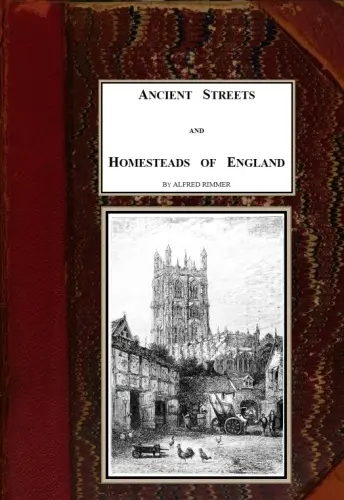
"Ancient Streets and Homesteads of England" by Alfred Rimmer is a historical account written in the late 19th century. The work explores the architectural heritage of England's towns and villages, focusing on ancient street designs and homesteads that encapsulate the country's history and culture. With a strong emphasis on preservation, Rimmer highlights the beauty and historical significance of lesser-known buildings and streets that often go unnoticed. At the start of the book, Rimmer discusses the importance of "minor monumental history," referring to the forgotten architectural treasures of England that reflect its rich past. The author hints at the gradual erosion of this heritage through modern development and expresses concern for the preservation of these historical sites. Through detailed commentary and illustrations, Rimmer introduces readers to various towns, beginning with Chester, where he describes its unique street architecture, including the famous Rows, and shares anecdotes connecting these structures to pivotal moments in England's history. He not only aims to document these architectural features but also encourages readers to appreciate the stories and aesthetic qualities of England's historic spaces.
Introduction adapted from the source catalogue; source summaries may be automatically generated.
Free to read · English · 60,014 words · No account needed
MAKE TIME FOR A GOOD BOOK
On by default. Untick to stop anonymous reading totals. Each page counts after 10 seconds in view. How this works.
Anonymous counting is on unless you have switched it off.
BEVERLEY--STONE
CROSSES--NORTHUMBERLAND--ALNWICK--HEXHAM--NEWCASTLE--DURHAM--KEPIER
HOSPITAL--CARLISLE.
The entrance gate to Beverley is a rather fine specimen of brick architecture, with mouldings and niches all in the same material. It fully carries out the principles of brickwork that have been the subject of a former chapter, and is a delightful entrance to a country town of first-class importance. The houses of Beverley are good, and it is resorted to by many retired merchants and tradesmen who wish to pass what remains of life in quiet.
In the market place, which the engraver has given an excellent idea of, is a quaint cross of the Carolean period. This market place occupies some four acres, and is a perfect gem of picturesque town beauty. The cross must have been among the last that were built as market crosses. The history of these beautiful remains, that have done so much to enliven old towns and cities, may be told in a few words. They were devoted to various uses. Sometimes they were preaching crosses, as the one at Iron Acton, where probably in very warm weather the vicar or incumbent would address the congregation in the open air, or, like the black friars in Hereford, where the pulpit cross seems to have stood in cloisters. Sometimes they were memorial crosses, like the three grand Eleanor crosses that are left us out of the original twelve; and it is satisfactory to be able to think that these beautiful memorials will again be copied very freely. The colonies even are beginning to erect some imitations of the Waltham cross,[9] and indeed its marvellous beauty speaks for itself. At one time there were certainly 5000 crosses in England, but they were so easily destroyed in Cromwell’s time, that very little trace of all this luxuriance of architecture is left. Some crosses may be buried only a foot under the soil, and noble examples lost to our sight; indeed it is by no means uncertain that we shall not be able to add at least one Eleanor cross to our list, if not two. The Chester Cross was buried for years, indeed centuries, before it was discovered in front of St. Peter’s Church, only a few inches below the footwalk, apparently placed reverently by some careful hand; and since these pages have been commenced, and in some very recent alterations to Neston church in this neighbourhood, the remains of three fine stone crosses were exhumed. A cross filled many uses, as has been said, but it was always contrived to make it an object of beauty to the neighbourhood. The Charing Cross that has been recently erected opposite the new hotel is one of the most successful that has been put up in modern days, and much resembles the roadside one at Waltham. From these old crosses proclamations used to be read, and tolls collected from the market people. The modern drinking-fountain also is an adaptation of the idea that suggested some of the crosses, and several of the old conduits might be copied with great advantage. The one at Sherborne, which has been illustrated in these pages, would be an excellent model for a drinking-fountain, and one that has not yet been copied. The covered market cross at Beverley is one of the last that was built, and answered the same purposes as those of Salisbury or Malmesbury. These were merely covered spaces for country people to rest in, in the heat and the rain, and generally connected with some religious house in the neighbourhood. They were usually octagonal and richly groined. That at Chichester is the most elaborate, though the more ancient one at Salisbury, engraved in page 119, is the most graceful and picturesque in the country. One thing strikes us in these crosses--the smallness of the accommodation for a public market; but then, as now, the market square was covered with awnings or tents. And one of the most picturesque sights in England is an old market square like the one at Hexham, or the one at Salisbury, with their booths, on a busy market-day. Sometimes a cross was built on an octagonal shaft surmounted with a crucifix, or a head with niches and small statues, and an octagonal covering was built up round it reaching to about half the height of the original shaft. This, as at Cheddar in Somerset, is sometimes of later date, and sometimes, as at Shepton-Mallet, in the same vicinity, built contemporaneously with the central column. In great numbers of villages we find flights of steps where a cross has once stood; but the eyesore being removed, the Puritans allowed the steps to remain. In Malpas these are of enormous dimensions, and when they were surmounted with a tall cross the effect in this picturesque little country town must have been most striking. As a rule, our modern representations of crosses have not been very successful; they are wanting in lightness and ingenuity. One mode of decoration, however, that is thoroughly unsuited to our climate, we are not likely to see renewed, and that is the gilding of crosses. The magnificent cross at Coventry was regilded in the reign of James II., and is said to have used up 15,403 books of gold.
Your reading position is saved on this browser. Take it to another device with a library code. Reading pages adapt to text, rather than matching a printed edition.
BEHIND THE BOOK
This eBook is for the use of anyone anywhere in the United States and most other parts of the world at no cost and with almost no restrictions whatsoever. You may copy it, give it away or re-use it under the terms of the Project Gutenberg License included with this eBook or online at www.gutenberg.org. If you are not located in the United States, you will have to check the laws of the country where you are located before using this eBook. Read the source licence.
The original source file, including credits and licence, is retained by this library. Request an original-format copy at no charge. Please include the book title and Project Gutenberg identifier #53230.
KEEP YOUR CURIOSITY GOING
Wilfrid Scawen Blunt
Wilfrid Scawen Blunt

E. W. (Edgar Watson) Howe
Cécile Tormay

Moritz Busch
John L. Ransom