THE CLASSIC COLLECTION✦My diaries, being a personal narrative of events 1888-1914, Part 2 (1900-1914)CLASSIC FREE BOOKS
My diaries, being a personal narrative of events 1888-1914, Part 2 (1900-1914)
Wilfrid Scawen Blunt
THE CLASSIC COLLECTION · 1877
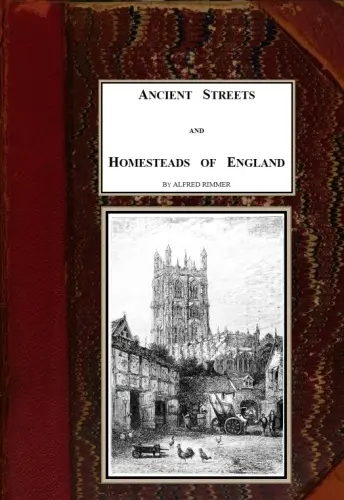
"Ancient Streets and Homesteads of England" by Alfred Rimmer is a historical account written in the late 19th century. The work explores the architectural heritage of England's towns and villages, focusing on ancient street designs and homesteads that encapsulate the country's history and culture. With a strong emphasis on preservation, Rimmer highlights the beauty and historical significance of lesser-known buildings and streets that often go unnoticed. At the start of the book, Rimmer discusses the importance of "minor monumental history," referring to the forgotten architectural treasures of England that reflect its rich past. The author hints at the gradual erosion of this heritage through modern development and expresses concern for the preservation of these historical sites. Through detailed commentary and illustrations, Rimmer introduces readers to various towns, beginning with Chester, where he describes its unique street architecture, including the famous Rows, and shares anecdotes connecting these structures to pivotal moments in England's history. He not only aims to document these architectural features but also encourages readers to appreciate the stories and aesthetic qualities of England's historic spaces.
Introduction adapted from the source catalogue; source summaries may be automatically generated.
Free to read · English · 60,014 words · No account needed
MAKE TIME FOR A GOOD BOOK
On by default. Untick to stop anonymous reading totals. Each page counts after 10 seconds in view. How this works.
Anonymous counting is on unless you have switched it off.
Of course, unless an architect is also partly an artist he cannot be successful; no amount of learning can compensate for this. The two best expositors we ever had of Gothic architecture, Rickman and Britton, were indifferent architects. Perhaps they may be said to have known more than all who went before them or followed after; and both of them were endowed with a thorough love for their profession. There may be something to urge that they were not brought up to it, one being in a mercantile office in Liverpool, and the other a wine-bottler in London. Rickman had a number of opportunities of testing his architectural skill, but they are all dreary, and showed that his hand could not put into practice the principles of the architecture he understood and loved so well. Britton had fewer chances, and was even less successful with his few.
Perhaps it might be well to try to answer the question, “What would be the best way to improve the architecture of the most dreary of all classes of buildings, the humbler houses of the middle classes, the houses that are let for about £40 or £50 per annum?” and the best way to answer it is to suppose a case in which the conditions would be the most favourable. Suppose, for example, there were to be a number of gentlemen who were each prepared to spend £800 in a row of houses for their own residences. Well, let them all agree upon an artistic architect, and let them each arrange their own plans to suit their own convenience. This would give the architect not only data, but ideas to work upon. Well, let him then take all these plans, and fit to them an elevation which shall be as broad and uniform as the convenience admits. There will still be plenty of variety, the various requirements of the builders will secure that, or enable the architect to employ it. The Vicar’s Close at Wells, or the collegiate buildings in Oxford or Ely, would afford any number of examples of what he required. In one of the excellent Manuals published for the use of amateur artists by Winsor and Newton, the author has divided his subject into Atmosphere, Keeping, Contrast, and Variety, which, if rightly understood, is only another way of expressing the requirements of Barry in the former part of this chapter. A quotation from this Manual, though it relates to sketching in colour, may be as useful to an architect as to an artist. “First learn how to produce certain effects, and you will not then find it difficult to store them in your memory for use as you require them; you are learning nothing new in the art of painting--thousands have gone through this process before you; you are only seeking to chronicle your own experience. The scenes you commit to paper have, and will have, a peculiar charm for you, and perhaps to your friends if you represent them faithfully. They may be new scenes, but they are not seen under new effects. These have been already witnessed again and again; you yourself have seen the same effect produced in former pictures; but the charm lies in producing them yourself from nature. Aim then at facility in producing these effects in general, and you will easily apply and vary that knowledge as you require it. Aim at acquiring a kind of grammar of effect, just as in reading music, the habitué recognises a certain set of notes from their frequent recurrence, and which is even called by musical people a phrase, alluding to the similar recurrence of words in the composition of a sentence. It is knowledge that leads to decision, which is the secret of rapidity.”[11] Of course, with an architect rapidity is not necessary, it only pertains to a sketcher in water-colours, whose materials dry up rapidly. A hundred lessons in architecture may be gained every time that we walk along a pleasant lane, and the village with a cheerful row of cottages grown over with creepers, and showing tall chimneys, is full of suggestions in light and shade and composition. In all importations of foreign architecture--and it is not pretended that there should be none--the first thing to consider is its fitness for the climate and surroundings. Dol, Morlaix, and other towns in the north of France, contain many suggestions for city architecture. Our own cathedrals and great churches were meant to stand alone, and can only be seen at some distance; the churches on the Continent were often designed for the effect they would have in a crowded town; but here again, the old chronic error has to be met, that Gothic buildings suit country scenes the best, and Classic a town, whereas the only place where a classic building can be employed, except by a man of absolute genius, is in the country among heavy foliage.
Your reading position is saved on this browser. Take it to another device with a library code. Reading pages adapt to text, rather than matching a printed edition.
BEHIND THE BOOK
This eBook is for the use of anyone anywhere in the United States and most other parts of the world at no cost and with almost no restrictions whatsoever. You may copy it, give it away or re-use it under the terms of the Project Gutenberg License included with this eBook or online at www.gutenberg.org. If you are not located in the United States, you will have to check the laws of the country where you are located before using this eBook. Read the source licence.
The original source file, including credits and licence, is retained by this library. Request an original-format copy at no charge. Please include the book title and Project Gutenberg identifier #53230.
KEEP YOUR CURIOSITY GOING
Wilfrid Scawen Blunt
Wilfrid Scawen Blunt

E. W. (Edgar Watson) Howe
Cécile Tormay

Moritz Busch
John L. Ransom