THE CLASSIC COLLECTION✦The Stone AgeCLASSIC FREE BOOKS
The Stone Age
Clement Wood
THE CLASSIC COLLECTION · 1924
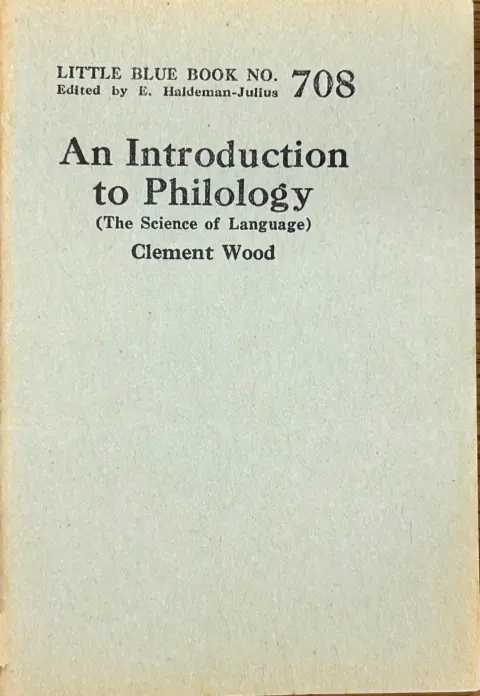
An introduction to philology by Clement Wood. Explore this classic work in a free online edition. Subjects include Philology. Read the locally hosted text below, adjust the reading display, and continue where you left off.
Introduction adapted from the source catalogue; source summaries may be automatically generated.
Free to read · English · 14,816 words · No account needed
MAKE TIME FOR A GOOD BOOK
On by default. Untick to stop anonymous reading totals. Each page counts after 10 seconds in view. How this works.
Anonymous counting is on unless you have switched it off.
One of the forms of words known to all languages staggers under the Greek term onomatopoetic, recently rechristened echoic—a word expressing a sound in Nature. The hiss of steam, the clang of a bell, the crash of falling timbers,—these words are echoic. Words like papa, mama, baby, probably of this type, are found in practically all languages. Bomb, murmur, cuckoo, go back through French to Latin, and to an antiquity hard to determine. Among echoic words originating independently in English are: buzz, fizz, purr, quack, hiss, boom, gibber, jabber, giggle, titter, whirr, ding-dong, hee-haw, hoot, chatter. The theory that this is responsible for all words has long been abandoned; yet there is a uniform overtone in a group of words like bosh, slosh, squash, plush, hush, mush, flush, blush; a related quality in crash, splash, smash, hash, trash, clash, dash, rash. Certain verbal sounds get associated with certain emotions; and out of the casual word creations, commencing as slang, come such words as the following list of recent additions to the first volume of the Oxford dictionary, all from the b’s: bamboozle, bang, bilk, blab, blabber, blare, blear, blight, blob, blizzard, blot, blotch, blubber, bluff, blunder, blunt, blur, blurt, bluster, bogus, boom, bore, bosh, bother, brash, brunt, bub, bump, bum, bunch, bungle, burr, bustle, buzz. Nonsense verse contributes here; but artificial word additions, such as Gelett Burgess’ fuddy for untidy, bimped for jilted, snosh for vain talk, cofle for “to try to find out a person’s name without asking,” may have a harder time horning into the language. The verb to horn in, a fine figurative phrase from the cattle country, is still ranked as slang; but it is beginning to receive academic approval.
Sometimes such word-formations are meant humorously, sometimes seriously. Thus from chimpanzee came humanzee, to describe one especial animal. Travelogue, from travel and dialogue, has more serious intention. Light recent creations are swellegant, yellocution, versiflage, alcoholiday, flumonia. The origin of these is obvious; but many accepted words in the language have roots as yet undiscovered, and may have come similarly. Dog came in before the Conquest, without known ancestry; the Teutonic name appears in hound, while the Latin canis furnishes canine. Girl, boy, lad, lass, big, bad, pig, cut, entered before Chaucer; bet, jump, dodge, before 1600; pun, in the 17th century; fun, bore, slang, fudge, in the 18th; rollicking, loaf (verb) in the 19th; the modern stunt and hooch are similar.
Another source of increase to the speech is the doublets, already mentioned. Other examples are of, off; through, thorough; porridge, pottage; shade, shed, shadow; strap, strop; courtesy, curtsey; fantasy, fancy; corpse, corps; posy, poesy.
Your reading position is saved on this browser. Take it to another device with a library code. Reading pages adapt to text, rather than matching a printed edition.
Clement Wood
Clement Wood
Clement Wood
Clement Wood
BEHIND THE BOOK
This eBook is for the use of anyone anywhere in the United States and most other parts of the world at no cost and with almost no restrictions whatsoever. You may copy it, give it away or re-use it under the terms of the Project Gutenberg License included with this eBook or online at www.gutenberg.org. If you are not located in the United States, you will have to check the laws of the country where you are located before using this eBook. Read the source licence.
The original source file, including credits and licence, is retained by this library. Request an original-format copy at no charge. Please include the book title and Project Gutenberg identifier #78985.
KEEP YOUR CURIOSITY GOING

Charles G. (Charles Griffith) Ross
Hannah Webster Foster

Emily Lawless
Edwin Hamlin Carr

Charles De Lano Hine
Andrew Ure