THE CLASSIC COLLECTION✦The Stone AgeCLASSIC FREE BOOKS
The Stone Age
Clement Wood
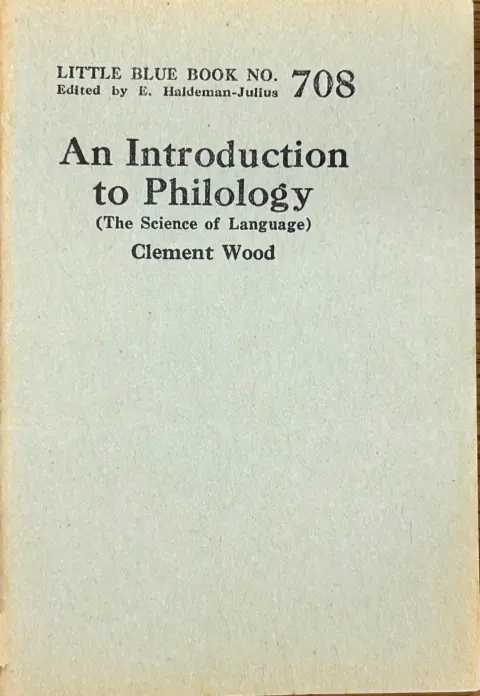
THE CLASSIC COLLECTION · 1924
An introduction to philology by Clement Wood. Explore this classic work in a free online edition. Subjects include Philology. Read the locally hosted text below, adjust the reading display, and continue where you left off.
Introduction adapted from the source catalogue; source summaries may be automatically generated.
Free to read · English · 14,816 words · No account needed
MAKE TIME FOR A GOOD BOOK
On by default. Untick to stop anonymous reading totals. Each page counts after 10 seconds in view. How this works.
Anonymous counting is on unless you have switched it off.
Furthermore, in pairs of synonyms, one native, one classical in origin, the greater directness in the native words is striking. Compare fire, conflagration; bloody, sanguinary; stiff, rigid; fat, corpulent; sweat, perspire. On one occasion Samuel Johnson, the great Latinist, lapsed into native English: “It has not wit enough to keep it sweet.” After a moment’s reflection, he weakened this with the classical gloss, “It has not vitality enough to preserve it from putrefaction.” There are imported words, however, which enter into the very warp and woof of the language: for instance, easy, large, sure, bet, boot, quiet, brace, peace, city, soldier, hour, move, turn, table, place, very, save, single, clear, plain. In some cases the foreign word has supplanted the native in general use; compare beautiful, fair; prosperity, speed; valley, dale; divide, cleave; forest, wold; fort, fastness; tremble, quake; joyous, blithe; mercury, quicksilver; mirror, looking-glass.
A class at Columbia was recently asked to select the 50 words of most basic importance in the expression of human life. From two lists prepared 78 words were finally selected; of these, 39 were French, and 35 Anglo-Saxon. A public-speaking club selected the 21 most beautiful words in English: of these 3 were Anglo-Saxon, 1 Scandinavian, 3 Latin, and 14 French.
Many modern words are blended of two or more languages. Classic prefixes are suffixes with native roots are found in co-worker, pro-German, re-birth, ante-room, superman, breakage, laughable, righteous, wreckage. Native prefixes and suffixes are blended with classic roots to form unruly, besiege, bashful, misplace, outcry, overcharge, outline, by-product, finest, forceful, napkin, beautiful, painting, statecraft, uncivil, overturn, understudy, relentless. Hybrids formed of native and classic roots are found in window-pane, table-cloth, faint-hearted, simple-minded, Saturday, birthplace, candlestick, staircase, grandstand, cocktail, fireplace, outrage.
One remarkable word has recently been unearthed, a hybrid made of elements from five different languages. The word is remacadamizing, which may be analyzed into re (Latin), mac (Celtic), adam (Hebrew), ize (Greek) and ing (native English.) It is a good vigorous word too, despite its mottled ancestry.
Word Creation.
Your reading position is saved on this browser. Take it to another device with a library code. Reading pages adapt to text, rather than matching a printed edition.
Clement Wood
Clement Wood
Clement Wood
Clement Wood
BEHIND THE BOOK
This eBook is for the use of anyone anywhere in the United States and most other parts of the world at no cost and with almost no restrictions whatsoever. You may copy it, give it away or re-use it under the terms of the Project Gutenberg License included with this eBook or online at www.gutenberg.org. If you are not located in the United States, you will have to check the laws of the country where you are located before using this eBook. Read the source licence.
The original source file, including credits and licence, is retained by this library. Request an original-format copy at no charge. Please include the book title and Project Gutenberg identifier #78985.
KEEP YOUR CURIOSITY GOING

Charles G. (Charles Griffith) Ross
Hannah Webster Foster

Emily Lawless
Edwin Hamlin Carr

Charles De Lano Hine
Andrew Ure