THE CLASSIC COLLECTION✦The Stone AgeCLASSIC FREE BOOKS
The Stone Age
Clement Wood
THE CLASSIC COLLECTION · 1924
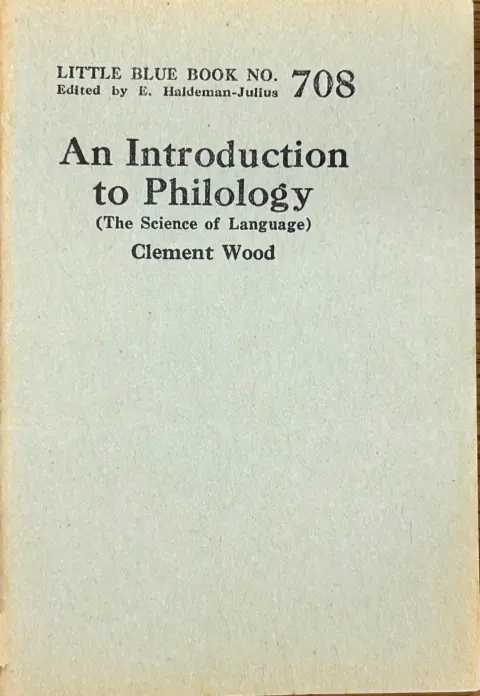
An introduction to philology by Clement Wood. Explore this classic work in a free online edition. Subjects include Philology. Read the locally hosted text below, adjust the reading display, and continue where you left off.
Introduction adapted from the source catalogue; source summaries may be automatically generated.
Free to read · English · 14,816 words · No account needed
MAKE TIME FOR A GOOD BOOK
On by default. Untick to stop anonymous reading totals. Each page counts after 10 seconds in view. How this works.
Anonymous counting is on unless you have switched it off.
The most prolific source has been the combination of two or more elements into one word. Almost back to the forgotten beginnings of our speech go such words as barn (O. E. bere-aern, barley-place); lord (hlaf-weard, bread-keeper); gossip (god-sibbe, good kinsman); hussy (house-wife); gospel (god-spell, good narrative); world (wer-eld, man age); sheriff (scir-gerefa, shire reeve); daisy (daeges-eage, day’s eye). The Elizabethan age was rich in compounds, such as freshman, huntsman, bookseller, keyhole, bookworm, potluck, and horseplay. Shakespeare offered honey-heave, pity-pleading, wind-changing, carry-tale, and others, which have not found permanent lodgings in the language. Others which have endured are rawboned, crestfallen, untutored, high-born, red-hot, blood-stained, mouth-filling, heart-ache, hairbreadth, break neck, even-handed, moss-grown. Among those which did not survive are hotspur, aleknight, maltworm, hangby, crackhemp, findfault (but compare fault-finder), makepiece, tearsheet, ticklebrain, tosspot, wantwit. A great stock of terms of contempt have survived, such as killjoy, scarecrow, pickpocket, daredevil, spitfire, hangdog, lickspittle, makeshift, skinflint, slipshod, turncoat, telltale. Modern equivalents are speak-easy, bootlegger, and juvenile tattletale and copycat. Smut-hound, dope-fiend, and other modern mixtures have not yet acquired lasting dignity.
The English settlers in America used this method in naming many natural objects: compare bullfrog, canvas-back, lightning-bug, mud-hen, cat-bird, razor-back, garter-snake, groundhog, live-oak, turkey-gobbler, pokeweed, copperhead, eelgrass, reedbird, eggplant, peanut, bluegrass, Junebug. Recent American blends include pussyfoot, skyscraper, bell-hop, hayseed, shin-plaster, bucket-shop, lounge-lizard, rum-hound, and many other -lizard and -hound blends.
Prefixes and suffixes are taken from all speeches. Native prefixes include mis-, un-, after-, be-, for-, man-; suffixes, -ness, -less, -ly, -ish, -er, -y, -head, -hood. With these may be used the Latin pro-, post-, inter-, ante-, pre-, co-, sub-, super-, -ation, -ative; French dis-, en-, -age, -al, -ment, -able, -ous, -ose, -ese, -gy, -ate, -ard, -esque, -ade, many of these borrowed by the French; Greek a- (without), hyper-, nec-, pseudo-, arche-, -ize, -ist, -ism, -ite, -itis; Scandinavian -ling, and others listed; Flemish -kin. Hundreds of compounds made from these have failed to survive; this is especially true of those made with native prefixes and suffixes. Wanton is the only word preserving the prefix wan-, once common in such combinations as wanthrift, extravagance; wanhap, misfortune; wanlust, languor; wanwit, folly; wantrust, lack of confidence; wantruth, falsehood; wanchance, ill-luck. Blameful, crimeful, dareful, deathful, ruthful, all from Shakespeare, are only a few of the -ful compounds that have died; aidless, bragless, heirless, effectless, also from Shakespeare, are four out of many more that have gone. Gainsay alone lives out of gainscope, gainstand, gainstrive, etc.; laughing-stock is the one relict of gazing-stock, jesting-stock, mocking-stock, etc. Five only of the -worthy adjectives (blameworthy, etc.) remain. Most of the -th nouns are gone: while keeping warmth, health, growth, wealth, and height (often pronounced heighth still) we have surrendered lowth, greenth, coolth, illth, spilth, etc. More of the classic prefixes and suffixes have taken root; there are five hundred words listed in the Oxford dictionary beginning with the Greek anti-. Only two tele- words were in Samuel Johnson’s dictionary; there are 130 in the present Oxford one. The Century Dictionary supplement contains 168 words beginning with auto-. The process is a living one: thus book-fiend, dope-fiend, chess-fiend, bomb-proof, fool-proof, near-beer, near-great, near-champion, are all recent inventions.
Your reading position is saved on this browser. Take it to another device with a library code. Reading pages adapt to text, rather than matching a printed edition.
Clement Wood
Clement Wood
Clement Wood
Clement Wood
BEHIND THE BOOK
This eBook is for the use of anyone anywhere in the United States and most other parts of the world at no cost and with almost no restrictions whatsoever. You may copy it, give it away or re-use it under the terms of the Project Gutenberg License included with this eBook or online at www.gutenberg.org. If you are not located in the United States, you will have to check the laws of the country where you are located before using this eBook. Read the source licence.
The original source file, including credits and licence, is retained by this library. Request an original-format copy at no charge. Please include the book title and Project Gutenberg identifier #78985.
KEEP YOUR CURIOSITY GOING

Charles G. (Charles Griffith) Ross
Hannah Webster Foster

Emily Lawless
Edwin Hamlin Carr

Charles De Lano Hine
Andrew Ure