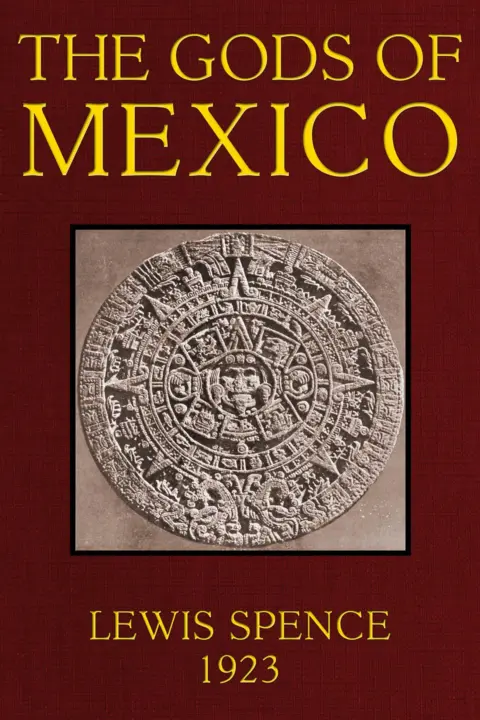
The gods of Mexico
Lewis Spence
THE CLASSIC COLLECTION · 1921
"An Introduction to Mythology" by Lewis Spence is a scholarly examination of mythological principles, likely written in the early 20th century. This comprehensive work explores the evolution, classification, and significance of myths within the context of primitive religion and culture, presenting an overview of the scientific approaches to mythology. Spence aims to illuminate the historical progression of mythic study and its modern applications by synthesizing various theories and presenting definitions that clarify key concepts. The opening of the text introduces the reader to the foundational aspects of mythology, explaining its purpose in understanding the early religious and scientific experiences of humanity. It lays out important definitions distinguishing myths from folklore and legends, suggesting that myths function as explanations for physical and social phenomena. Spence outlines how mythology intersects with folklore, illustrating that myths serve as primitive attempts at rationalizing the universe, while also highlighting significant changes in myth interpretation and classification over time as societies evolve.
Introduction adapted from the source catalogue; source summaries may be automatically generated.
Free to read · English · 115,570 words · No account needed
MAKE TIME FOR A GOOD BOOK
On by default. Untick to stop anonymous reading totals. Each page counts after 10 seconds in view. How this works.
Anonymous counting is on unless you have switched it off.
Bushmen. The mother of the little hare is dead. The moon strikes the hare on its lip, splitting it in two, and tells it that its mother is really dead and will not live again as the moon does.
Hottentots. The moon sends the hare to men to tell them that they will live again as he (the moon) does, but the hare forgets the message and tells men that they will surely die, for which mistake the moon burns a hole in his lip.
Namaquas. The hare and the moon's mother.
Central Africans. Sleep unknown; woman offers to teach
man how to sleep; holds his nostrils; man never wakes;
dying made easy.
Hurons. Atænsic (the moon) destroys the living,
Australians. Woman goes near a forbidden tree.
New Zealand. Mani was not properly baptized.
Fiji Islanders. The moon desired that men should die and live again like herself, but the rat opposed this, and so men die as rats do.
Polynesians. Mani tries to pass through Night, a little bird sings, night awakes, snaps up Mani, and "so men die."
Banks Islanders. Qat, Mate, Panoi, and Tangaro the Fool. Tangaro the Fool is set to watch the path taken by Death, that men may avoid it, but makes the mistake of pointing to men the path to Hades as that of the path of the upper world. So men have, perforce, to follow this road to Panoi and the dead.
Pentecost Islanders. Tagar makes man die for live days only and live again, but Suque causes them to die for ever.
Solomon Islanders. Koevari resumes cast-off skin.
SOUL MYTHS, (1) In which the idea is found that a person's life, heart, or soul may be separated from him as a life-token or life-index, and that so long as this is kept safe or remains concealed, its owner is immortal. (2) Other myths dealing with the passage of the soul to the Otherworld.
Egyptians. Story of the two brothers.
Hebrews. Samson and Delilah.
Greeks.
Meleager and the firebrand.
Misus, King of Megara, and his purple hair.
Souls ferried across the Styx by Charon.
Romans. Silvia and the son of Mars.
Yorkshiremen. 'Brig o'Dread, nae braider than a thread.'
Mohammedans. Reach Paradise across bridge composed of a
single hair.
Cingalese. Story of Thossakin, King of Ceylon, who kept his soul in a box when he went to war with Rama.
Ainu (Japan). The 'inao.'
Tinneh or Déné Indians. Etwa-eke and his stone hatchet.
Malays. Tree-trunk across boiling lake to 'Island of
Fruits.'
Eskimos. Kujanguak and his life-lock (hair).
Universal. Belief in birth-trees.
FIRE MYTHS. In which the world is destroyed by fire.
Romans. Seneca (see Natur. Questiones, iii, cap. 27).
Your reading position is saved on this browser. Take it to another device with a library code. Reading pages adapt to text, rather than matching a printed edition.
BEHIND THE BOOK
This eBook is for the use of anyone anywhere in the United States and most other parts of the world at no cost and with almost no restrictions whatsoever. You may copy it, give it away or re-use it under the terms of the Project Gutenberg License included with this eBook or online at www.gutenberg.org. If you are not located in the United States, you will have to check the laws of the country where you are located before using this eBook. Read the source licence.
The original source file, including credits and licence, is retained by this library. Request an original-format copy at no charge. Please include the book title and Project Gutenberg identifier #45048.
KEEP YOUR CURIOSITY GOING

Maurice Baring
Francis Greenleaf Allinson & Anne C. E. (Anne Crosby Emery) Allinson
Stuart Dodgson Collingwood
Percy Keese Fitzhugh
Mary Macleod & Edmund Spenser

Cooke Don-Carlos