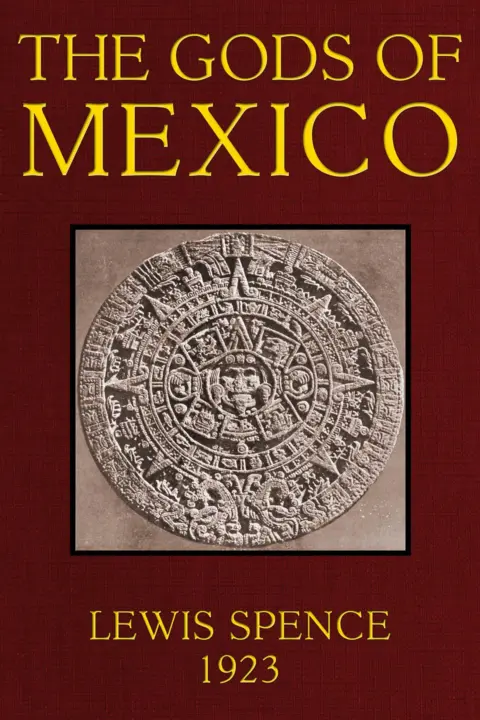
The gods of Mexico
Lewis Spence
THE CLASSIC COLLECTION · 1921
"An Introduction to Mythology" by Lewis Spence is a scholarly examination of mythological principles, likely written in the early 20th century. This comprehensive work explores the evolution, classification, and significance of myths within the context of primitive religion and culture, presenting an overview of the scientific approaches to mythology. Spence aims to illuminate the historical progression of mythic study and its modern applications by synthesizing various theories and presenting definitions that clarify key concepts. The opening of the text introduces the reader to the foundational aspects of mythology, explaining its purpose in understanding the early religious and scientific experiences of humanity. It lays out important definitions distinguishing myths from folklore and legends, suggesting that myths function as explanations for physical and social phenomena. Spence outlines how mythology intersects with folklore, illustrating that myths serve as primitive attempts at rationalizing the universe, while also highlighting significant changes in myth interpretation and classification over time as societies evolve.
Introduction adapted from the source catalogue; source summaries may be automatically generated.
Free to read · English · 115,570 words · No account needed
MAKE TIME FOR A GOOD BOOK
On by default. Untick to stop anonymous reading totals. Each page counts after 10 seconds in view. How this works.
Anonymous counting is on unless you have switched it off.
Celts. Sagas and romances of Arthur, Merlin, and Beowulf.
Indians. Saga of Rama, in Ramayana.
Mexicans. Uitzilopochtli, myth of his birth.
Kiches. Hun-Apu and Xbalanque in the Popol Vuh.
Peruvians. Ataguju, the creator, begets Guamansuri, who seduces a woman, who gives birth to two eggs. From these emerged Apocatequil and Piguerão. Apocatequil was prince of evil and the most respected hero of the Peruvians.
(See also Culture Myths for other examples.)
MYTHS OF FIRE-STEALING. In which a supernatural being--usually a bird--steals fire from Heaven and brings it to earth for the benefit of mankind.
Greeks. Prometheus.
Vedas. Matarisvan.
Bretons. Golden-crested wren.
Normandy Peasantry. The wren.
Ahts Indians (Vancouver Island). Quawteaht.
Athapascan Indians (N.W. America). Yetl the raven.
Cahrocs and Navaho Indians. The coyote.
Murri Tribe (Gippsland, Australia). Man who became a
bird.
Thlinkeets (N.W. America). Yetl the raven.
New Zealanders. Mani.
Andaman Islanders. A bird.
CULTURE MYTHS. MYTHS OF THE ORIGIN OF THE ARTS OF LIFE. A god or culture-hero teaches man the useful arts. The outstanding figures in such myths are:
Egyptians. Osiris.
Babylonians. Oannes.
Greeks. Prometheus, Bacchus, Cadmus.
Celts (Irish). Nuada of the Silver Hand.
Teutons (Scandinavia). Wieland the Smith.
Japanese. Okikurimi.
Bushmen (South Africa). Cagn.
Zulus. Unkulunkulu.
Algonquins. Michabo or Manibozho.
Antis Indians (Brazil). Son of Ulé.
Arawaks. Kamu.
Carayas. Kaboi.
Caribs. Tamu (grandfather).
Cherokees. Wasi.
Chiapas. Votan.
Hurons. Joskeha.
Maya (Yucatan). Itzamna, Kukulcan.
Mexicans. Quetzalcoatl.
Orinoco Tribes. Amalivaca.
Paraguayans. Zumé.
Peruvians. Manco Ccapac; Viracocha arises from the depths
of Lake Titicaca on a civilizing mission.
Toltecs. Hueymactzin.
Australians. Pund-jel.
Melanesians. Qat.
TABOO MYTHS. Myths which relate the existence of, origin of, and necessity for certain taboos or forbidden things.
Hebrews. Adam, Eve, and the eating of the apple.
Greeks.
The myth of Cupid and Psyche.
Actæon turned into a stag for observing Artemis when
bathing.
Teutons (Scandinavia). Lohengrin and Elsa (name taboo).
Ningphos (Bengal). Think they became mortal by bathing
in tabooed water.
Australians. Death introduced by woman going to tabooed
tree.
MYTHS OF DEATH. To account for death, regarded by some savage races as unnatural. Usually some custom or taboo is supposed to have been broken, or some ritual neglected or mismanaged, and death has followed. The reasons given by the different races are as follows:
Greeks. Death comes from lifting cover off Pandora's box.
Hindus. Yama is pioneer to the Otherworld.
Southern India. Death (snake) bites men while God
sleeps. God makes dog drive away snake; thus dogs howl at
approach of death.
Ningphos (Bengal). Think they became mortal through
bathing in tabooed water.
Your reading position is saved on this browser. Take it to another device with a library code. Reading pages adapt to text, rather than matching a printed edition.
BEHIND THE BOOK
This eBook is for the use of anyone anywhere in the United States and most other parts of the world at no cost and with almost no restrictions whatsoever. You may copy it, give it away or re-use it under the terms of the Project Gutenberg License included with this eBook or online at www.gutenberg.org. If you are not located in the United States, you will have to check the laws of the country where you are located before using this eBook. Read the source licence.
The original source file, including credits and licence, is retained by this library. Request an original-format copy at no charge. Please include the book title and Project Gutenberg identifier #45048.
KEEP YOUR CURIOSITY GOING

Maurice Baring
Francis Greenleaf Allinson & Anne C. E. (Anne Crosby Emery) Allinson
Stuart Dodgson Collingwood
Percy Keese Fitzhugh
Mary Macleod & Edmund Spenser

Cooke Don-Carlos