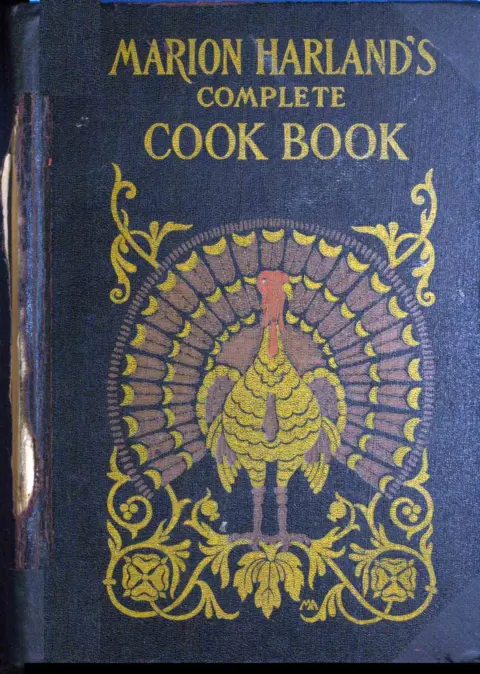
Marion Harland’s Complete Cook Book A Practical and Exhaustive Manual of Cookery and Housekeeping
Marion Harland

THE CLASSIC COLLECTION · 1898
"Alone" by Marion Harland is a novel written in the mid-19th century. The story explores themes of love, loss, and the emotional struggles of its main character, Ida Ross, who is grappling with the tragic death of her mother. As she navigates her newfound life as an orphan, the novel delves into her profound sense of isolation and her search for genuine companionship. The opening portion of the book immediately immerses readers in a somber atmosphere, highlighting Ida's heartbreaking experience at her mother's funeral. The ceremony poignantly captures the deep sorrow of loss, emphasizing the profound bond between Ida and her mother. The narrative then shifts to the young girl’s painful transition into her new life with a guardian who lacks warmth and understanding. Harland's writing paints a vivid picture of Ida's emotions, showcasing her yearning for love and her struggle against a world that seems indifferent to her suffering. As the story progresses, the dynamics between Ida and the people around her, including her cold guardian and new acquaintances, promise a deeper exploration of her character and the challenges she must face.
Introduction adapted from the source catalogue; source summaries may be automatically generated.
Free to read · English · 137,500 words · No account needed
MAKE TIME FOR A GOOD BOOK
On by default. Untick to stop anonymous reading totals. Each page counts after 10 seconds in view. How this works.
Anonymous counting is on unless you have switched it off.
"We won't waste time by an elaborate toilet, dear," said Carry, seeing Ida deliberating upon two dresses. "Father will be too much engaged with his supper to notice our dress. Wear the plain white one; it is very becoming; and remember, you are in the back-woods."
Arthur was in the parlor when they descended. He looked as happy as Carry, and "almost as good," thought Ida. She was not de trop; it might have been a brother and sister who strove to convince her that this, their home, was hers for the time-being. The supper-table was set with taste and profusion. Ida wondered whether the menage were entirely controlled by coloured servants. She learned afterwards that "Mammy," trained by Mrs. Carleton, and until that lady's death, her constant attendant, was housekeeper.
"You have not much affection for a city life, Miss Ida," said Arthur, continuing a conversation commenced in the parlor.
"No. I am country-bred, and cherish a preference for the scenes of my childhood. Perhaps," she said, ingenuously, "the fault is in myself. I did not want to live in Richmond, and determined not to like it."
"And are your aversions so strong that the manifold attractions of the metropolis cannot shake them? or, are you countrified upon principle?"
"I have not given the city a fair trial. It has occurred to me lately that my weariness of it proceeded from monotony rather than satiety. There is little variety in school life."
"Except when we regard it as the world in miniature," said Arthur. "It is different, doubtless, in 'Young Lady Establishments,' but we boys contrived to maintain a healthy circulation, one way or another."
"Is it not a popular fallacy that school-days are the happiest of one's
life?" asked Ida.
"Unquestionably," rejoined he, promptly. "As well say that Spring is the farmer's happiest season. He has the pleasures of hope, the delight of viewing his whitening harvests in futuro; but there is severe, unromantic drudgery; suspense and boding fears for the result. The 'harvest home' for me!"
"And when is that!" questioned Ida.
"Now!" said he, with emphasis.
"What do you mean?" inquired Carry.
"That you and Miss Ida begin to reap from this date. To dispense with this inconvenient metaphor, your actions will be the proof of what your lessons have been; every day your knowledge and principles will be brought into play,--you will be binding up sheaves of worthy or of evil deeds."
"You are trying to terrify us," said Carry. "Don't you wish yourself at
school again, Ida!"
"Are you sorry you're a-goin' to turn out!" replied Ida, in a
peculiar tone.
"Oh, Celestia!" exclaimed Carry, with a burst of laughter.
Your reading position is saved on this browser. Take it to another device with a library code. Reading pages adapt to text, rather than matching a printed edition.
Marion Harland
Marion Harland
Marion Harland
Marion Harland
BEHIND THE BOOK
This eBook is for the use of anyone anywhere in the United States and most other parts of the world at no cost and with almost no restrictions whatsoever. You may copy it, give it away or re-use it under the terms of the Project Gutenberg License included with this eBook or online at www.gutenberg.org. If you are not located in the United States, you will have to check the laws of the country where you are located before using this eBook. Read the source licence.
The original source file, including credits and licence, is retained by this library. Request an original-format copy at no charge. Please include the book title and Project Gutenberg identifier #46505.
KEEP YOUR CURIOSITY GOING
Coulson Kernahan

Maurice Baring
Frances Wright
Cécile Tormay

Frederic Jesup Stimson

W. H. P. (William Henry Pope) Jarvis