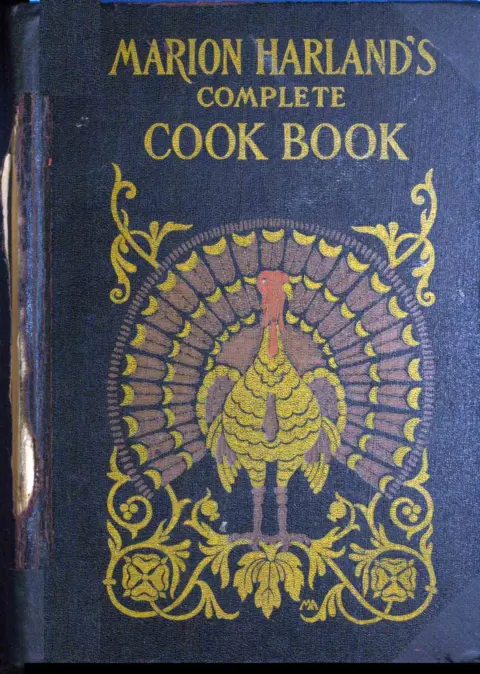
Marion Harland’s Complete Cook Book A Practical and Exhaustive Manual of Cookery and Housekeeping
Marion Harland
THE CLASSIC COLLECTION · 1898
"Alone" by Marion Harland is a novel written in the mid-19th century. The story explores themes of love, loss, and the emotional struggles of its main character, Ida Ross, who is grappling with the tragic death of her mother. As she navigates her newfound life as an orphan, the novel delves into her profound sense of isolation and her search for genuine companionship. The opening portion of the book immediately immerses readers in a somber atmosphere, highlighting Ida's heartbreaking experience at her mother's funeral. The ceremony poignantly captures the deep sorrow of loss, emphasizing the profound bond between Ida and her mother. The narrative then shifts to the young girl’s painful transition into her new life with a guardian who lacks warmth and understanding. Harland's writing paints a vivid picture of Ida's emotions, showcasing her yearning for love and her struggle against a world that seems indifferent to her suffering. As the story progresses, the dynamics between Ida and the people around her, including her cold guardian and new acquaintances, promise a deeper exploration of her character and the challenges she must face.
Introduction adapted from the source catalogue; source summaries may be automatically generated.
Free to read · English · 137,500 words · No account needed
MAKE TIME FOR A GOOD BOOK
On by default. Untick to stop anonymous reading totals. Each page counts after 10 seconds in view. How this works.
Anonymous counting is on unless you have switched it off.
"I never thought you unreasonable before, Ida."
"I am sorry you should now, Carry."
"How can I help it, when after travelling with us for weeks you suddenly resolve to return to Eastern Virginia by yourself; and to that lonesome place in the country, which you have not visited for years!"
"I have an escort; a gentleman who is on his way to Richmond, and will
take charge of me."
"But why this notion, just as we decided to go north? Has your
curiosity to behold Niagara diminished since your sight of 'the
Bridge?'"
"Frankly and truly, I do not care to see it. I would not ride to the House Mountain yonder, if Mont Blanc, the Lake of Como, and the Great Fall were to be seen from the other side."
"Do you hear that, Arthur?" said Carry, despairingly, to her husband,
who was reading.
"No--what is it?"
"This obstinate young lady is about to deprive us of the honour of her company. She is going back to Staunton to-morrow."
"To the Lunatic Hospital?" inquired Arthur, putting aside his book. "You are not in earnest, Ida? Are you tired of us; or do you dislike our sketched route? If the last, we will alter it."
"And if the first, we will alter ourselves," interposed Carry,
laughingly.
"I would have you and your plans remain as they are. I am not well, and require rest--not change. My desire to see old Sunnybank is not a caprice, as Carry supposes; I have had it in contemplation for a long time. Mr. Read deterred me from it by representations of the discomfort I would encounter; the only white man left on the plantation being the overseer. This summer he has been removed, and his place given to a former tenant of mother's; a man of family; and the accommodations, which serve for them, will keep me from hardship."
"She is sick," said Carry, when Ida retired. "She has not been herself lately. Were it not that she is used to dissipation, I should think that the round of parties, after our wedding, overtasked her strength. Yet, she enjoyed them."
"Her malady may be of the mind," said Dr. Dana, thoughtfully. "Do you
consider this probable?"
"Oh, no! she was well and happy when she came to us; and what can have occurred since to affect her?"
"You are right, I dare say;" returned he, absently. He was pondering upon her behaviour after Charley's departure.
Argument did not dissuade, and conjecture was baffled in the effort to explain this unexpected movement. They parted in Lexington--Ida to recross the mountains eastward; they, to travel north by way of Harper's Ferry.
Your reading position is saved on this browser. Take it to another device with a library code. Reading pages adapt to text, rather than matching a printed edition.
Marion Harland
Marion Harland
Marion Harland
Marion Harland
BEHIND THE BOOK
This eBook is for the use of anyone anywhere in the United States and most other parts of the world at no cost and with almost no restrictions whatsoever. You may copy it, give it away or re-use it under the terms of the Project Gutenberg License included with this eBook or online at www.gutenberg.org. If you are not located in the United States, you will have to check the laws of the country where you are located before using this eBook. Read the source licence.
The original source file, including credits and licence, is retained by this library. Request an original-format copy at no charge. Please include the book title and Project Gutenberg identifier #46505.
KEEP YOUR CURIOSITY GOING
Coulson Kernahan

Maurice Baring
Frances Wright
Cécile Tormay

Frederic Jesup Stimson

W. H. P. (William Henry Pope) Jarvis