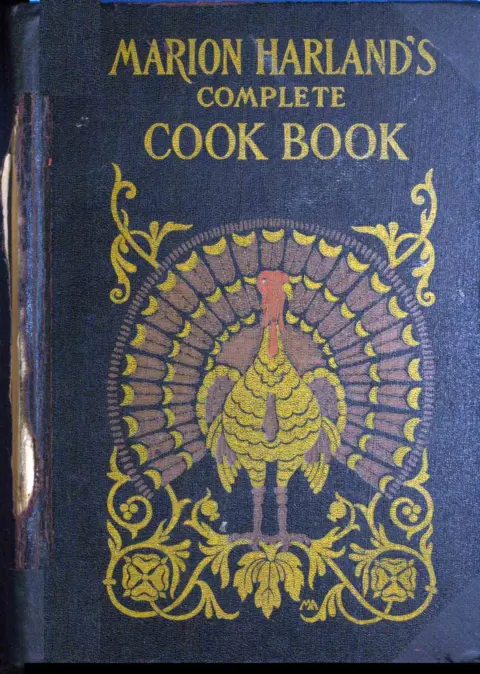
Marion Harland’s Complete Cook Book A Practical and Exhaustive Manual of Cookery and Housekeeping
Marion Harland
THE CLASSIC COLLECTION · 1898
"Alone" by Marion Harland is a novel written in the mid-19th century. The story explores themes of love, loss, and the emotional struggles of its main character, Ida Ross, who is grappling with the tragic death of her mother. As she navigates her newfound life as an orphan, the novel delves into her profound sense of isolation and her search for genuine companionship. The opening portion of the book immediately immerses readers in a somber atmosphere, highlighting Ida's heartbreaking experience at her mother's funeral. The ceremony poignantly captures the deep sorrow of loss, emphasizing the profound bond between Ida and her mother. The narrative then shifts to the young girl’s painful transition into her new life with a guardian who lacks warmth and understanding. Harland's writing paints a vivid picture of Ida's emotions, showcasing her yearning for love and her struggle against a world that seems indifferent to her suffering. As the story progresses, the dynamics between Ida and the people around her, including her cold guardian and new acquaintances, promise a deeper exploration of her character and the challenges she must face.
Introduction adapted from the source catalogue; source summaries may be automatically generated.
Free to read · English · 137,500 words · No account needed
MAKE TIME FOR A GOOD BOOK
On by default. Untick to stop anonymous reading totals. Each page counts after 10 seconds in view. How this works.
Anonymous counting is on unless you have switched it off.
It had been predicted from the premature beginning of the winter's gaieties, that an ebb would occur before the Southern carnival, Christmas, and the party-goers resolved to falsify the prophecy.
Mrs. Dana called on the afternoon of the 24th to invite Ida and Josephine to dine with her. "You will see only ourselves and Mr. Holmes, who is Charley's shadow."
"A stupid set," was Josephine's reflection. "How pleasant," Ida's; and their answers corresponded. The former, "very sorry, papa would always dine at home, Christmas-day; he held it to be a religious duty she verily believed," laughing affectedly, "and he could not eat unless she were there."
Ida said, "I will come with pleasure, thank you," and lost all but the main purport of Miss Read's apology, in an eager whisper from Elle, who was with her mother.
"I don't hear, will I 'please come to what?'" lifting her to her lap.
Elle put her arms around her neck, and her mouth to her ear.
"To your molasses stew!" said Ida, "indeed I will. When is it to be?"
Another important whisper.
"Josephine, are we engaged for to-morrow evening?"
"I do not know," she replied, shortly.
"I hope not," said Mrs. Dana. "Elle's head is full of her frolic. I was describing to her the molasses stew I had every Christmas, when I was a child, and nothing would do but I must promise her one for 'being a good girl.'"
"She deserves it, I know," said Ida, fondly. "I will come, Elle, if I leave fifty grown people's parties."
"Will you, too?" asked the child, going up to Josephine. Mrs. Dana
pressed the invitation.
"I am not certain, but I have engaged to go somewhere else," said Josephine, smiling heartlessly into the pure little face. "If I can, I will do myself the honor, Miss Dana."
The wretched attempt at playfulness actually frightened Elle, who shrunk again to the side of her friend.
"Are you serious in promising to go to this babyish fal-lal?" snapped Josephine, the minute Mrs. Dana was gone.
"I am."
"Did not you hear that Anna Talbot is to receive company to-morrow
night?"
"Yes; and I am rejoiced that Elle's invitation was earliest. There are
Anna and Ellen Morris."
"I haven't time to stay," exclaimed the young lady, throwing herself upon the sofa. "You both must spend a sociable evening with me--a Christmas jubilee--egg-nogg, country-dances, etc. We are to have a high time. You are disengaged?"
"I am," said Josephine, promptly, "and if I were not, I could not resist the temptation to send a 'regret,' and go to your house."
Your reading position is saved on this browser. Take it to another device with a library code. Reading pages adapt to text, rather than matching a printed edition.
Marion Harland
Marion Harland
Marion Harland
Marion Harland
BEHIND THE BOOK
This eBook is for the use of anyone anywhere in the United States and most other parts of the world at no cost and with almost no restrictions whatsoever. You may copy it, give it away or re-use it under the terms of the Project Gutenberg License included with this eBook or online at www.gutenberg.org. If you are not located in the United States, you will have to check the laws of the country where you are located before using this eBook. Read the source licence.
The original source file, including credits and licence, is retained by this library. Request an original-format copy at no charge. Please include the book title and Project Gutenberg identifier #46505.
KEEP YOUR CURIOSITY GOING
Coulson Kernahan

Maurice Baring
Frances Wright
Cécile Tormay

Frederic Jesup Stimson

W. H. P. (William Henry Pope) Jarvis