
Marion Harland’s Complete Cook Book A Practical and Exhaustive Manual of Cookery and Housekeeping
Marion Harland

THE CLASSIC COLLECTION · 1898
"Alone" by Marion Harland is a novel written in the mid-19th century. The story explores themes of love, loss, and the emotional struggles of its main character, Ida Ross, who is grappling with the tragic death of her mother. As she navigates her newfound life as an orphan, the novel delves into her profound sense of isolation and her search for genuine companionship. The opening portion of the book immediately immerses readers in a somber atmosphere, highlighting Ida's heartbreaking experience at her mother's funeral. The ceremony poignantly captures the deep sorrow of loss, emphasizing the profound bond between Ida and her mother. The narrative then shifts to the young girl’s painful transition into her new life with a guardian who lacks warmth and understanding. Harland's writing paints a vivid picture of Ida's emotions, showcasing her yearning for love and her struggle against a world that seems indifferent to her suffering. As the story progresses, the dynamics between Ida and the people around her, including her cold guardian and new acquaintances, promise a deeper exploration of her character and the challenges she must face.
Introduction adapted from the source catalogue; source summaries may be automatically generated.
Free to read · English · 137,500 words · No account needed
MAKE TIME FOR A GOOD BOOK
On by default. Untick to stop anonymous reading totals. Each page counts after 10 seconds in view. How this works.
Anonymous counting is on unless you have switched it off.
"It is a sorry task to pick flaws in your beautiful analogy," said the old gentleman. "You may not be aware that your pine, sturdy as it appears, is less fitted than any other tree, for standing alone; its roots running out laterally from the trunk; and lying near the surface of the earth. Cut down the outer row which have kept off the tempests, and helped to support him, and the first hard wind is apt to lay him low."
"And so there are fates, against which the mightiest of mortal energies are powerless. Leave the pine unprotected, and if it survive one blast, it strikes its roots deeper and deeper into the ground, until it has strength to brave an hundred winters. Adversity, if it does not kill--strengthens."
"Do you favor the philosophy, which teaches that a certain amount of trouble is necessary for the complete development of character?"
"Whether necessary or not--it comes. That is not a matter of hypothesis; but I have seen some, who, I did not think, required discipline; and many more, who wanted softening, instead of hardening."
"Is hardening the legitimate effect of sorrow?" asked he, more gravely. "When the chastening is guided by love, does it not melt and refine? Are strength and hardness synonymous?"
"I question the difference, sir,--as the world goes."
"Instead of referring to 'the world,' in an abstract sense--judge we of the influence of trials, by what we know of ourselves. I never tasted real happiness, until I learned to bear grief, by submitting to the will of Providence."
"And one affliction has embittered life for me!" returned Ida, gloomily.
"Poor child!" then recollecting himself, he addressed Carry in a jesting tone. "And you--Miss Carry--what is your vote upon this important question?"
"I have had no trouble, sir," replied she, lightly, "except
school-quarrels. You would not class them in the category of
tribulations."
There was sadness in her father's look of love, as he answered, "I hope you may long be able to say so, dear!"
Carry brushed away the mist from her lashes. "'A consummation devoutly to be desired,'--as Charley, or Shakspeare would say. Where is he, father?"
"Who? Shakspeare or Charley?"
"The latter, of course. Apart from his probable location being more easily decided upon,--he is, to me, the more interesting of the two."
"He is somewhere in the Western part of the State;--travelling, partly for pleasure. John told you, that they have committed the New York branch of the business to Mr. E----, and that Charley will in future reside in Richmond."
Your reading position is saved on this browser. Take it to another device with a library code. Reading pages adapt to text, rather than matching a printed edition.
Marion Harland

Marion Harland
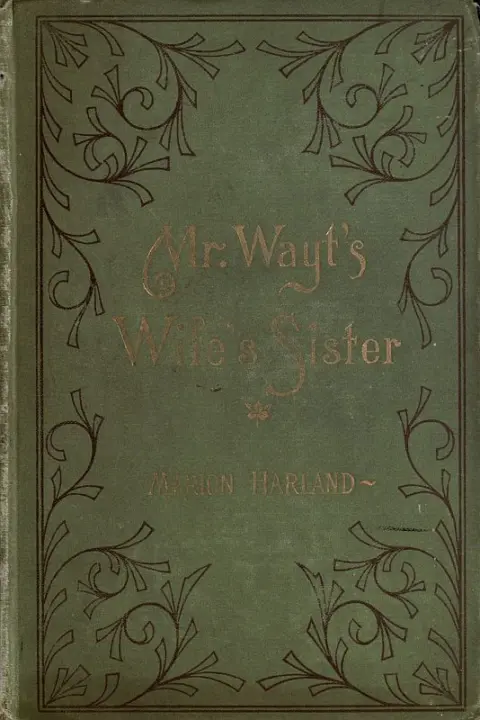
Marion Harland
Marion Harland
BEHIND THE BOOK
This eBook is for the use of anyone anywhere in the United States and most other parts of the world at no cost and with almost no restrictions whatsoever. You may copy it, give it away or re-use it under the terms of the Project Gutenberg License included with this eBook or online at www.gutenberg.org. If you are not located in the United States, you will have to check the laws of the country where you are located before using this eBook. Read the source licence.
The original source file, including credits and licence, is retained by this library. Request an original-format copy at no charge. Please include the book title and Project Gutenberg identifier #46505.
KEEP YOUR CURIOSITY GOING
Coulson Kernahan

Maurice Baring
Frances Wright
Cécile Tormay

Frederic Jesup Stimson

W. H. P. (William Henry Pope) Jarvis