
Marion Harland’s Complete Cook Book A Practical and Exhaustive Manual of Cookery and Housekeeping
Marion Harland

THE CLASSIC COLLECTION · 1898
"Alone" by Marion Harland is a novel written in the mid-19th century. The story explores themes of love, loss, and the emotional struggles of its main character, Ida Ross, who is grappling with the tragic death of her mother. As she navigates her newfound life as an orphan, the novel delves into her profound sense of isolation and her search for genuine companionship. The opening portion of the book immediately immerses readers in a somber atmosphere, highlighting Ida's heartbreaking experience at her mother's funeral. The ceremony poignantly captures the deep sorrow of loss, emphasizing the profound bond between Ida and her mother. The narrative then shifts to the young girl’s painful transition into her new life with a guardian who lacks warmth and understanding. Harland's writing paints a vivid picture of Ida's emotions, showcasing her yearning for love and her struggle against a world that seems indifferent to her suffering. As the story progresses, the dynamics between Ida and the people around her, including her cold guardian and new acquaintances, promise a deeper exploration of her character and the challenges she must face.
Introduction adapted from the source catalogue; source summaries may be automatically generated.
Free to read · English · 137,500 words · No account needed
MAKE TIME FOR A GOOD BOOK
On by default. Untick to stop anonymous reading totals. Each page counts after 10 seconds in view. How this works.
Anonymous counting is on unless you have switched it off.
"There is a carriage at the door," interrupted the other, in an unvarying tone, and without changing her posture. The host met, in the entry, an elderly gentleman and a young girl, whom he saluted as "Mr. Hall" and "Miss Ross," introducing them to "Miss Read, my daughter." Ida glanced timidly into the face of her guardian, and then hastily scanned that of his daughter. That the scrutiny was unsatisfactory, was to be read in the deeper sadness that fell over her countenance, while the sinking lashes, and trembling lip showed how sharp was the disappointment. Youthful and inexperienced as she was, her heart told her that the bruised tendrils which had been torn from their original support could never learn to twine around these gelid statues.
"You will remain to tea, Mr. Hall," said Mr. Read, as the good
clergyman arose.
"I thank you, sir; but our journey has been fatiguing owing to the extreme heat. I find myself in need of rest,--and my charge here requires it more than I do."
"You will call before you leave the city. May we not hope for the pleasure of your company to dinner to-morrow?"
The invitation was accepted; and after a silent pressure of the hand from Ida, and a courtly bow from father and daughter, Mr. Hall took his leave.
"Miss Ross would perhaps like to make some alteration in her dress, Josephine," Mr. Read said; his manner testifying how necessary he esteemed the proposed measure. Miss Read rang for a light, and signified to Ida that she was ready to show her up stairs. Any change from the bleak formality of their presence was a relief; and she longed to be alone, if but for half an hour, that she might give way to the emotions which had been rising and beating, through the livelong day, choking and blinding her. But Miss Read summoned a servant, whom she ordered to wait upon Miss Ross, now and in future; and seated herself in a rocking-chair to watch the progress of the toilette. Mechanically Ida went through the torture of dressing. There are times when it is such;--when the manifold details, heretofore so engaging, are to the preoccupied and suffering mind, like the thorn of the prickly-pear, too small to be observed, but pricking burningly in every fibre and pore. It was a woman--a sister--a girl as young as herself--perhaps as tender-hearted, who sat there. Why not, with the unrepressed sorrowfulness of a child, bury her face in her lap, and sob, "I have lost my mother!" to be fondled and comforted into composure? It would be sacrilege to ruffle the elegant propriety of her figure; and the glassy eyes said, by their tearless stare,--"Between you and me there is a great gulf fixed!" One weakness Ida could not overcome; the repugnance to beholding herself in her mourning garments. They as yet reminded her too vividly of the bier and the pall. She averted her eyes, as she stood before the mirror, to put the finishing stroke to her apparel. "I beg your pardon," said the calm voice of Josephine. "Your collar is all awry. Permit me"--Ida submitted in silence, while her volunteer assistant unpinned, and re-arranged the crape folds, but as she gathered them under the mourning brooch, a tear, large and pellucid, dropped upon her hand. It was but a drop of salt water to Miss Read, and she wiped it off, as she asked her guest "to walk down to tea." To the new-comer, the palatable food was as the apples of Sodom--bitter ashes. She could not swallow or speak. Her companions ate and chatted with great gusto. The ill-humour of an hour since had passed away. This exemplary daughter was her father's idol, when contrasted with other, and less favored girls. She was formed in his image, and when the plastic mind was wax to receive, and adamant to retain impressions, he moulded it after a pattern of his own. He taught her deceit, under the name of self-control; heartlessness, he called prudence; veiled distrust and misanthropy under clear-sightedness and knowledge of human nature. All those holy and beautiful feelings which evidence to man his kindred to his Divine model and Creator, he tossed aside, with the sweeping condemnation--"romance and nonsense!" The crying sin was to be "womanish;"--"woman" and "fool" were synonymes, used indiscriminately to express the superlative of ire-exciting folly. He delighted in showing things as they were. Men were machines, moved by secret springs of policy and knavery; the world a stage, viewed by others in the deceptive glare of artificial lights, and so made attractive. He had penetrated into the mysteries behind the curtain, and examined, in the unflattering day, the clumsy contrivances, gaudy daubing and disgustful hollowness of the whole. Fancy and the pleasures of imagination were empty, bombastic names; he would have seen in Niagara only a sizeable fall, and "calculated," amidst the rushing shout of its mighty waters, as to the number of cotton-mills it would turn, and the thousands it would net him, could he transport it, patent right secured, to Virginia. He tore the cloud-covering from the storm-god's brow, and beheld a roaring, vaporing giant, whose insane attacks might be warded off by philosophical precautions, and discretion in the disposition of lightning rods.
Your reading position is saved on this browser. Take it to another device with a library code. Reading pages adapt to text, rather than matching a printed edition.
Marion Harland

Marion Harland
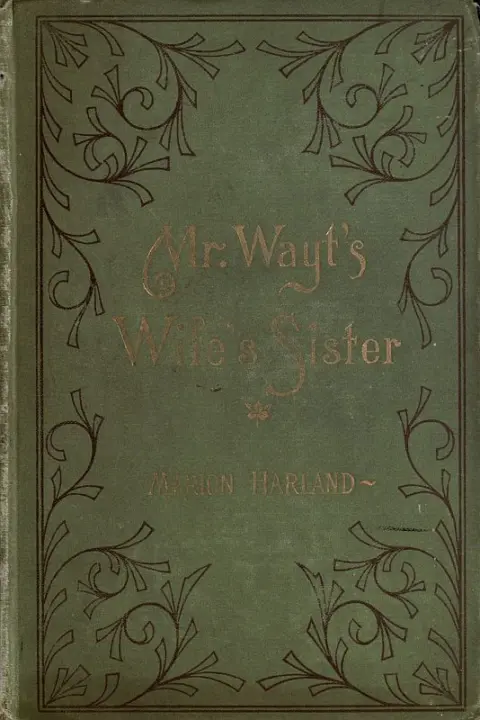
Marion Harland
Marion Harland
BEHIND THE BOOK
This eBook is for the use of anyone anywhere in the United States and most other parts of the world at no cost and with almost no restrictions whatsoever. You may copy it, give it away or re-use it under the terms of the Project Gutenberg License included with this eBook or online at www.gutenberg.org. If you are not located in the United States, you will have to check the laws of the country where you are located before using this eBook. Read the source licence.
The original source file, including credits and licence, is retained by this library. Request an original-format copy at no charge. Please include the book title and Project Gutenberg identifier #46505.
KEEP YOUR CURIOSITY GOING
Coulson Kernahan

Maurice Baring
Frances Wright
Cécile Tormay

Frederic Jesup Stimson

W. H. P. (William Henry Pope) Jarvis