
Marion Harland’s Complete Cook Book A Practical and Exhaustive Manual of Cookery and Housekeeping
Marion Harland

THE CLASSIC COLLECTION · 1898
"Alone" by Marion Harland is a novel written in the mid-19th century. The story explores themes of love, loss, and the emotional struggles of its main character, Ida Ross, who is grappling with the tragic death of her mother. As she navigates her newfound life as an orphan, the novel delves into her profound sense of isolation and her search for genuine companionship. The opening portion of the book immediately immerses readers in a somber atmosphere, highlighting Ida's heartbreaking experience at her mother's funeral. The ceremony poignantly captures the deep sorrow of loss, emphasizing the profound bond between Ida and her mother. The narrative then shifts to the young girl’s painful transition into her new life with a guardian who lacks warmth and understanding. Harland's writing paints a vivid picture of Ida's emotions, showcasing her yearning for love and her struggle against a world that seems indifferent to her suffering. As the story progresses, the dynamics between Ida and the people around her, including her cold guardian and new acquaintances, promise a deeper exploration of her character and the challenges she must face.
Introduction adapted from the source catalogue; source summaries may be automatically generated.
Free to read · English · 137,500 words · No account needed
MAKE TIME FOR A GOOD BOOK
On by default. Untick to stop anonymous reading totals. Each page counts after 10 seconds in view. How this works.
Anonymous counting is on unless you have switched it off.
"What error to suppose that sickness softens, and predisposes the heart to repentance!" thought Ida. She went into the other room, and beckoned Mrs. Read. "The doctor was here this morning," she said; "and told me, privately, not to mind his irritability, nor to answer him, unless silence increased it. It is an ordinary symptom in neuralgic affections. We must be forbearing."
"There is a limit to everything," was Mrs. Read's response.
"True--but forbearance should last as long as the pain we would cure."
"That is your theory, Miss Ida. I am tired of the practice. You mean well, I have no doubt, but I am not a fit object for your charity."
The asperity was pointed at herself, rather than at her hearer, and Ida pondered upon her words and manner, often during the day.
"It did not agree with" Josephine "to sit up"--a constitutional weakness, loudly lamented, and encouraged, instead of overcome. Ida and Mrs. Read divided the vigil; the mulatto nurse, Sarah, sleeping in the apartment. Ida was to watch the latter part of the night. The patient was cross and restless, when she looked in upon him at bed-time--railing, and swearing and abusive.
"You want me dead!" he said to his wife; "but I won't die--to spite you. I shall live years, and years, and years, 'till you are a toothless hag, and walk with a crutch! Ha! ha!"
"He is delirious!" whispered Ida. "Let me stay with you!"
"He is not! I prefer your retiring. Sarah will call you at two."
"I shall not undress, to-night, Rachel," said Ida. "I have a
presentiment I shall be wanted."
"Is he much worse?"
"No--but I may be called up. I shall sleep here, upon the lounge."
But sleep was coy to her wooing. If she had ever felt fear, she would have known that she was scared and excited. The south wind generally affected her unpleasantly, creating heat and nervousness; but to-night the breeze was from the north, and the moonbeams were spread in broad, white sheets upon the floor. "I must be sick!" she said, aloud. "I cannot ascribe this numb horror to anything else. They have a superstition that it is a precursor of death." Her mind rejected this explanation, but the utterance of that word had populated her soul with phantoms. Lynn's chill, damp hands again enfolded hers; and his glazed, upward look--still and fixed, moved not at her weeping; the clods rattled upon the coffin--frozen clods! and how warmly soever the sun smiled upon the swelling turf--down where he slept, it was frosty night still! Must he, the loved and gifted, rest there forever? would a tender mother's arms never more embrace her,--the dear lips, now turned to dust, never cling to hers, in speechless fondness? But the dead should rise! some to the resurrection of the just, some to everlasting shame and contempt. Oh! the unspeakable woe of a hopeless death! the dying strife of the finally impenitent! Was his end approaching? "My God! avert from him this doom!" His room was beneath hers. She could hear occasionally a groan, which she knew was an execration. He might be dying. She thrust her feet into a pair of felted slippers, and descended to his door. "Quiet--quiet as death!" "This is improper! irrational!" said she, severely, to herself. "I need repose and steadiness of nerve--there are watchers with him." But she would not go back to her room. She went, instead, to the parlor. The hall-lamp burned all night; and setting open a door, and unclosing a shutter, to dissipate the darkness, which suffocated her, as a thick pall, she stretched herself upon a sofa. She slumbered and dreamed--visions, like her waking fancies. She was in Mr. Read's chamber; writing to Carry, at her far window;--the door swung back, and his wife glided in. With a gesture of silence to her, she passed to his bedside, and poised a knife above his heart! Ida strove to scream--to move--but her mighty efforts only shifted the scene--did not awaken her. He was dead; and his friends had come to the funeral. They thronged the room where his corpse lay in its costly coffin; and the carriages, headed by the hearse, grated upon the pebbled gutter. The undertaker was tightening the silver screws--when, oh! horror! the lid was heaved up from within--crashing and splintering--and the dead sat upright! The distorted features were Mr. Ashlin's,--the yell, as he tossed his arms aloft,--Mr. Read's. "I will not die!" She was in the centre of the apartment; the cold beads dripping from her forehead, and her hair, dank and heavy, upon her face and neck. She put it back, and listened. The silence drove by her in waves--throbbed with the beatings of her heart. Hark! it was not all a dream! the pawing of hoofs rang upon the stones. The moon had set; and the lamp was brighter than the starlight. She had the presence of mind to creep to that side of the window hidden by the shutter, and looked out. A carriage was at the door--in appearance like the doctor's. He had been summoned--the sick man was worse. Something light and white sailed past her window, from overhead; as it fluttered to the ground, a tall figure stepped from the vehicle, and caught it to his bosom. The apparition of the Arch-Fiend himself would not have shaken Ida, as did that manly form. She was awake! A stealing step fell, softly as a snow-flake, upon the floor above--she heard it. With the speed of light, she flew to the front door--locked it--to that at the other extremity of the passage--hid both keys beneath the cushion of the hall-sofa, and back again to the street entrance, as Mrs. Read, dressed for travelling, had her foot upon the lowest stair. The fugitive leaned against the wall for support, faint with the terrors of detected guilt.
Your reading position is saved on this browser. Take it to another device with a library code. Reading pages adapt to text, rather than matching a printed edition.
Marion Harland

Marion Harland
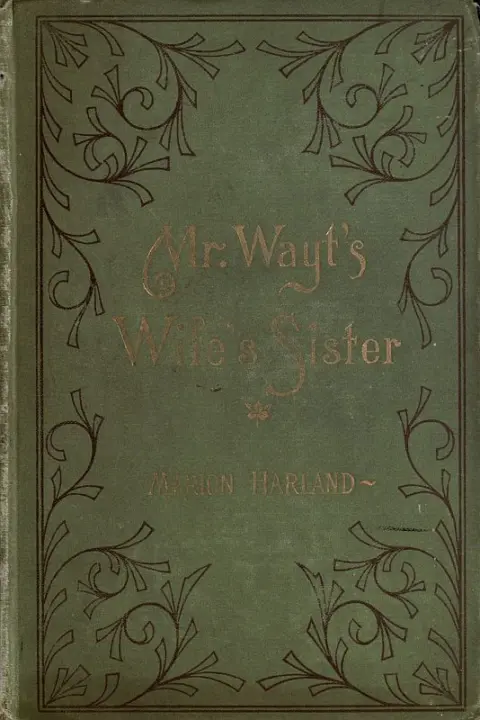
Marion Harland
Marion Harland
BEHIND THE BOOK
This eBook is for the use of anyone anywhere in the United States and most other parts of the world at no cost and with almost no restrictions whatsoever. You may copy it, give it away or re-use it under the terms of the Project Gutenberg License included with this eBook or online at www.gutenberg.org. If you are not located in the United States, you will have to check the laws of the country where you are located before using this eBook. Read the source licence.
The original source file, including credits and licence, is retained by this library. Request an original-format copy at no charge. Please include the book title and Project Gutenberg identifier #46505.
KEEP YOUR CURIOSITY GOING
Coulson Kernahan

Maurice Baring
Frances Wright
Cécile Tormay

Frederic Jesup Stimson

W. H. P. (William Henry Pope) Jarvis