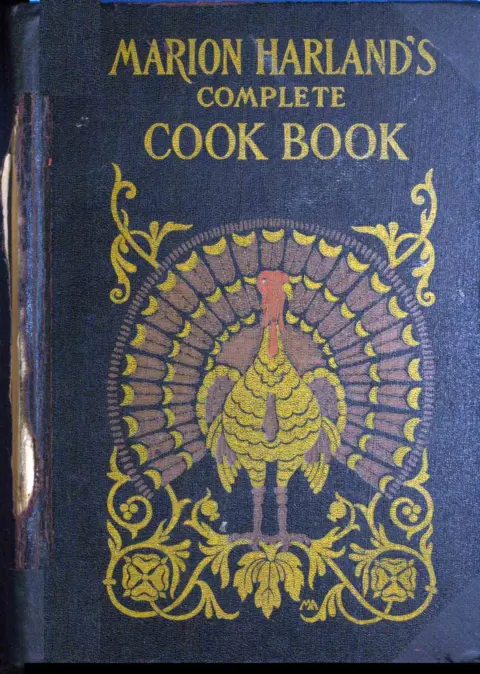
Marion Harland’s Complete Cook Book A Practical and Exhaustive Manual of Cookery and Housekeeping
Marion Harland
THE CLASSIC COLLECTION · 1898
"Alone" by Marion Harland is a novel written in the mid-19th century. The story explores themes of love, loss, and the emotional struggles of its main character, Ida Ross, who is grappling with the tragic death of her mother. As she navigates her newfound life as an orphan, the novel delves into her profound sense of isolation and her search for genuine companionship. The opening portion of the book immediately immerses readers in a somber atmosphere, highlighting Ida's heartbreaking experience at her mother's funeral. The ceremony poignantly captures the deep sorrow of loss, emphasizing the profound bond between Ida and her mother. The narrative then shifts to the young girl’s painful transition into her new life with a guardian who lacks warmth and understanding. Harland's writing paints a vivid picture of Ida's emotions, showcasing her yearning for love and her struggle against a world that seems indifferent to her suffering. As the story progresses, the dynamics between Ida and the people around her, including her cold guardian and new acquaintances, promise a deeper exploration of her character and the challenges she must face.
Introduction adapted from the source catalogue; source summaries may be automatically generated.
Free to read · English · 137,500 words · No account needed
MAKE TIME FOR A GOOD BOOK
On by default. Untick to stop anonymous reading totals. Each page counts after 10 seconds in view. How this works.
Anonymous counting is on unless you have switched it off.
"The Utopia of one who studies Lalla Rookh more than 'Eastern Statistics,' or 'Incidents of Travel,'" said Mr. Dermott, smiling. "Yet Moore's descriptions are not so much overwrought as some suppose. His words came continually to my tongue. He has imbibed the true spirit of Oriental poetry; the melancholy, which, like the ghost of a dead age, broods over that oldest of lands; the passion flushing under their tropical sun; their wealth of imagery. Lalla Rookh reads like a translation from the original Persian. The wonder is that he has never been self-tempted to visit the 'Vale of Cashmere' in person."
"Campbell, too, having immortalized Wyoming, will not cross the ocean
to behold it," said Ida.
There was a consultation between the confederates, and Pemberton crossed to Ida's chair, with a smirk that belied the fire in his eye.
"Excuse me, Mr. Dermott,--Miss Ida, I am commissioned to inquire of you the authorship and meaning of this quotation--
'Deeply, darkly, desperately blue!'"
It is impossible to convey a just impression of the offensive tone and emphasis with which this impertinence was uttered. The quick-witted Irishman saw through the design in an instant. "It is from a Scotch author," said he, before Ida could reply, "and the rhyme runs after this fashion--
'Feckless, fairlie, farcically fou!'"
and not deigning a second glance at the questioner, he continued his account of a visit he had paid to Moore. The object of this merciless retort stood for a second, in doubt as to its meaning, and then walked off, still in incertitude. Ida's laugh, while it might have been in response to Mr. Dermott's story assured Josephine that her end was unaccomplished, before her messenger had delivered his lame return.
"She understood me, and it cut pretty deeply, but that puppy of a paddy answered for her. He repeated the next line, too, 'from a Scotch author,' he said, but I believe he made it up."
"What was it?" asked Josephine.
"'Fairly, farcically fou,' or something like that. If I were sure that last word meant fool, I would knock him down. Do you understand Scotch?"
"No," replied Josephine, vexed, but afraid to excite him further. "He is beneath the notice of a gentleman; we can let him alone."
But Ida's share in this was not to be overlooked. Josephine appeared as usual at breakfast: talkative to her father, and taciturn to her female companion. At length she inquired, meaningly, "by the way, Ida, when does your travelled Hibernian 'lave this counthry?'"
"If you speak of Mr. Dermott, I do not know."
Your reading position is saved on this browser. Take it to another device with a library code. Reading pages adapt to text, rather than matching a printed edition.
Marion Harland
Marion Harland
Marion Harland
Marion Harland
BEHIND THE BOOK
This eBook is for the use of anyone anywhere in the United States and most other parts of the world at no cost and with almost no restrictions whatsoever. You may copy it, give it away or re-use it under the terms of the Project Gutenberg License included with this eBook or online at www.gutenberg.org. If you are not located in the United States, you will have to check the laws of the country where you are located before using this eBook. Read the source licence.
The original source file, including credits and licence, is retained by this library. Request an original-format copy at no charge. Please include the book title and Project Gutenberg identifier #46505.
KEEP YOUR CURIOSITY GOING
Coulson Kernahan

Maurice Baring
Frances Wright
Cécile Tormay

Frederic Jesup Stimson

W. H. P. (William Henry Pope) Jarvis