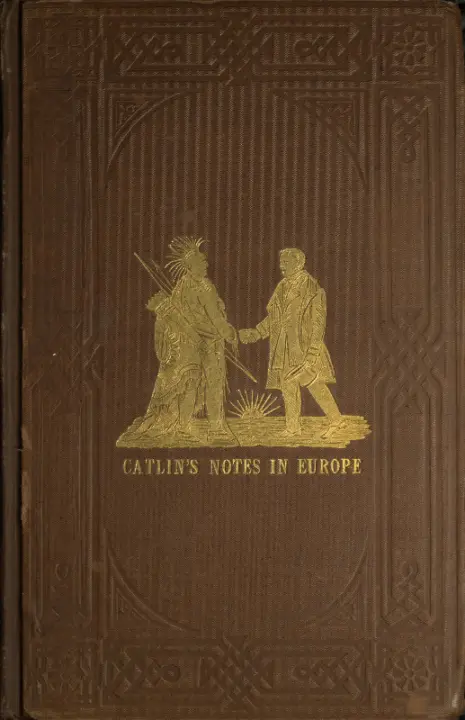
Adventures of the Ojibbeway and Ioway Indians in England, France, and Belgium; Vol. 2 (of 2) being Notes of Eight Years’ Travels and Residence in Europe with his North American Indian Collection
George Catlin
THE CLASSIC COLLECTION · 1852
"Adventures of the Ojibbeway and Ioway Indians in England, France, and Belgium" by George Catlin is a historical account written in the mid-19th century. The book chronicles Catlin's experiences and observations during his travels across Europe with his Indian collection, highlighting interactions between Native Americans and European society. It aims to provide a deeper understanding of North American Indian culture while documenting the perspectives of both the indigenous people and the European aristocracy. The opening of the book sets the stage for Catlin's journey, recapping his earlier experiences among Native American tribes and detailing his transatlantic voyage with two grizzly bears, which adds both humor and intrigue. As he arrives in England, Catlin describes the arrival of the bears amidst public excitement, as well as his intentions to showcase his extensive collection of Native American artifacts. He reflects on the various accidents and cultural misunderstandings he encounters during this impactful period in his travels, establishing a tone of lively adventure that promises readers a vivid exploration of the contrasts between indigenous and civilized life.
Introduction adapted from the source catalogue; source summaries may be automatically generated.
Free to read · English · 113,465 words · No account needed
MAKE TIME FOR A GOOD BOOK
On by default. Untick to stop anonymous reading totals. Each page counts after 10 seconds in view. How this works.
Anonymous counting is on unless you have switched it off.
We returned from this half-day's work, fatigued, and almost sorry that we had seen so much of the "shining dust" which our hands are labouring so hard through life to earn a pittance of.
There were several Americans with us on this day's expedition, and all agreed that we drew more pleasure from the gentlemanly politeness we met in the Bank of England than we did from its wonderful system (which was all explained to us), and from its golden riches which were all laid open to our view.
Our fatigue, when we got home, seemed enough for one day; but as it happened on that day, our sight-seeing was only begun; for it had been arranged that we were to go to the Polish ball at the Mansion House on that evening, and what was to make it a double task, it was arranged that we should all go, some five or six of us, in Indian costumes. My Indian wardrobe was therefore laid under heavy contributions for that night. My nephew Burr and myself were dressed as chiefs, and two or three more of my friends were arrayed as warriors. My dear little Christian Clara, whose sphere it was not, and who never wore an Indian dress or painted her fair face before, becoming inspired with a wish to see the splendour of the scene, proposed to assume the dress of an Indian woman and follow me through the mazes of that night as an Indian squaw follows her lord on such occasions. I selected for her one of the prettiest and most beautifully ornamented women's dresses, which was made of the fine white skin of the mountain sheep; and with her hair spread over her back, and her face and her arms painted to the colour of a squaw, and her neck and ears loaded with the usual profusion of beads and other ornaments, and her fan of the eagle's tail in her hand, she sidled along with us amidst the glare and splendour, and buzz and din of the happy throng we were soon in the midst of, and dragging our awkward shields and quivers and heavy buffalo robes through, as well as we could. We took good care not to dance on that occasion, so we kept the paint on our faces, and by understanding no questions, answered none, and passed off with everybody as real Indians. We went resolved to gratify our eyes, but to give no gratification to others besides what they could take to themselves by looking at us. Our interpreter was true to his promise: he made out his own descriptions for us, and assured all who inquired, that we could not speak a word of English. French, German, Russian, and Italian were all tried in vain upon us; and as they turned away, one after another, from us, they exclaimed, "What a pity! how unfortunate the poor things can't speak English! how interesting it would be to talk with them! that's a noble-looking fellow, that big chief; egad, he is six feet and a half. I'll be bound that fellow has taken many a scalp. That's a nice-looking little squaw: upon my word, if she had a white skin she would be rather pretty!" and a thousand such remarks, as the reader can imagine, while we were wending our tedious way through the bewildering mazes of this endless throng. The task for my poor Clara soon became more than she had anticipated before entering the room, and was growing too much for her delicate frame to bear: she had not thought of the constant gaze of thousands she was to stand in every moment of the evening; and another discipline (which she knew must be strictly adhered to, to act out the character she was supporting, and which had not occurred to her before she had commenced upon the toils of the evening) made her part a difficult one to act--that was the necessity of following in the wake of all the party of men when we were in motion, the place assigned to Indian women on the march rather than by the side or on the arms of their husbands. This, in the street or in the wilderness or anywhere else would have been tolerable, she said, but in her present condition was insupportable. The idea was so ridiculous to her, to be the last of a party of Indians (who always walk in single file) so far behind her husband, and then the crowd closing in upon her and in danger of crushing her to death. We soon however were so lucky as to find a flight of several broad steps which led to a side room, but now closed, which furnished us comfortable seats above the crowd, which we took good care to hold until our curiosity was all gratified, and we were ready to return home. Our interpreter, in answer to all inquiries as to the locale of these strange foreigners, mentioned the Egyptian Hall; and for weeks after, Daniel testified to the increase of our receipts, and bore sad evidence too of the trouble he had in explaining the difficulty of showing to his visiters the "real Indians." After having satiated our curiosity, and several of the youngest of the party having received some very pretty trinkets and other presents that had been forced upon them, we made our way home in good season to enjoy the joke, and part of a good night's rest.
Your reading position is saved on this browser. Take it to another device with a library code. Reading pages adapt to text, rather than matching a printed edition.
BEHIND THE BOOK
This eBook is for the use of anyone anywhere in the United States and most other parts of the world at no cost and with almost no restrictions whatsoever. You may copy it, give it away or re-use it under the terms of the Project Gutenberg License included with this eBook or online at www.gutenberg.org. If you are not located in the United States, you will have to check the laws of the country where you are located before using this eBook. Read the source licence.
The original source file, including credits and licence, is retained by this library. Request an original-format copy at no charge. Please include the book title and Project Gutenberg identifier #44776.
KEEP YOUR CURIOSITY GOING
Wilfrid Scawen Blunt
Wilfrid Scawen Blunt

E. W. (Edgar Watson) Howe
Cécile Tormay

Moritz Busch
John L. Ransom