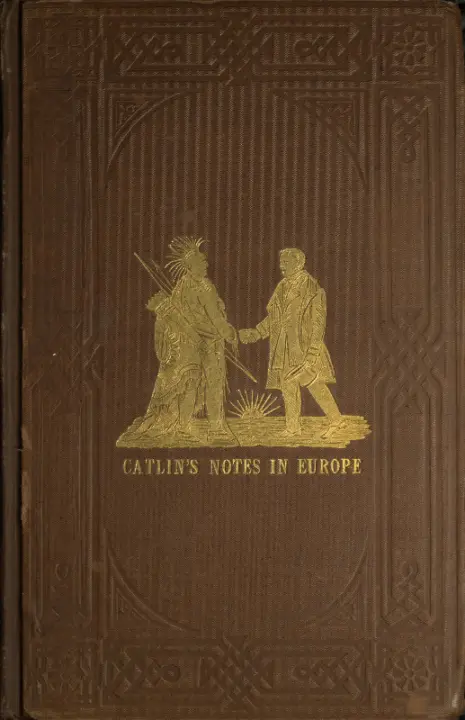
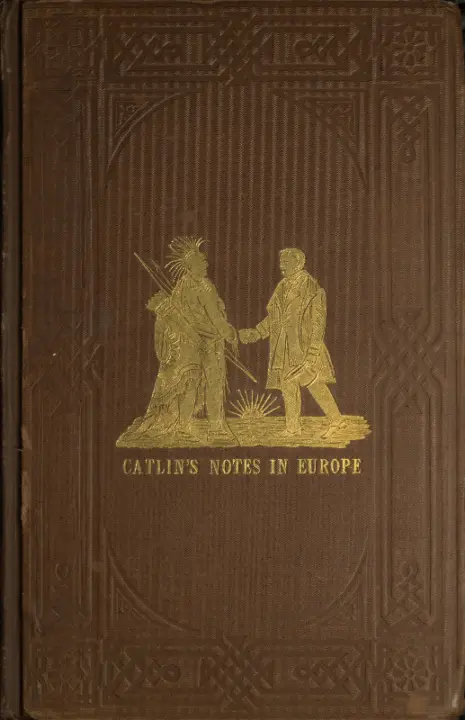
Adventures of the Ojibbeway and Ioway Indians in England, France, and Belgium; Vol. 2 (of 2) being Notes of Eight Years’ Travels and Residence in Europe with his North American Indian Collection
George Catlin
THE CLASSIC COLLECTION · 1852
"Adventures of the Ojibbeway and Ioway Indians in England, France, and Belgium" by George Catlin is a historical account written in the mid-19th century. The book chronicles Catlin's experiences and observations during his travels across Europe with his Indian collection, highlighting interactions between Native Americans and European society. It aims to provide a deeper understanding of North American Indian culture while documenting the perspectives of both the indigenous people and the European aristocracy. The opening of the book sets the stage for Catlin's journey, recapping his earlier experiences among Native American tribes and detailing his transatlantic voyage with two grizzly bears, which adds both humor and intrigue. As he arrives in England, Catlin describes the arrival of the bears amidst public excitement, as well as his intentions to showcase his extensive collection of Native American artifacts. He reflects on the various accidents and cultural misunderstandings he encounters during this impactful period in his travels, establishing a tone of lively adventure that promises readers a vivid exploration of the contrasts between indigenous and civilized life.
Introduction adapted from the source catalogue; source summaries may be automatically generated.
Free to read · English · 113,465 words · No account needed
MAKE TIME FOR A GOOD BOOK
On by default. Untick to stop anonymous reading totals. Each page counts after 10 seconds in view. How this works.
Anonymous counting is on unless you have switched it off.
Exhibition rooms--Great crowd--The "jolly fat dame"--Her interview with Cadotte--She gives presents to all the Indians--Excitement in the crowd--Women kissing the Indians--Red paint on their faces and dresses--Old Chief's dream and feast of thanksgiving--An annual ceremony--Curious forms observed--Indians invited to the St. George's archery-ground--They shoot for a gold medal--They dine with the members of the club--The "jolly fat dame" and Cadotte--She takes him to his lodgings in her carriage--Cadotte (or the "Strong-wind") gets sick--Is in love with another!--Daniel unfolds the secret to her--Her distress--She goes to the country--The "jolly fat dame" returns--Cadotte's engagement to marry--Rankin promotes the marriage--The Author disapproves of it.
The reader will easily imagine the position of the Indians at this time to have been a very pleasant and satisfactory one to themselves--all in good health; having seen and pleased the Queen; having met the public several times in the great city of London, where their Hall was crowded every night, and was likely to continue so; where everybody applauded, and many bestowed on them presents in trinkets and money; with plenty of roast beef, and withal indulged in their chickabobboo. The old chief had finished his talks on religion, and Cadotte was in the delightful state of incubation under the genial warmth of the wing of the jolly fat dame.
The Hall on this evening was as overflowing as on the previous nights. The "jolly fat dame" had been the first one at the door, and, by the power of her smiles upon Daniel's gallantry, she had passed in before the hour for admitting the public. This had most luckily (and bewitchingly, as she did not expect it) allowed her a delightful tête-à-tête of a few minutes with Cadotte, who happened to be sauntering about in the half-lighted hall of the exhibition, while the Indians were in an ante-chamber, putting on their streaks of paint, and arranging their locks of hair and ornaments for the evening. Lucky, lucky hour! What passed there in these few minutes nobody knows. One thing, however, we may presume, did pass in that short time. Upon Daniel's authority she had a letter in her hand when she entered, and which was never identified on her person afterwards, though a similar one poor Cadotte was seen poring over for several subsequent days, at odd spells, like a child at its task in its spelling-book. As she was first in, she took her old position, which had afforded her so much pleasure the evening before. As her heart was more smitten, her hand became more liberal: she had come this night loaded with presents, and dealt them out without stint to the whole party. As each one received his brooch, or his pin, or his guard-chain, he held it up and gave a yell, which made the good lady's kindnesses subjects of notoriety; and we believed, and feared also, that her vanity was such, that, to make the most of the occasion, she drew upon some of the most costly of the ornaments that adorned her own ample person. During the excitement thus produced by the distribution of her trinkets, some female in the midst of the crowd held up and displayed a beautiful bracelet "for the first one who should get to it." Three or four of the young fellows, with their naked shoulders and arms, leaped with the rapidity almost of lightning into the screaming mass. The little Sah-mah, who was the beau-ideal of Indian beauty among them, bore off the prize. As there was not the same inducement for retracing their steps, and they were in the midst of strong inducements to stay in the crowd, it became exceedingly difficult to get them back, and to resume the amusements of the evening. Many ladies were offering them their hands and trinkets: some were kissing them, and every kiss called forth the war-whoop (as they called it, "a scalp"). The women commenced it as Sah-mah had dashed into the crowd; and as he was wending his way back, finding it had pleased so well, he took every lady's hand that was laid upon his naked arm or his shoulder as a challenge, and he said that he kissed every woman that he passed. This may or may not be true; but one thing is certain, that many there were in the room that evening who went home to their husbands and mothers with streaks of red and black paint upon their cheeks, which nothing short of soap and water could remove. And, curious to relate, when the amusements were finished, and the audience nearly withdrawn, and the "jolly fat dame" was strolling about the room, she met her two maids, to whom she had given their shillings, and told them to "go and see the Indians." These two buxom young girls had been in the midst of the crowd, and, both of them having met with the accident I have mentioned above, the good-natured fat lady glowed into a roar of laughter as she vociferated, "Why, girls, you husseys, you have been kissing those Indians! Bless me, what a pretty figure you cut! why, your faces are all covered with red paint!" "And your face, mistress! Look here! all one side of your face, and on your neck! Oh, look at your beautiful new lace!" And it was even so; but how it happened, or where, or in what part of the excitement, or by whom, is yet to be learned.
Your reading position is saved on this browser. Take it to another device with a library code. Reading pages adapt to text, rather than matching a printed edition.
BEHIND THE BOOK
This eBook is for the use of anyone anywhere in the United States and most other parts of the world at no cost and with almost no restrictions whatsoever. You may copy it, give it away or re-use it under the terms of the Project Gutenberg License included with this eBook or online at www.gutenberg.org. If you are not located in the United States, you will have to check the laws of the country where you are located before using this eBook. Read the source licence.
The original source file, including credits and licence, is retained by this library. Request an original-format copy at no charge. Please include the book title and Project Gutenberg identifier #44776.
KEEP YOUR CURIOSITY GOING
Wilfrid Scawen Blunt
Wilfrid Scawen Blunt

E. W. (Edgar Watson) Howe
Cécile Tormay

Moritz Busch
John L. Ransom