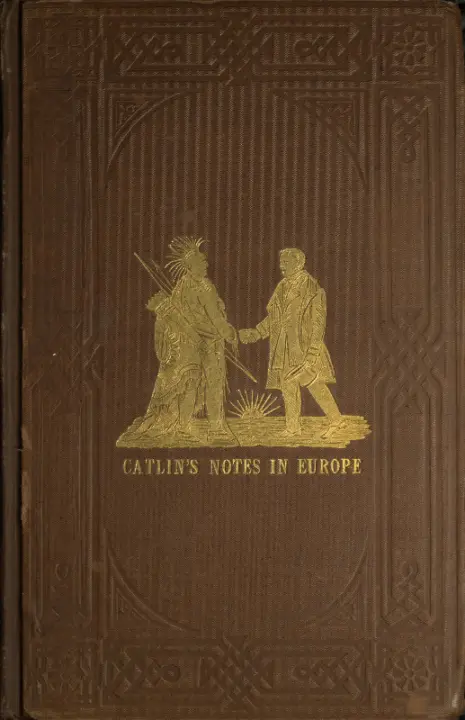
Adventures of the Ojibbeway and Ioway Indians in England, France, and Belgium; Vol. 2 (of 2) being Notes of Eight Years’ Travels and Residence in Europe with his North American Indian Collection
George Catlin
THE CLASSIC COLLECTION · 1852
"Adventures of the Ojibbeway and Ioway Indians in England, France, and Belgium" by George Catlin is a historical account written in the mid-19th century. The book chronicles Catlin's experiences and observations during his travels across Europe with his Indian collection, highlighting interactions between Native Americans and European society. It aims to provide a deeper understanding of North American Indian culture while documenting the perspectives of both the indigenous people and the European aristocracy. The opening of the book sets the stage for Catlin's journey, recapping his earlier experiences among Native American tribes and detailing his transatlantic voyage with two grizzly bears, which adds both humor and intrigue. As he arrives in England, Catlin describes the arrival of the bears amidst public excitement, as well as his intentions to showcase his extensive collection of Native American artifacts. He reflects on the various accidents and cultural misunderstandings he encounters during this impactful period in his travels, establishing a tone of lively adventure that promises readers a vivid exploration of the contrasts between indigenous and civilized life.
Introduction adapted from the source catalogue; source summaries may be automatically generated.
Free to read · English · 113,465 words · No account needed
MAKE TIME FOR A GOOD BOOK
On by default. Untick to stop anonymous reading totals. Each page counts after 10 seconds in view. How this works.
Anonymous counting is on unless you have switched it off.
This boy and girl, who had been for several years prisoners amongst the Osages, were purchased by the Indian Commissioner; the girl was sent home to her nation by the dragoons, and the boy was killed by a ram the day before we started. They were brother and sister.
A small tribe, living near to, and under the protection of, the Pawnee Picts, speaking an unknown language; probably the remnant of a tribe conquered and enslaved by the Pawnee Picts.
68. U'sh-ee-kitz, He who fights with a Feather. Chief of the
tribe.
This man came into Fort Gibson with the dragoons; he was famous for a custom he observed after all his speeches, of embracing the officers and chiefs in council.
This is one of the most numerous and powerful tribes at present existing on the continent, numbering, undoubtedly, some 40,000, occupying a vast tract of country on the upper waters of the Mississippi and Missouri rivers, and extending quite to the base of the Rocky Mountains. They live in skin lodges, and move them about the prairies, without any permanent residence. This tribe lost about 8000 by smallpox a few years since.
69. Ha-wón-je-tah, the One Horn; first Chief of the tribe; Mee-ne-cow-e-gee band, Upper Missouri; hair tied on his head in form of a turban, and filled with glue and red earth, or vermilion.
The Sioux have forty-one bands; every band has a chief, and this
man was head of all: he has been recently killed by a buffalo-bull.
#/
70. Wá-nah-de-túnk-ah, the Big Eagle, or Black Dog; at the Falls of St. Anthony. Chief of the O-hah-has-ka-toh-y-an-te, or Long Avenue band.
71. Tchán-dee, Tobacco; second Chief of the nation, of the O-gla-la band, Upper Missouri.
72. Wán-ee-ton, ----; Chief of the Sus-se-ton band, Upper Missouri; full-length, in a splendid dress; head-dress of war-eagle's quills and ermine, and painted robe.
One of the most noted and dignified, as well as graceful chiefs of
the Sioux tribe.
73. Tóh-to-wah-kón-da-pee, the Blue Medicine; a noted "medicine-man," or doctor, at the St. Peter's, of the Ting-ta-to-ah band; with his medicine or mystery drum and rattle in his hands, his looking-glass on his breast, his rattle of antelope's hoofs, and drum of deer-skins.
These "medicine-men" are conjurers as well as physicians, paying their dernier visits to the sick, with their mysteries, endeavouring and pretending to cure by a charm.
Your reading position is saved on this browser. Take it to another device with a library code. Reading pages adapt to text, rather than matching a printed edition.
BEHIND THE BOOK
This eBook is for the use of anyone anywhere in the United States and most other parts of the world at no cost and with almost no restrictions whatsoever. You may copy it, give it away or re-use it under the terms of the Project Gutenberg License included with this eBook or online at www.gutenberg.org. If you are not located in the United States, you will have to check the laws of the country where you are located before using this eBook. Read the source licence.
The original source file, including credits and licence, is retained by this library. Request an original-format copy at no charge. Please include the book title and Project Gutenberg identifier #44776.
KEEP YOUR CURIOSITY GOING
Wilfrid Scawen Blunt
Wilfrid Scawen Blunt

E. W. (Edgar Watson) Howe
Cécile Tormay

Moritz Busch
John L. Ransom