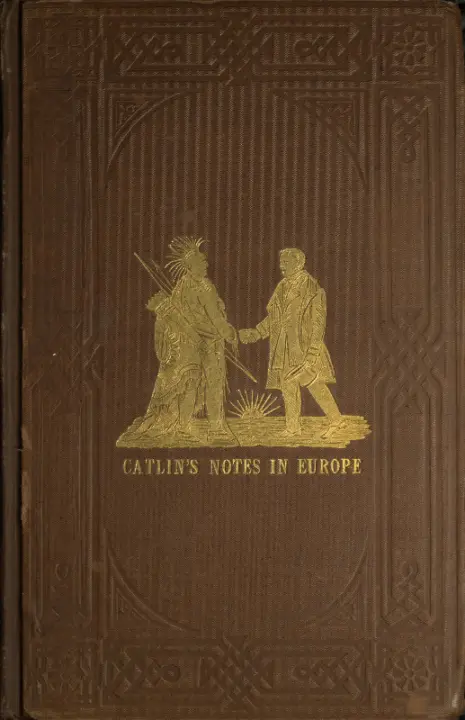
Adventures of the Ojibbeway and Ioway Indians in England, France, and Belgium; Vol. 2 (of 2) being Notes of Eight Years’ Travels and Residence in Europe with his North American Indian Collection
George Catlin
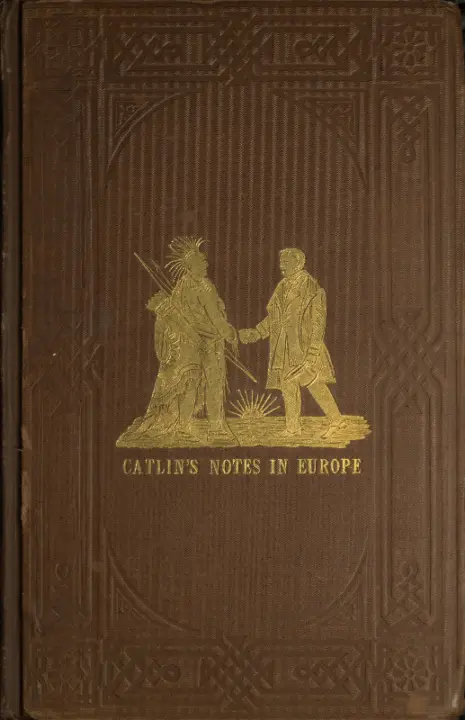
THE CLASSIC COLLECTION · 1852
"Adventures of the Ojibbeway and Ioway Indians in England, France, and Belgium" by George Catlin is a historical account written in the mid-19th century. The book chronicles Catlin's experiences and observations during his travels across Europe with his Indian collection, highlighting interactions between Native Americans and European society. It aims to provide a deeper understanding of North American Indian culture while documenting the perspectives of both the indigenous people and the European aristocracy. The opening of the book sets the stage for Catlin's journey, recapping his earlier experiences among Native American tribes and detailing his transatlantic voyage with two grizzly bears, which adds both humor and intrigue. As he arrives in England, Catlin describes the arrival of the bears amidst public excitement, as well as his intentions to showcase his extensive collection of Native American artifacts. He reflects on the various accidents and cultural misunderstandings he encounters during this impactful period in his travels, establishing a tone of lively adventure that promises readers a vivid exploration of the contrasts between indigenous and civilized life.
Introduction adapted from the source catalogue; source summaries may be automatically generated.
Free to read · English · 113,465 words · No account needed
MAKE TIME FOR A GOOD BOOK
On by default. Untick to stop anonymous reading totals. Each page counts after 10 seconds in view. How this works.
Anonymous counting is on unless you have switched it off.
By the violence of the concussion I had been landed in the street, and the gentleman, to whose harness I had done some injury, was suddenly in front of me with his whip in his hand; and in the hearing of the crowd that was hovering around, in the most excited manner, demanding of me what I meant by driving against him in that awkward manner, and threatening to hold me responsible for damages done by not turning the right way, whilst I felt every disposition to answer his questions respectfully, as I saw the injury was all on his side. I still felt that a little tenacity was allowable on my side; and I almost as peremptorily demanded of him why he did not rein to the right, as the law requires:--"Rein to the right!" said he, "who the devil ever heard of such a thing as turning to the right? Where are you from, I should like to know?" "I am from a country, sir, where the law directs all vehicles to 'turn to the right.'" "What country is that, I should like to know?" "North America, sir." "Ha! just about what I should have thought, sir:--I suppose I shall get pay for my coupling-lines about the time the States pay interest." "Most likely," said I, as we were mutually taking our seats, amidst the sullen remarks that I heard in various parts of the crowd as I was driving off--"There's a Yankee for you!--ee's a rum-looking fellow, ha?--There's a Repudiator for you"--"I'll be bound--" &c., &c., &c.
I drove off from this scene with some satisfaction that I had learned so important a fact at so little expense, and steered my way very safely amidst the thousands of vehicles of various sorts that I was passing and meeting, in which time I was very pleasantly receiving a brief lecture on the subject from my good-natured and very civil footman, who was behind me; in which (having silently learned in the disaster we had just witnessed that I was from a foreign country) he took especial pains to explain to me that "in Hengland it's holays the abit to turn to the left." Just at that moment I found myself in a fresh difficulty, and some danger also, by one wheel of my chaise grinding against the curbstone, and a huge omnibus in full press against us, and driving us on to the pavement, where it had at that moment stopped and fastened us, whilst discharging a passenger. I demanded of the driver, a sullen-looking fellow, half covered with an apron or boot which protected him from the weather in front, and something like a feather-bed and bolsters tied around his neck and chin, and half concealing his bloated face, what he meant by reining in upon me in that way, and crowding me upon the pavement? to which he grumly replied as he snapped his whip, "I should like to know what business you have in there?" "Never mind," said I, "I shall go ahead." "No you woan't--ain't you old enough to know which side of a carriage to pass?" At that moment the conductor of the omnibus cried out "All right!" which was echoed by a policeman who had taken my horse by the bit. I was somewhat relieved, though a little surprised, at the verdict given by the conductor and the policeman at the same instant, that "all" (or both), as I at that moment understood it, "were right." I sat still of course till the omnibus had left us, nearly crushed, but luckily not damaged, when I said to my footman, "Why, what does this mean?--what do you call the 'left side' in this country, I should like to know?" To this he very distinctly as well as amusingly explained, that the invariable custom in England is when meeting a vehicle, to turn to the left, and when passing, to turn to the right. But why did the policeman and the conductor say we were both right or "all right?" "Why, sir, you know wen the homnibus olds up to land a gent or a lady, or to take em hin, it would be wery hawkard to drive off wen the lady ad one leg hin the bus and the other hout; so wen they are both hout or both hin, and all right, the conductor ollows out 'Holl right!' and the bus goes hon, d'ye see, sir?" "Ah, yes, I thank you, Jerry, I understand it now." I was then growing wiser every moment amongst the incidents that were occasionally taking place in my drives with the goodnatured footman and his fine horse, which I used for several days, much to my satisfaction and amusement, without other accident or incident worth the reader's valuable time.
Your reading position is saved on this browser. Take it to another device with a library code. Reading pages adapt to text, rather than matching a printed edition.
BEHIND THE BOOK
This eBook is for the use of anyone anywhere in the United States and most other parts of the world at no cost and with almost no restrictions whatsoever. You may copy it, give it away or re-use it under the terms of the Project Gutenberg License included with this eBook or online at www.gutenberg.org. If you are not located in the United States, you will have to check the laws of the country where you are located before using this eBook. Read the source licence.
The original source file, including credits and licence, is retained by this library. Request an original-format copy at no charge. Please include the book title and Project Gutenberg identifier #44776.
KEEP YOUR CURIOSITY GOING
Wilfrid Scawen Blunt
Wilfrid Scawen Blunt

E. W. (Edgar Watson) Howe
Cécile Tormay

Moritz Busch
John L. Ransom