THE CLASSIC COLLECTION✦A tragedy of love and hateCLASSIC FREE BOOKS
A tragedy of love and hate
Bertha M. Clay
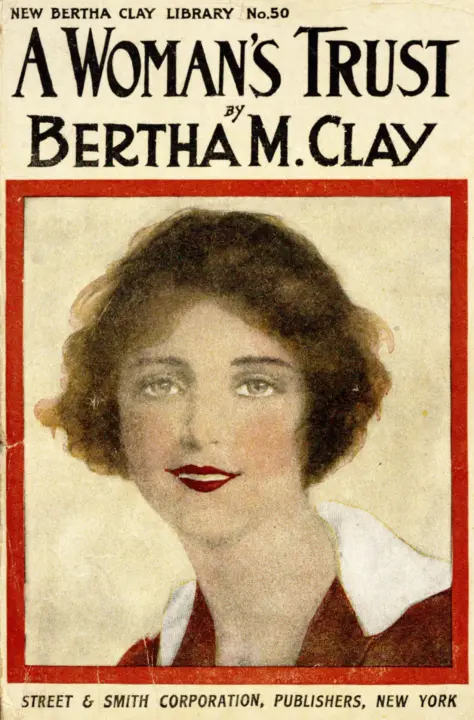
THE CLASSIC COLLECTION · 1900
"A Woman's Trust; or, Lady Elaine's Martyrdom" by Bertha M. Clay is a novel written in the early 20th century. The story revolves around the emotional entanglements and trials of Lady Elaine Seabright and Sir Harold Annesley as they navigate love, jealousy, and betrayal. Central themes include the challenges of romantic relationships and the societal expectations of the time. The opening of the novel introduces Lady Elaine, who has recently accepted Sir Harold's proposal after an intense and swift courtship. However, as their engagement progresses, the couple faces turmoil fueled by jealousy and misunderstandings, particularly surrounding Lady Elaine's interactions with other suitors, notably Viscount Rivington. The characters are set against a backdrop of social expectations and personal desires, landing them in emotional conflicts that could threaten their future together. An emotional climactic moment occurs when Sir Harold hears rumors of Lady Elaine's prior engagement with Rivington, leading him to doubt her loyalty and causing him to consider ending the relationship in despair.
Introduction adapted from the source catalogue; source summaries may be automatically generated.
Free to read · English · 62,142 words · No account needed
MAKE TIME FOR A GOOD BOOK
On by default. Untick to stop anonymous reading totals. Each page counts after 10 seconds in view. How this works.
Anonymous counting is on unless you have switched it off.
He had been provided with plenty of books and cigars; but neither afforded him any pleasure now, and he wandered out of the garden into the lane beyond.
How many weeks had he been confined within the cottage and its environs? Six or seven? He could not remember exactly, and now the idea for viewing the country beyond seized upon him like an inspiration.
If he should chance to meet people who remembered him, what did it matter? He was a free agent. But there was little likelihood of that, and he strode away, interested in every new object that met his view.
When a sense of weariness began to creep over him, he knew that he must have walked half-a-dozen miles. He looked at his watch. It was eleven when he left the cottage, and now the hands pointed to the hour of one.
Half-a-mile away there was a town perched upon the side of a hill.
“I will get refreshments there,” he thought, “and then hasten back. Theresa will wonder what has become of me.”
He went into the town, and pulled his hat over his eyes like a man who has committed some crime. The people whom he met stared curiously after him. His was no common, everyday figure.
At last he turned into a public house, and, walking into a little parlor, the door of which was held invitingly open by a trim-looking maid, he called for a glass of ale and some biscuits.
“This is Farnwell, is it not?” he presently inquired.
“Yes, sir,” replied the girl.
He was about to express his astonishment at the number of alterations that had taken place in an amazingly short space of time, when he remembered his accident.
“I have not been here for a long time,” he explained, “and everything seems quite strange. Who is the landlord now?”
“Mr. Fletcher, sir.”
“Fletcher? Oh, I do not remember him. I suppose that the house has
recently changed hands?”
“Not for ten years, sir,” the maid replied.
“Of course; I had forgotten my long absence. A very nice and quiet
town, is it not?”
He turned to a newspaper that lay near him, hoping that the girl would take the hint and retire; but it was not often that so handsome a gentleman talked to her, and she endeavored to continue the conversation.
“Yes, very quiet,” she said; “rather too quiet to my liking, sir, though, of course, we do get a bit of sensation sometimes in connection with the gentry. Now, the best bit for years is the disappearance of Sir Harold Annesley, and everybody is talking about it.”
Your reading position is saved on this browser. Take it to another device with a library code. Reading pages adapt to text, rather than matching a printed edition.
BEHIND THE BOOK
This eBook is for the use of anyone anywhere in the United States and most other parts of the world at no cost and with almost no restrictions whatsoever. You may copy it, give it away or re-use it under the terms of the Project Gutenberg License included with this eBook or online at www.gutenberg.org. If you are not located in the United States, you will have to check the laws of the country where you are located before using this eBook. Read the source licence.
The original source file, including credits and licence, is retained by this library. Request an original-format copy at no charge. Please include the book title and Project Gutenberg identifier #74270.
KEEP YOUR CURIOSITY GOING
Coulson Kernahan

Maurice Baring
Frances Wright
Cécile Tormay

Frederic Jesup Stimson

W. H. P. (William Henry Pope) Jarvis