THE CLASSIC COLLECTION✦A tragedy of love and hateCLASSIC FREE BOOKS
A tragedy of love and hate
Bertha M. Clay
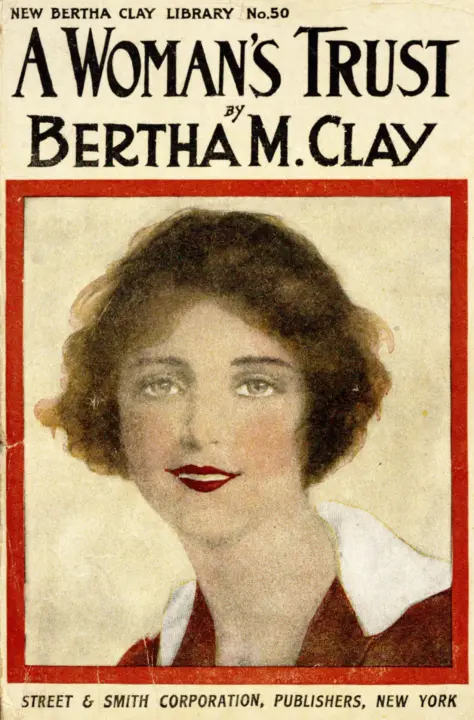
THE CLASSIC COLLECTION · 1900
"A Woman's Trust; or, Lady Elaine's Martyrdom" by Bertha M. Clay is a novel written in the early 20th century. The story revolves around the emotional entanglements and trials of Lady Elaine Seabright and Sir Harold Annesley as they navigate love, jealousy, and betrayal. Central themes include the challenges of romantic relationships and the societal expectations of the time. The opening of the novel introduces Lady Elaine, who has recently accepted Sir Harold's proposal after an intense and swift courtship. However, as their engagement progresses, the couple faces turmoil fueled by jealousy and misunderstandings, particularly surrounding Lady Elaine's interactions with other suitors, notably Viscount Rivington. The characters are set against a backdrop of social expectations and personal desires, landing them in emotional conflicts that could threaten their future together. An emotional climactic moment occurs when Sir Harold hears rumors of Lady Elaine's prior engagement with Rivington, leading him to doubt her loyalty and causing him to consider ending the relationship in despair.
Introduction adapted from the source catalogue; source summaries may be automatically generated.
Free to read · English · 62,142 words · No account needed
MAKE TIME FOR A GOOD BOOK
On by default. Untick to stop anonymous reading totals. Each page counts after 10 seconds in view. How this works.
Anonymous counting is on unless you have switched it off.
John Hamilton’s cottage was one of the prettiest of its kind. It was built of brown stone, and seemed to be a combination of nooks and gables. To the doors, both at the back and the front, there was a trellised porch, wreathed with trailing vines, roses and sweet-smelling clematis. On every window-sill there was a box of bright-hued flowers and fragrant mignonette, while the garden that surrounded the house was a veritable maze of bewildering beauty.
At the farther end was a summer arbor, and there Sir Harold spent many happy hours, a cigar between his teeth and a book in his hands.
Sometimes he would dream lazily, and try to think of the mystery of his life, but always gave up these efforts with a sigh.
John Hamilton and his daughter attended to the household duties, and the labor was equally divided. No stranger ever crossed the threshold of the little cottage door.
Sir Harold would watch the girl in wonderment, and listen with rapture to her sweet singing as she worked about the house.
Oh, how happy she was, though at times a great black cloud would rise before her, and she would clutch at her heart to still its agony!
When her work was done, her sweetest delight was to sit near to Sir Harold, and drink in eagerly every word that he uttered.
John Hamilton saw all this, and frowned, but he felt that he was
helpless at present.
One day he spoke harshly to his daughter, and she listened half-ashamed.
“Theresa,” he said, “you must not seek the society of our guest so much, or I shall send him away.”
The girl started, and a swift blush leaped into her cheeks.
“Father!”
“Do you not understand that your conduct is unbecoming a lady?” he
continued.
“What have I done?” murmured Theresa.
“You are wasting your thoughts upon a stranger, my dear,” he said. “I can see it in your eyes. You are not so much to blame for this, because you are purely a child of Nature, but it will be best if Sir Harold Annesley is left more to himself.”
“Oh, father, must this be?” cried Theresa. “Must I not speak to him again? Must I not listen to his reading while I work? It is like heaven to me! I never understood the meaning of life until he came here!”
She rocked herself to and fro bitterly.
“I wish that he had never crossed our path,” he returned, harshly. “You are in love with this man!”
He was very angry--as much with himself and Sir Harold as with his daughter--and left the room determined to speak to the baronet.
Your reading position is saved on this browser. Take it to another device with a library code. Reading pages adapt to text, rather than matching a printed edition.
BEHIND THE BOOK
This eBook is for the use of anyone anywhere in the United States and most other parts of the world at no cost and with almost no restrictions whatsoever. You may copy it, give it away or re-use it under the terms of the Project Gutenberg License included with this eBook or online at www.gutenberg.org. If you are not located in the United States, you will have to check the laws of the country where you are located before using this eBook. Read the source licence.
The original source file, including credits and licence, is retained by this library. Request an original-format copy at no charge. Please include the book title and Project Gutenberg identifier #74270.
KEEP YOUR CURIOSITY GOING
Coulson Kernahan

Maurice Baring
Frances Wright
Cécile Tormay

Frederic Jesup Stimson

W. H. P. (William Henry Pope) Jarvis