THE CLASSIC COLLECTION✦A tragedy of love and hateCLASSIC FREE BOOKS
A tragedy of love and hate
Bertha M. Clay
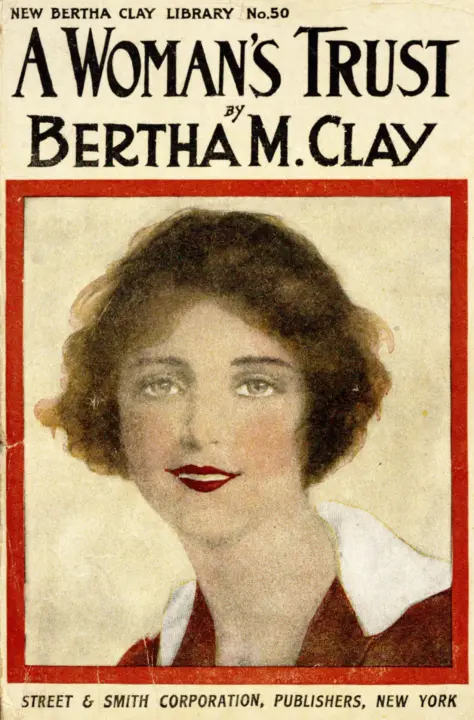
THE CLASSIC COLLECTION · 1900
"A Woman's Trust; or, Lady Elaine's Martyrdom" by Bertha M. Clay is a novel written in the early 20th century. The story revolves around the emotional entanglements and trials of Lady Elaine Seabright and Sir Harold Annesley as they navigate love, jealousy, and betrayal. Central themes include the challenges of romantic relationships and the societal expectations of the time. The opening of the novel introduces Lady Elaine, who has recently accepted Sir Harold's proposal after an intense and swift courtship. However, as their engagement progresses, the couple faces turmoil fueled by jealousy and misunderstandings, particularly surrounding Lady Elaine's interactions with other suitors, notably Viscount Rivington. The characters are set against a backdrop of social expectations and personal desires, landing them in emotional conflicts that could threaten their future together. An emotional climactic moment occurs when Sir Harold hears rumors of Lady Elaine's prior engagement with Rivington, leading him to doubt her loyalty and causing him to consider ending the relationship in despair.
Introduction adapted from the source catalogue; source summaries may be automatically generated.
Free to read · English · 62,142 words · No account needed
MAKE TIME FOR A GOOD BOOK
On by default. Untick to stop anonymous reading totals. Each page counts after 10 seconds in view. How this works.
Anonymous counting is on unless you have switched it off.
Never until Sir Harold Annesley came into her life had Theresa Hamilton understood the ecstatic joy of living. The songs of the birds were tuned afresh, the flowers took on a newer bloom, and the bees that buzzed in the blossoming garden told but one story, and its name was Love--beautiful Love!
In a few short weeks she had changed from a girl into a woman, and the soft, happy light that shone in her glorious, Southern eyes told its own story.
And now that Mr. Hamilton had given his consent to Sir Harold’s wooing, he became aware that Theresa wanted new frocks, and things of which most girls are proud.
One day he called her to him.
“My darling,” he said, kissing her tenderly, “in one way I have been very unkind to you, and you have never once complained.”
She looked at him wonderingly.
“You do not understand me, Theresa?”
“No, father; because I do not know the meaning of unkindness. You have ever striven hard to teach me all those accomplishments that are so essential to women of refinement. I never knew their value until----”
She hesitated, and he asked:
“Until when, Theresa?”
“Until Sir Harold expressed his pleasure and surprise,” she replied, blushing vividly and burying her face on his shoulder.
“Theresa,” her father went on, “I will tell you how I have been unkind, though my motives in all things concerning you have been actuated by my keen desire to leave you in some way provided for. Have you ever wanted nicer frocks and boots, and all those little fineries that add a charm to woman’s dress?”
“No, but I should like them now,” she replied, naïvely, “only that I
know we are poor.”
“Then you shall have them,” he promised her, with a sparkle of triumph in his eyes. “I have a little money put away, Theresa--a little hoard of gold which I have saved for you. What do you say to going with me to one of the big towns and choosing all that you require?”
She clapped her hands gleefully. “I wonder what Sir Harold will think of me then,” she laughed.
It was always Sir Harold first with her now, and her father smiled
indulgently.
“Well, Theresa, is it settled? I am feeling better to-day than I have for years. A burden seems to have been lifted from about me.”
“Oh, father, I am so happy! Is it much money that you have saved--very
much?”
“Enough for present needs, Theresa, and I have dreamed of buying this little house in which to spend the evening of my life, but it may not be needed now.”
Your reading position is saved on this browser. Take it to another device with a library code. Reading pages adapt to text, rather than matching a printed edition.
BEHIND THE BOOK
This eBook is for the use of anyone anywhere in the United States and most other parts of the world at no cost and with almost no restrictions whatsoever. You may copy it, give it away or re-use it under the terms of the Project Gutenberg License included with this eBook or online at www.gutenberg.org. If you are not located in the United States, you will have to check the laws of the country where you are located before using this eBook. Read the source licence.
The original source file, including credits and licence, is retained by this library. Request an original-format copy at no charge. Please include the book title and Project Gutenberg identifier #74270.
KEEP YOUR CURIOSITY GOING
Coulson Kernahan

Maurice Baring
Frances Wright
Cécile Tormay

Frederic Jesup Stimson

W. H. P. (William Henry Pope) Jarvis