THE CLASSIC COLLECTION✦A tragedy of love and hateCLASSIC FREE BOOKS
A tragedy of love and hate
Bertha M. Clay
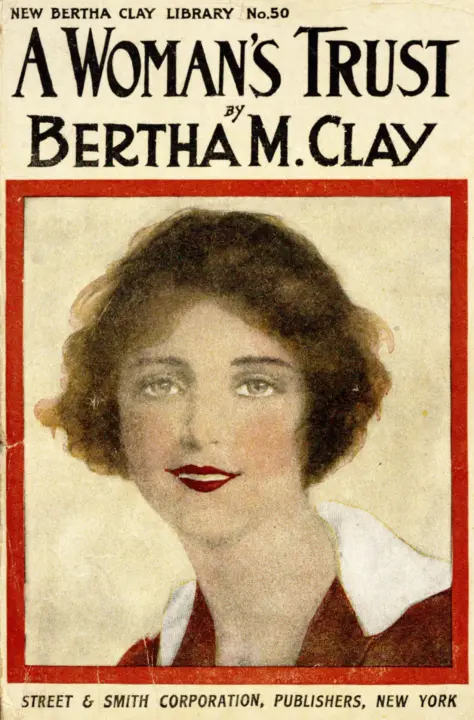
THE CLASSIC COLLECTION · 1900
"A Woman's Trust; or, Lady Elaine's Martyrdom" by Bertha M. Clay is a novel written in the early 20th century. The story revolves around the emotional entanglements and trials of Lady Elaine Seabright and Sir Harold Annesley as they navigate love, jealousy, and betrayal. Central themes include the challenges of romantic relationships and the societal expectations of the time. The opening of the novel introduces Lady Elaine, who has recently accepted Sir Harold's proposal after an intense and swift courtship. However, as their engagement progresses, the couple faces turmoil fueled by jealousy and misunderstandings, particularly surrounding Lady Elaine's interactions with other suitors, notably Viscount Rivington. The characters are set against a backdrop of social expectations and personal desires, landing them in emotional conflicts that could threaten their future together. An emotional climactic moment occurs when Sir Harold hears rumors of Lady Elaine's prior engagement with Rivington, leading him to doubt her loyalty and causing him to consider ending the relationship in despair.
Introduction adapted from the source catalogue; source summaries may be automatically generated.
Free to read · English · 62,142 words · No account needed
MAKE TIME FOR A GOOD BOOK
On by default. Untick to stop anonymous reading totals. Each page counts after 10 seconds in view. How this works.
Anonymous counting is on unless you have switched it off.
“My dear love!” she murmured. “I feel that I have misjudged you. I will never bother you again with my silly caprices. Oh, how bright and beautiful the world seems, now that my king will soon be with me again!”
She drew before her a pearl-enameled writing desk, and, having opened
it, penned the following:
MY DARLING HAROLD--Can you ever forgive me for being so cruel to you? I have myself suffered agonies that words cannot paint. Come back to me, my love! I will confess that I detest Viscount Rivington, and promise you that in future your wishes shall be my law. My pride is humbled to the dust, and you will never be jealous of me again. I can write no more; only come to me! Forever your own.
She wrote the loving words with glowing cheeks and eyes beaming with happiness. Then she sealed up the letter, and kissed it again and again.
“Nina, my trusty maid, shall take this to my lover,” she thought, “and while she is gone I will tell Margaret that my troubles are ended.”
She was awakened from a blissful reverie by the return of her maid, with Margaret Nugent following close behind.
“I declare,” exclaimed Miss Nugent, “it is a positive relief to find that there is nothing seriously wrong. Nina was so urgent, so mysterious, that I began to anticipate all sorts of awful possibilities; and here you are looking perfectly happy, Lady Elaine.”
Margaret’s dark eyes promptly took in the situation, as she swept into my lady’s boudoir, while Nina retired to another room.
“You are right, Margaret; I am happier than I have been for days and days,” Lady Elaine said. “And it is really very kind of you to bother with my foolish troubles. I can never forget your sympathy and kindness.” Then she told Miss Nugent all, concluding:
“You advised me for the best, but my pride is broken. I can live no longer without my lover.”
Margaret was almost bewildered by the shock.
“You have astonished me,” she said, at last. “I can scarcely realize that the proud daughter of a hundred earls can possibly become so meek. But, then, we are all forced to acknowledge that man is lord of creation, while we poor women are crushed into obedience.”
She tried to laugh, but it was a dismal failure.
“Oh, Elaine,” she added, a pang of bitterness at her heart, “I pity
your future!”
“I am not afraid,” the earl’s daughter replied, softly. “My faith, my love is too strong.”
Even now she did not for one moment suspect Margaret Nugent hated her as only a jealous woman can hate.
Your reading position is saved on this browser. Take it to another device with a library code. Reading pages adapt to text, rather than matching a printed edition.
BEHIND THE BOOK
This eBook is for the use of anyone anywhere in the United States and most other parts of the world at no cost and with almost no restrictions whatsoever. You may copy it, give it away or re-use it under the terms of the Project Gutenberg License included with this eBook or online at www.gutenberg.org. If you are not located in the United States, you will have to check the laws of the country where you are located before using this eBook. Read the source licence.
The original source file, including credits and licence, is retained by this library. Request an original-format copy at no charge. Please include the book title and Project Gutenberg identifier #74270.
KEEP YOUR CURIOSITY GOING
Coulson Kernahan

Maurice Baring
Frances Wright
Cécile Tormay

Frederic Jesup Stimson

W. H. P. (William Henry Pope) Jarvis