THE CLASSIC COLLECTION✦A tragedy of love and hateCLASSIC FREE BOOKS
A tragedy of love and hate
Bertha M. Clay
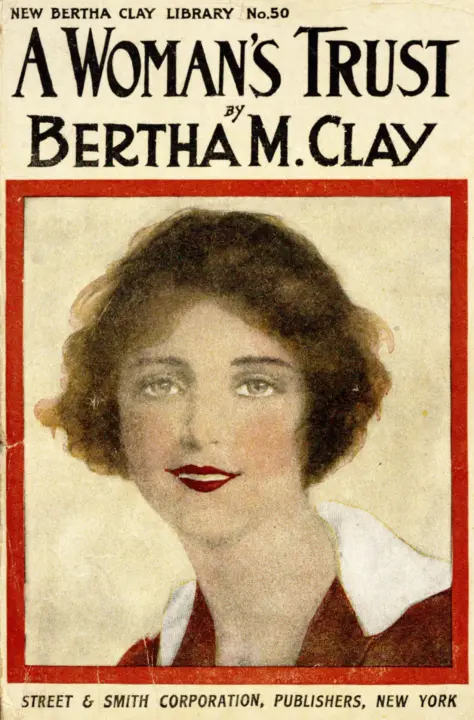
THE CLASSIC COLLECTION · 1900
"A Woman's Trust; or, Lady Elaine's Martyrdom" by Bertha M. Clay is a novel written in the early 20th century. The story revolves around the emotional entanglements and trials of Lady Elaine Seabright and Sir Harold Annesley as they navigate love, jealousy, and betrayal. Central themes include the challenges of romantic relationships and the societal expectations of the time. The opening of the novel introduces Lady Elaine, who has recently accepted Sir Harold's proposal after an intense and swift courtship. However, as their engagement progresses, the couple faces turmoil fueled by jealousy and misunderstandings, particularly surrounding Lady Elaine's interactions with other suitors, notably Viscount Rivington. The characters are set against a backdrop of social expectations and personal desires, landing them in emotional conflicts that could threaten their future together. An emotional climactic moment occurs when Sir Harold hears rumors of Lady Elaine's prior engagement with Rivington, leading him to doubt her loyalty and causing him to consider ending the relationship in despair.
Introduction adapted from the source catalogue; source summaries may be automatically generated.
Free to read · English · 62,142 words · No account needed
MAKE TIME FOR A GOOD BOOK
On by default. Untick to stop anonymous reading totals. Each page counts after 10 seconds in view. How this works.
Anonymous counting is on unless you have switched it off.
To his surprise it was opened at once, and his master took the card with an exclamation of impatience.
“I told you not to disturb me, Stimson,” he said, harshly.
“But you never refuse to see the colonel, Sir Harold, and I felt
anxious about you.”
Stimson was a privileged servant. He had traveled over half the globe with his young master, and had nursed him through the yellow fever in an African swamp.
“You are ill, master, I am sure.”
“Ill?” echoed Sir Harold. “No, I am not ill. I wish to heaven that I were sick unto death!”
It was a strange speech, but Stimson pretended not to notice it. He
merely said:
“You will see Colonel Greyson, Sir Harold?”
“Yes, I will see him here, in my study,” was the gloomy reply, and when Stimson had gone he added:
“He it was who introduced us, and who more fitting to be the first to hear that we are parted forever?”
Then the colonel’s bluff tones fell upon his ears; and he felt his hand
being shaken warmly.
“I have not seen much of you for weeks, my boy,” he was saying; “but suddenly determined to make an assault upon you. In your bower of bliss, presided over by I don’t know how many Cupids, you seem to forget that you are necessary, to a small extent at least, to your neighbors.”
Every word was like the stab of a knife, and Sir Harold, his heart too full for words, made a deprecatory gesture.
However, the colonel went on without noticing the agony of his young friend. The study was a dark room at any time, when no artificial light was used, and Colonel Greyson was notoriously short-sighted.
“Yes, my boy, we are organizing a steeplechase. Now, don’t tell me that you cannot ride, or that you have other engagements. You must have a little consideration for the county. I want you to become even more popular than you are already, and we may yet run you for a seat in the House.”
“Colonel,” broke in Sir Harold, “why will you torture me in this way?”
His voice was so harsh that the old soldier promptly pulled himself up, and began to search for his eyeglasses.
“Torture you, eh? Egad, what is wrong with the boy? Confound it, sir, what is the trouble? You, whom I account one of the most fortunate men of the century, talking of torture!
Your reading position is saved on this browser. Take it to another device with a library code. Reading pages adapt to text, rather than matching a printed edition.
BEHIND THE BOOK
This eBook is for the use of anyone anywhere in the United States and most other parts of the world at no cost and with almost no restrictions whatsoever. You may copy it, give it away or re-use it under the terms of the Project Gutenberg License included with this eBook or online at www.gutenberg.org. If you are not located in the United States, you will have to check the laws of the country where you are located before using this eBook. Read the source licence.
The original source file, including credits and licence, is retained by this library. Request an original-format copy at no charge. Please include the book title and Project Gutenberg identifier #74270.
KEEP YOUR CURIOSITY GOING
Coulson Kernahan

Maurice Baring
Frances Wright
Cécile Tormay

Frederic Jesup Stimson

W. H. P. (William Henry Pope) Jarvis