THE CLASSIC COLLECTION✦A tragedy of love and hateCLASSIC FREE BOOKS
A tragedy of love and hate
Bertha M. Clay
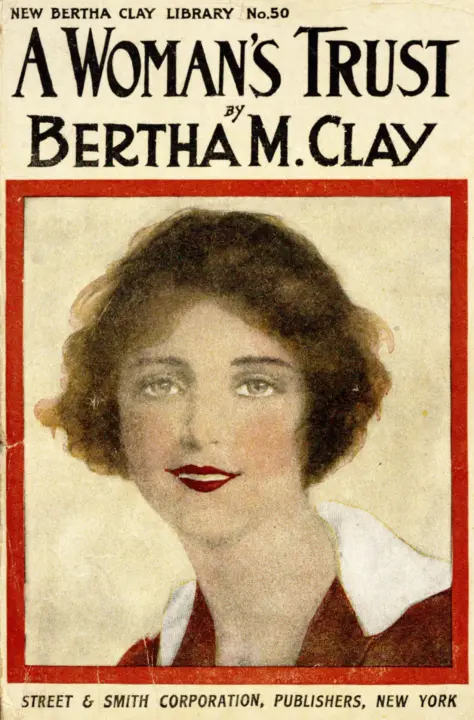
THE CLASSIC COLLECTION · 1900
"A Woman's Trust; or, Lady Elaine's Martyrdom" by Bertha M. Clay is a novel written in the early 20th century. The story revolves around the emotional entanglements and trials of Lady Elaine Seabright and Sir Harold Annesley as they navigate love, jealousy, and betrayal. Central themes include the challenges of romantic relationships and the societal expectations of the time. The opening of the novel introduces Lady Elaine, who has recently accepted Sir Harold's proposal after an intense and swift courtship. However, as their engagement progresses, the couple faces turmoil fueled by jealousy and misunderstandings, particularly surrounding Lady Elaine's interactions with other suitors, notably Viscount Rivington. The characters are set against a backdrop of social expectations and personal desires, landing them in emotional conflicts that could threaten their future together. An emotional climactic moment occurs when Sir Harold hears rumors of Lady Elaine's prior engagement with Rivington, leading him to doubt her loyalty and causing him to consider ending the relationship in despair.
Introduction adapted from the source catalogue; source summaries may be automatically generated.
Free to read · English · 62,142 words · No account needed
MAKE TIME FOR A GOOD BOOK
On by default. Untick to stop anonymous reading totals. Each page counts after 10 seconds in view. How this works.
Anonymous counting is on unless you have switched it off.
“It is my last throw,” he thought, “and I must keep my nerves steady. If I fail--exit! Pshaw! Why should I? The very alternative should give me confidence and strength.”
He left the cab at Oxford Circus, and strolled along in a leisurely manner until he reached a narrow court.
Here he paused momentarily, and glanced to the right and left. Again those eyes haunted him, but the man was not in the crowd. It was impossible.
Turning into the court, he walked, perhaps twenty paces, and then entered a foul-smelling hallway, almost as dark as night. He was evidently well acquainted with the place, for, without any hesitation, he stepped lightly up a flight of rickety stairs and knocked sharply at a door at the top.
It was opened by a middle-aged automaton, of powerful build, who stared
dully at the visitor.
“Is Mr. Isaacs within, Bulger?” inquired Rivington.
“Oh, it’s the viscount!” observed Bulger, after a full minute’s reflection. “Yes, sir, he’s in. Do you wish to see him?”
“Of course, Bulger; most important. Here is half-a-crown to expedite your movements, old man.”
Bulger took the coin between the dirty fingers of his right hand, and
smiled a wooden smile.
“Thank you, viscount. I hope you are able to settle with him now.”
He laid particular stress upon the word “now,” and Rivington understood that things looked pretty bad.
“Announce me,” was all he said, again caressing the spot where his
revolver lay hidden.
He watched the huge form of Bulger disappear within a farther room, and wondered why the man, who was by courtesy called the “clerk,” did not strangle the life out of old Isaacs.
Bulger reappeared, and beckoned to Rivington with one of his forefingers, supplementing this with a jerk of his thumb toward the room occupied by the money-lender.
The viscount went in, closed the door behind him, and dropped languidly into a chair, directly opposite an old man, whose features at once proclaimed him a Jew. He was attired in a greasy suit of black, which had evidently done duty for ten years, at least. His linen and flesh were equally as dirty as Mr. Bulger’s own, but, unlike his clerk, he wore a magnificent diamond ring upon one hooked finger. His nose was like the beak of a hawk, his eyes deep-set and close together, while his mouth was full and large, surrounded by a closely-cropped beard and mustache, as white as snow.
He glanced up at Rivington with a wolfish grin that disclosed two rows of broken, yellow teeth, and said in cackling tones:
Your reading position is saved on this browser. Take it to another device with a library code. Reading pages adapt to text, rather than matching a printed edition.
BEHIND THE BOOK
This eBook is for the use of anyone anywhere in the United States and most other parts of the world at no cost and with almost no restrictions whatsoever. You may copy it, give it away or re-use it under the terms of the Project Gutenberg License included with this eBook or online at www.gutenberg.org. If you are not located in the United States, you will have to check the laws of the country where you are located before using this eBook. Read the source licence.
The original source file, including credits and licence, is retained by this library. Request an original-format copy at no charge. Please include the book title and Project Gutenberg identifier #74270.
KEEP YOUR CURIOSITY GOING
Coulson Kernahan

Maurice Baring
Frances Wright
Cécile Tormay

Frederic Jesup Stimson

W. H. P. (William Henry Pope) Jarvis