THE CLASSIC COLLECTION✦A tragedy of love and hateCLASSIC FREE BOOKS
A tragedy of love and hate
Bertha M. Clay
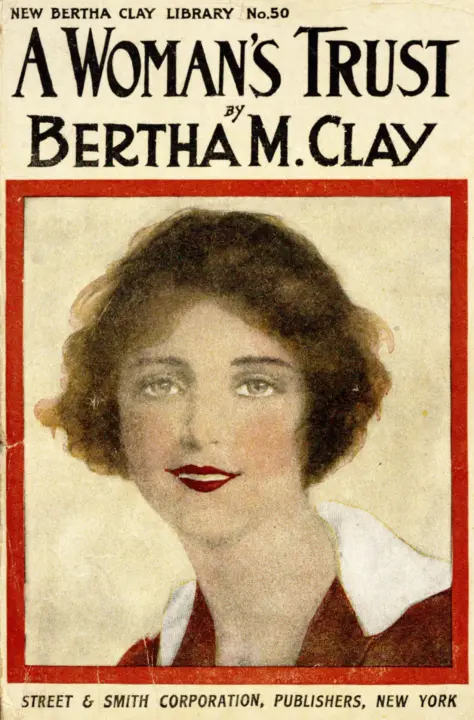
THE CLASSIC COLLECTION · 1900
"A Woman's Trust; or, Lady Elaine's Martyrdom" by Bertha M. Clay is a novel written in the early 20th century. The story revolves around the emotional entanglements and trials of Lady Elaine Seabright and Sir Harold Annesley as they navigate love, jealousy, and betrayal. Central themes include the challenges of romantic relationships and the societal expectations of the time. The opening of the novel introduces Lady Elaine, who has recently accepted Sir Harold's proposal after an intense and swift courtship. However, as their engagement progresses, the couple faces turmoil fueled by jealousy and misunderstandings, particularly surrounding Lady Elaine's interactions with other suitors, notably Viscount Rivington. The characters are set against a backdrop of social expectations and personal desires, landing them in emotional conflicts that could threaten their future together. An emotional climactic moment occurs when Sir Harold hears rumors of Lady Elaine's prior engagement with Rivington, leading him to doubt her loyalty and causing him to consider ending the relationship in despair.
Introduction adapted from the source catalogue; source summaries may be automatically generated.
Free to read · English · 62,142 words · No account needed
MAKE TIME FOR A GOOD BOOK
On by default. Untick to stop anonymous reading totals. Each page counts after 10 seconds in view. How this works.
Anonymous counting is on unless you have switched it off.
“But you do not know who this man is!” she said, shivering with a
deadly chill.
“I do not anticipate that he is an enemy,” he smiled. “Besides, Theresa, I am armed, and shall be merciless enough to shoot the foe like a mad dog!”
He pressed a kiss upon her brow, and noticed that it was moist and cold.
“The gentleman is here, Sir Harold,” Stimson announced, adding, in an undertone: “It is Viscount Rivington, sir.”
Annesley’s face flushed with fierce resentment. What business had the viscount with him? He paused, irresolute, then said, suddenly, “I will see him.”
With a fond glance of assurance toward Theresa, he stepped into the anteroom beyond, softly closing the door of the dining-room behind him.
“I have no doubt that you are somewhat surprised to see me here, Sir Harold Annesley,” Rivington said, in his smooth, bland tones, rising quickly from a seat in the corner next to the door. “You will not take my hand? Well, I cannot help it if you are determined to be unfriendly. I came to congratulate you upon your recent marriage, and the recovery of your memory, though I cannot say that either event has made you particularly robust or joyful in appearance!”
“What is your business with me?” Annesley demanded, steadily.
“I came as a friend--an old acquaintance,” Rivington said.
“I never recognized you as a friend, and I have no desire for your acquaintance, viscount,” was the cold reply. “Your impertinence would be amusing if it were not irritating.”
Rivington laughed sneeringly.
“Well, if you will not accept my friendship, I cannot help it,” he said. “I hate to be bad friends with any one.”
“Your friendship and enmity are equally indifferent to me,” retorted Annesley, raising his voice; “and I should advise you to retire, or my servant must show you the door. I have nothing in common with gamblers and blacklegs.”
He spoke so loudly that every word reached the ears of the trembling Theresa, and she crept near to the door, ready to push between her husband and the foe. It was not the detective; the man’s tones were strange to her. Who else was he but one of the fiends who was pursuing her with the relentless certainty of fate?
“A gambler and a blackleg, am I?” cried Rivington, his voice full of concentrated rage. “Well, granted that I am, I think that you are the last man on earth to preach morality, Sir Harold Annesley! To be plain with you, I am here to warn you against intriguing with women to whom you have no right! Pray remember, also, that you are a married man!”
“Scoundrel!”
Your reading position is saved on this browser. Take it to another device with a library code. Reading pages adapt to text, rather than matching a printed edition.
BEHIND THE BOOK
This eBook is for the use of anyone anywhere in the United States and most other parts of the world at no cost and with almost no restrictions whatsoever. You may copy it, give it away or re-use it under the terms of the Project Gutenberg License included with this eBook or online at www.gutenberg.org. If you are not located in the United States, you will have to check the laws of the country where you are located before using this eBook. Read the source licence.
The original source file, including credits and licence, is retained by this library. Request an original-format copy at no charge. Please include the book title and Project Gutenberg identifier #74270.
KEEP YOUR CURIOSITY GOING
Coulson Kernahan

Maurice Baring
Frances Wright
Cécile Tormay

Frederic Jesup Stimson

W. H. P. (William Henry Pope) Jarvis