THE CLASSIC COLLECTION✦An outlaw’s diary: the CommuneCLASSIC FREE BOOKS
An outlaw’s diary: the Commune
Cécile Tormay
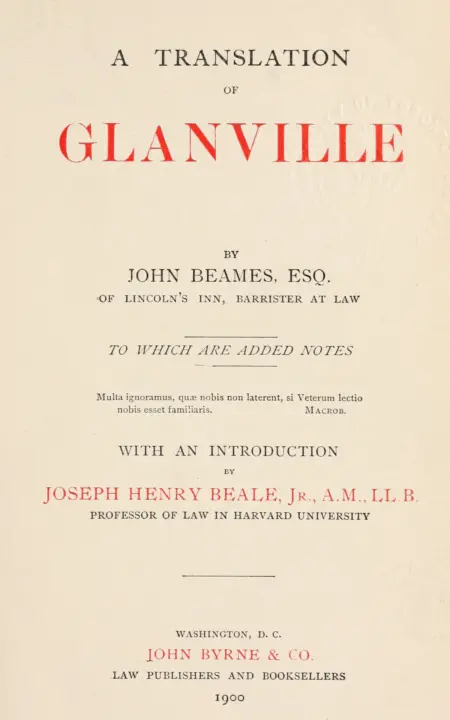
THE CLASSIC COLLECTION · 1900
"A translation of Glanville" by Ranulf de Glanville is a legal treatise written between 1187-1189. This groundbreaking work systematically codified English law for the first time, defining legal processes and introducing writs that remain influential today. Written for Henry II after years of chaos, it served as the foundation of English common law. The treatise consists of fourteen books covering jurisdictions and procedures in the King's Court, fundamentally transforming how justice was administered throughout the kingdom.
Introduction adapted from the source catalogue; source summaries may be automatically generated.
Free to read · English · 91,270 words · No account needed
MAKE TIME FOR A GOOD BOOK
On by default. Untick to stop anonymous reading totals. Each page counts after 10 seconds in view. How this works.
Anonymous counting is on unless you have switched it off.
[Footnote 144: Proclamat, according to the Bodl. MS., which I follow, proclamo, appello, provoco, &c. (Spelm. Gloss. ad voc.)]
[Footnote 145: “Yet,” says the Mirror, “if the Defendant can shew a free stock of his Ancestors, either in the conception, or in the birth, the Defendant hath always been accounted for a freeman, although his Father, Mother, Brother, and Cousins, and all his Parentage, acknowledge themselves to be the Plaintiff’s Villeins, and do testify the Defendant to be a Villein.” (Mirror, c. 3. s. 23.)
We must suppose that this was an improvement posterior to the time of Glanville, since though some part of the Mirror was probably written before the conquest, the other part was written subsequently to the Reign of Henry the 2nd. Few ancient law books would perhaps stand higher than the Mirror, could we clearly ascertain what was original, what was superadded. At present, one part of the work is often a direct refutation of another part.]
[Footnote 146: “It shall be tried by an Assise,” says the Reg.
Majestatem, (L. 2. c. 11.)]
[Footnote 147: “Acknowledge him to be related to them, whilst those produced by the other party should”—Added by Cotton., Bodl. and Dr. Milles’s MSS.]
[Footnote 148: “Or to disprove it.” Bodl. and Dr. Milles’s MSS. The Regiam Majestatem is yet more unrestrained—“But, it is to be noted, that single combat shall not have place in any plea, to prove or disprove the liberty or Estate of any man.” (L. 2. c. 11.)]
There are many modes by which a Man, in a state of Villenage, may acquire his freedom.[149] Thus if his Lord, being desirous of emancipating him, releases him, as well from all his own claims, as those of the Lord’s Heirs: or, if the Lord give or sell him to another, for the purpose of liberating him. It must, however, be observed, that no one in a state of Villenage can purchase his freedom with his own Money; for, in such case, he may, according to the Law and Custom of the Realm, be again recalled by his Lord to a state of Villenage, all the Chattels of a Villein-born being understood as so absolutely in the power of his Lord, as to preclude the former, at least with his own Money, and as against his Lord, from redeeming himself from Villenage. But, if a stranger with his own Money purchase the Villein’s freedom, the Villein may for ever after maintain his freedom against his Lord, who has sold him. When any one has released a Villein, from all right which he, or his Heirs, could claim in him, or has sold him to a stranger, the Villein who has been thus enfranchised may for ever after defend his freedom, as well against the Lord himself, as his Heirs; whilst he can prove the fact in Court, either by a Charter, or by any other lawful means. And the question may even be decided by the Duel, if any one deny, that the party has been liberated from his state of Villenage, and, there be a proper Witness, who, having both seen and heard the very fact of Enfranchisement, is ready to prove his freedom in Court.
Your reading position is saved on this browser. Take it to another device with a library code. Reading pages adapt to text, rather than matching a printed edition.
BEHIND THE BOOK
This eBook is for the use of anyone anywhere in the United States and most other parts of the world at no cost and with almost no restrictions whatsoever. You may copy it, give it away or re-use it under the terms of the Project Gutenberg License included with this eBook or online at www.gutenberg.org. If you are not located in the United States, you will have to check the laws of the country where you are located before using this eBook. Read the source licence.
The original source file, including credits and licence, is retained by this library. Request an original-format copy at no charge. Please include the book title and Project Gutenberg identifier #71142.
KEEP YOUR CURIOSITY GOING
Cécile Tormay

Moritz Busch
John L. Ransom
Frances Wright
Cécile Tormay

Mabel Potter Daggett