THE CLASSIC COLLECTION✦An outlaw’s diary: the CommuneCLASSIC FREE BOOKS
An outlaw’s diary: the Commune
Cécile Tormay
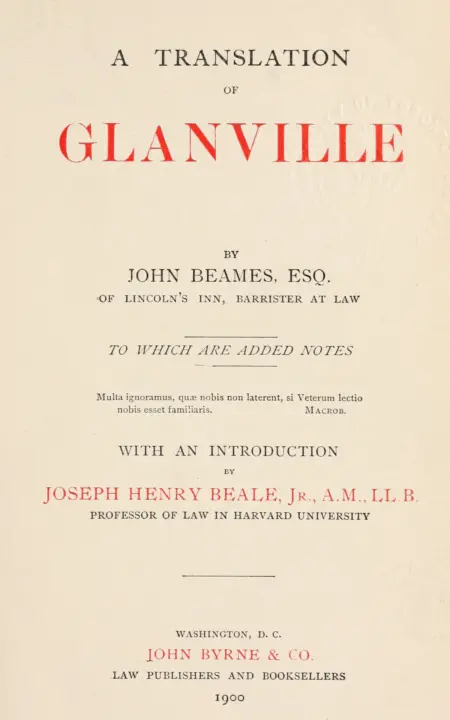
THE CLASSIC COLLECTION · 1900
"A translation of Glanville" by Ranulf de Glanville is a legal treatise written between 1187-1189. This groundbreaking work systematically codified English law for the first time, defining legal processes and introducing writs that remain influential today. Written for Henry II after years of chaos, it served as the foundation of English common law. The treatise consists of fourteen books covering jurisdictions and procedures in the King's Court, fundamentally transforming how justice was administered throughout the kingdom.
Introduction adapted from the source catalogue; source summaries may be automatically generated.
Free to read · English · 91,270 words · No account needed
MAKE TIME FOR A GOOD BOOK
On by default. Untick to stop anonymous reading totals. Each page counts after 10 seconds in view. How this works.
Anonymous counting is on unless you have switched it off.
Darrien presentment—Writ of, 263
Debt—Writ of, 198
Debts—Pleas concerning, 198
—— how proved, 213
Default, how punished, 16
Deposit, 199
Descents, general Canons of, 124
—— amongst Grecians, Normans, Lombardi, &c. (Note 2.), 125
Desponsatio (Note 1.), 94
Disseisins, 270
Distresses, 103, 179, 191, 199, 228, &c.
Divisa (Note 1.), 133
Divorce for Incontinence bars Dower, 110
—— for Relationship bars Dower, 110
Dominium (Note 1.), 123
Dower, general doctrine of, begins at, 93
—— in what senses used, 93
—— ad Ostium Ecclesiæ, 94
—— Ex assensu Patris, 111
—— admeasurement of, 95
—— how demanded, 101
—— not of land already in Dower, 109
—— its assignment not postponed for Heir’s Infancy, 109
—— barred by Divorce for Incontinence or Relationship, 110
—— Writ of Right of, 99
Duel, Trial by, 33
—— its rise and decline (Note 1.), 34
—— reason of (Note 1.), 35
—— not allowed in questions of Villenage, 88
—— not waged by Villein-born though Knighted, 89
—— Courts not bound to defend their Records by, 171
—— Courts bound to defend their Judgments by, 171
—— in Criminal matters, 282
—— when only compromised by License, 282
Duodecimâ Manu (Note 2.), 8
Earnest, 216
Ecclesiastical Court—holds not plea of Debt—when, 212
—— when it has Jurisdiction generally, 245
Election of Knights on Grand Assise, 48
Enfranchisement—modes of effecting, 88
—— under Saxons (Note 1.), 88
Escambium (Note 1.), 61
—— when Bracton wrote (Note 1.), 61
Escheat for want of Heir, 154
—— for incontinence of female Heir, 154
—— for felony, 154
—— for conviction of Theft, 156
—— for Outlawry, 155
Essoins, principal kinds of (Note 1.), 6
—— general doctrine of—begins at, 6
—— not allowed by one of full age against Minor, 256
—— nor in Novel Disseisins, 251
—— may be cast by Attorney for himself, 226
Essoiners may appoint Essoiners, 18
—— Writ to take as Defaulters, 13
Essonium (Note 1.), 6
Exceptions to Jurors, 50
Exchequer, 142
Executors—who, 136
Failure of Justice in Lord’s Court, 234
Faldæ (Note 2.), 165
Faldæ secta (Note 2.), 165
Falsifying Judgments, 172
False-claim, punishable, 30
Famâ publicâ (Note 2.), 278
Fealty, 129, 157
Fee, how lost, 179
Felony—appeal of, 141
—— forfeits Land, 154
Females, Custody of, 143
Feme sole may make a Testament, 134
—— covert cannot without Husband’s consent, 134
Feodum (Note 2.), 103
Fidei interpositio (Note 2.), 280
Final Concord—forms of, 162, 163
Fine—bar to Assise of mort d’auncestor, 254
Fines—general doctrine of—begins at, 161
Forfeitures, 154, 155, 156, 179, 282, &c., &c.
Forgeries, 290
Forinseca (Note 1.), 165
Forisfacio (Note 2.), 146
Forisfamiliatus (Note 1.), 131
Fossatum (Note 4.), 272
Frankalmoigne, 114
Freedom, how proved, 85
—— not to be purchased with Villein’s own money, 89
—— means of acquiring, 88
Frussetum (Note 2.), 164
Gifts of Land—how far allowed, 114
—— —— defective without seisin, 114
Grand Assise, 44
—— —— bars to, 42
—— —— the Essoins it allows, 49
—— —— concerning what things, 51
Gyldam (Note 4.), 90
Heirs—how far bound by Ancestors’ Gifts, 124
—— how divided, 124
—— when disinherited (see Forfeiture, Escheat, &c.)
—— in right line preferred to transverse line, 124, 129
Heres remotior (Note 4.), 117
—— Ultimus, a Man’s Lord, 153
Hiring, 221
Homage, difference between and Fealty (Note 1.), 128
—— performed by Husband of Eldest Daughter, 128
—— general doctrine of, begins at, 175
—— must be received by Lord, when, 177
—— performed to several Lords for different Fees, 177
—— liege, when due, 177
—— form of, 177
—— effect of, 178
—— not performed by Women, 176
—— not by consecrated Bishops, 180
—— for what due, 181
—— to whom, 182
Homicide, its species, 285
—— properly so called, 286
—— not bailable, 281, 285
Hue and Cry, 286
Your reading position is saved on this browser. Take it to another device with a library code. Reading pages adapt to text, rather than matching a printed edition.
BEHIND THE BOOK
This eBook is for the use of anyone anywhere in the United States and most other parts of the world at no cost and with almost no restrictions whatsoever. You may copy it, give it away or re-use it under the terms of the Project Gutenberg License included with this eBook or online at www.gutenberg.org. If you are not located in the United States, you will have to check the laws of the country where you are located before using this eBook. Read the source licence.
The original source file, including credits and licence, is retained by this library. Request an original-format copy at no charge. Please include the book title and Project Gutenberg identifier #71142.
KEEP YOUR CURIOSITY GOING
Cécile Tormay

Moritz Busch
John L. Ransom
Frances Wright
Cécile Tormay

Mabel Potter Daggett