THE CLASSIC COLLECTION✦An outlaw’s diary: the CommuneCLASSIC FREE BOOKS
An outlaw’s diary: the Commune
Cécile Tormay
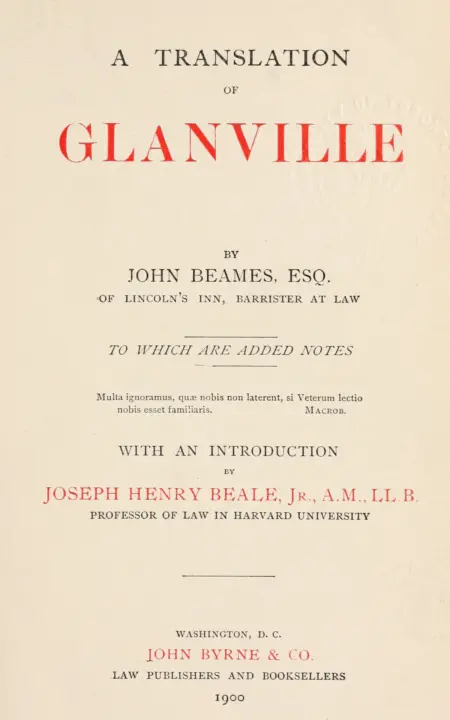
THE CLASSIC COLLECTION · 1900
"A translation of Glanville" by Ranulf de Glanville is a legal treatise written between 1187-1189. This groundbreaking work systematically codified English law for the first time, defining legal processes and introducing writs that remain influential today. Written for Henry II after years of chaos, it served as the foundation of English common law. The treatise consists of fourteen books covering jurisdictions and procedures in the King's Court, fundamentally transforming how justice was administered throughout the kingdom.
Introduction adapted from the source catalogue; source summaries may be automatically generated.
Free to read · English · 91,270 words · No account needed
MAKE TIME FOR A GOOD BOOK
On by default. Untick to stop anonymous reading totals. Each page counts after 10 seconds in view. How this works.
Anonymous counting is on unless you have switched it off.
“The King to the Sheriff, Health.[143] R. complains to me that N. draws him to Villenage, although he is a freeman, as he says. And, therefore, I command you that, if the said R. make you secure of prosecuting his claim, then, that you put the suit before me, or my Justices, on such a day; and, in the mean time, you cause that he be in peace; and summon, by good Summoners, the aforesaid N. that he be then there to shew why, he unjustly draws him to Villenage. And have there, &c.”
[Footnote 143: Vide F.N.B. 171, 172.]
By the same Writ, the party who lays claim to the other, as being his Villein, shall be summoned; and a day shall be appointed him on which he may prosecute his claim. But, if on the day appointed, the person who is claimed as a Villein should neither appear, nor send a Messenger, nor Essoin, let the same course be pursued, as that before described in treating of Pleas, where the Pledges are to be attached. But, if he chuse to essoin himself, he may avail himself of the same number of Essoins, and on the same occasions as we have already mentioned. But if the party who claims the other as his Villein, neither appear on that day, nor send, let the other party, if present, be dismissed unconditionally, under such form, namely, that the claimant shall recover so much as by Law he ought to recover, concerning which principle we have spoken more fully, in the preceding part of this Treatise. In the mean time, the party who is claimed as a Villein shall be in Seisin of his freedom.
Both parties being present in Court, the freedom shall be there proved in this manner: the party who claims his liberty, shall produce a number of his nearest relations and kindred, springing from the same stock from which he descended. If their freedom be recognized and proved in Court, the party who demands[144] his freedom shall be liberated from the yoke of servitude. But, if the free condition of those produced be denied,[145] or a doubt be entertained respecting it, recourse shall be had to the Vicinage, whose Verdict shall ascertain the fact, whether those produced are free, or not: and, according to its decision, the matter shall be adjudged. But, if the party who claims the other as his Villein, should bring forward other persons to prove the contrary, namely, that such persons as the claimant has now brought forward are his Villeins-born, and that they sprung from the same common stock with him, whom he claims as a Villein-born, then, in like manner, should those produced by both sides be recognized as of common kindred, let it be inquired by the Vicinage,[146] which of them are the nearest to him; and, according as the inquiry turns out, let the Judgment be given. In a similar manner, if those produced by one party should[147] deny in any respect his relationship, or, if a question arise concerning it, every doubt of this nature shall be determined by the Vicinage. The freedom having been sufficiently proved in Court, then, the party whose liberty has been questioned shall be absolved from the claim of him who would draw him to Villenage, and for ever freed from it. If, however, he should fail in his proof, or, if he should be recovered by his Adversary as his Villein-born, he shall be irrecoverably adjudged to belong to his Lord, together with all the Chattels he possesses. The same form and order are observed in pleading, when a freeman is claimed as a Villein, or when any one, in a state of Villenage, aspires of his own accord to freedom. For this purpose, the party whose freedom is impeached shall come to the King’s Court, and pray, that the suit might be removed into the same, which being conceded, the suit will then proceed in the form before stated. It must be remarked concerning this Plea, that the Duel cannot be resorted to, in order to prove the freedom of any one from his Birth.[148]
Your reading position is saved on this browser. Take it to another device with a library code. Reading pages adapt to text, rather than matching a printed edition.
BEHIND THE BOOK
This eBook is for the use of anyone anywhere in the United States and most other parts of the world at no cost and with almost no restrictions whatsoever. You may copy it, give it away or re-use it under the terms of the Project Gutenberg License included with this eBook or online at www.gutenberg.org. If you are not located in the United States, you will have to check the laws of the country where you are located before using this eBook. Read the source licence.
The original source file, including credits and licence, is retained by this library. Request an original-format copy at no charge. Please include the book title and Project Gutenberg identifier #71142.
KEEP YOUR CURIOSITY GOING
Cécile Tormay

Moritz Busch
John L. Ransom
Frances Wright
Cécile Tormay

Mabel Potter Daggett