THE CLASSIC COLLECTION✦An outlaw’s diary: the CommuneCLASSIC FREE BOOKS
An outlaw’s diary: the Commune
Cécile Tormay
THE CLASSIC COLLECTION · 1900
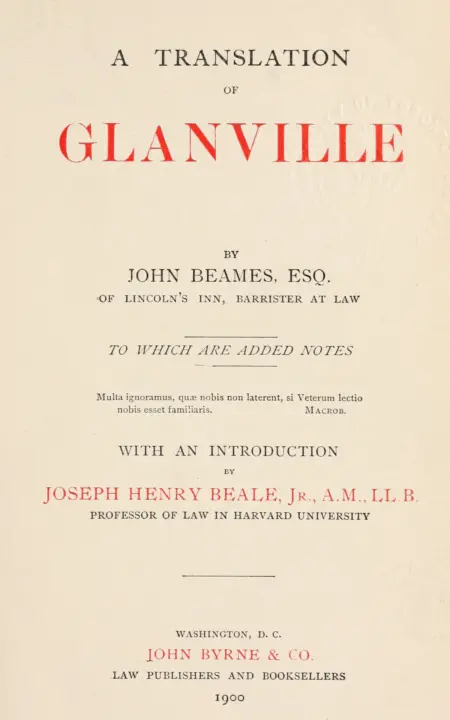
"A translation of Glanville" by Ranulf de Glanville is a legal treatise written between 1187-1189. This groundbreaking work systematically codified English law for the first time, defining legal processes and introducing writs that remain influential today. Written for Henry II after years of chaos, it served as the foundation of English common law. The treatise consists of fourteen books covering jurisdictions and procedures in the King's Court, fundamentally transforming how justice was administered throughout the kingdom.
Introduction adapted from the source catalogue; source summaries may be automatically generated.
Free to read · English · 91,270 words · No account needed
MAKE TIME FOR A GOOD BOOK
On by default. Untick to stop anonymous reading totals. Each page counts after 10 seconds in view. How this works.
Anonymous counting is on unless you have switched it off.
[Footnote 25: Reeves’s Hist. Eng. Law 225.]
[Footnote 26: Hist. Charles 5. Vol. 1. p. 296.]
In dismissing this subject, it may be remarked in the words of Mr. Reeves, that it seems unnecessary to contend for the originality of the Regiam Majestatem, whilst a doubt of much more importance remains unsettled—whether that Treatise, as well as the others in the publication of Skene, are now, or ever were, any part of the Law of Scotland, on which, as we have already observed, so many eminent men differ. On the other hand, the authenticity of Glanville, as the code of Law existing in this country during the Reign of Henry the Second, has been admitted, either expressly or impliedly by all the English Lawyers, who have florished in the long interval which has elapsed from that period to the present, and never has been questioned, if we except a solitary dictum, which, as it equally affected the credit of Bracton, and was totally unauthorised, is refuted by a thousand circumstances, if it were an object to mention them.[27] But to return from this digression.
[Footnote 27: Plowd. 357.]
Though the Translator had not the good fortune to meet with Mr. Davidson’s Pamphlet, he was more successful in discovering Skene’s translation of the Regiam Majestatem, deposited in Lincoln’s Inn Library. The Translator intended to have noticed such parts of the Regiam Majestatem, as coincided with Glanville. But, after having, with some attention, perused the former Book, he found the similarity between the two works so very general, and the correspondence so exact, that the Regiam Majestatem might frequently be taken verbal Translation of Glanville, or, at least, as another Edition of the same Treatise, in which the writer had made some slight additions and alterations, and had capriciously amused himself in contriving an arrangement totally different, though far less happy and systematical. The Translator has, therefore, generally contented himself with noticing those deviations between the two works, which were more immediately relevant to his subjects. Nor has he always stopped here, but has availed himself of the Regiam Majestatem, whenever it was less ambiguous, or more decided than Glanville, which from the very circumstance of its being a posterior publication, it sometimes naturally will happen to be. In addition to the Regiam Majestatem, reference has been occasionally made to the Grand Custumary of Normandy, Bracton, Fleta, Britton, Coke, Hale, &c. &c. Some of these references serve to corroborate—some to illustrate the Text: some tend to shew that a Law was not peculiar to this Country, and some that a similar Rule has been adopted even in Modern Times by a neighboring State. In consulting the Laws of that state, and noticing those instances of strong or faint resemblance between them and the Code of Henry the Second, the Translator acted in deference to the suggestions of a Gentleman, who, though possessed of the most profound legal knowledge, is yet more entitled to our admiration for his singular liberality of sentiment, and urbanity of manners. If the more enlightened mind derive no benefit from the plan which has been adopted in the notes, and anticipate the Result; yet, it is hoped, the Student may receive some advantage from it. But, if the Translator has been too diffuse in some instances, he has, on other occasions, contented himself with a bare reference. He has been averse to swell the Notes, where a bare citation would serve to direct the Student, if disposed to extend his inquiries. In addition to the Translator’s own Notes, the Reader is furnished with a few annotations extracted from a copy of Glanville, formerly belonging to Mr. Justice Aland, and now deposited in the collection of the Royal Institution. Yet, should it be observed, it is not perfectly clear whether these annotations were made by that learned Judge, or by the Reverend Mr. Elstob, a gentleman deeply versed in Anglo-Saxon Literature. By way of distinction, these Annotations are particularised by (Al. MS.)
Your reading position is saved on this browser. Take it to another device with a library code. Reading pages adapt to text, rather than matching a printed edition.
BEHIND THE BOOK
This eBook is for the use of anyone anywhere in the United States and most other parts of the world at no cost and with almost no restrictions whatsoever. You may copy it, give it away or re-use it under the terms of the Project Gutenberg License included with this eBook or online at www.gutenberg.org. If you are not located in the United States, you will have to check the laws of the country where you are located before using this eBook. Read the source licence.
The original source file, including credits and licence, is retained by this library. Request an original-format copy at no charge. Please include the book title and Project Gutenberg identifier #71142.
KEEP YOUR CURIOSITY GOING
Cécile Tormay

Moritz Busch
John L. Ransom
Frances Wright
Cécile Tormay

Mabel Potter Daggett