THE CLASSIC COLLECTION✦An outlaw’s diary: the CommuneCLASSIC FREE BOOKS
An outlaw’s diary: the Commune
Cécile Tormay
THE CLASSIC COLLECTION · 1900
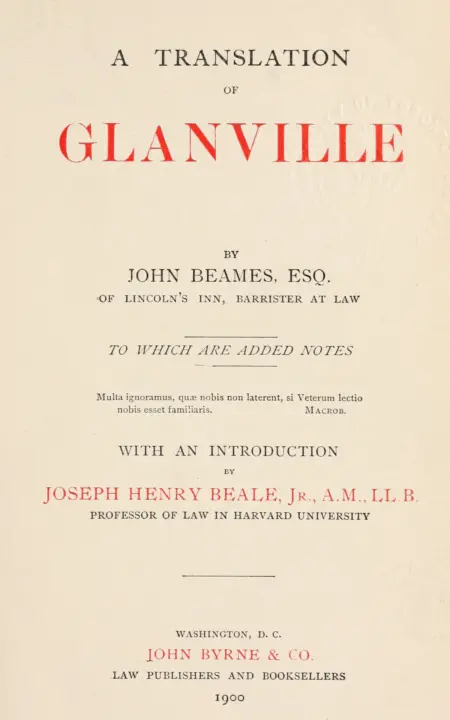
"A translation of Glanville" by Ranulf de Glanville is a legal treatise written between 1187-1189. This groundbreaking work systematically codified English law for the first time, defining legal processes and introducing writs that remain influential today. Written for Henry II after years of chaos, it served as the foundation of English common law. The treatise consists of fourteen books covering jurisdictions and procedures in the King's Court, fundamentally transforming how justice was administered throughout the kingdom.
Introduction adapted from the source catalogue; source summaries may be automatically generated.
Free to read · English · 91,270 words · No account needed
MAKE TIME FOR A GOOD BOOK
On by default. Untick to stop anonymous reading totals. Each page counts after 10 seconds in view. How this works.
Anonymous counting is on unless you have switched it off.
It remains to speak of the Translation now submitted to the Public. Fidelity has been the principal object of the Translator. If more be demanded, he would shelter himself under the high name of Sir William Jones. “Elegance, on a subject so delicate as Law, must be sacrificed, without mercy, to exactness.” Next to fidelity, simplicity has been aimed at, as most in unison with the original, and, perhaps, the best adapted for transfusing its spirit into the English Language. Not that with these two objects immediately before him, the Translator would be understood as conceding, that he has sacrificed any beauty, any elegance of expression generally abounding in, or spread over, the original work. He could not sacrifice that which never existed. The style of Glanville, destitute of every grace, and dry and harsh in the extreme, professedly aims at the peculiar qualities which characterise it. Stilo vulgari et verbis curialibus utens ex industria, ad notitiam comparandum eis, qui hujusmodi vulgaritate minus sunt exercitati, are the very terms in which he describes his own manner of writing. So successfully has he accomplished his object, that he imposes upon his Translator a Task not altogether unlike that of acquiring a new language. Yet to these difficulties the Translator reluctantly alludes, for though they may, in some measure, atone for those errors into which he is apprehensive he has often fallen, he is conscious, the merit of his attempt is not to be estimated by its arduousness, but its utility.
With respect to the Annotations, it was the Translator’s original intention to have confined himself to a mere explanation of the obsolete Terms. But, anxious to render the work more extensively useful, he has not unfrequently departed from his first design. Among the works occasionally referred to, the Reader will recognise the Regiam Majestatem—so termed from the words with which it commences. This work has been sometimes received, as containing the genuine ancient Law of Scotland—sometimes rejected, as a mere spurious fabrication. Among the names in collision on this point are those of Skene, Erskine, Lord Kaims, Houard, Dalrymple, Craig, Lord Stair and Dr. Robertson. Nor has there been less dispute whether Glanville, or the Regiam Majestatem be the original work. But this question is said to be satisfactorily disposed of by Mr. Davidson, who has published a pamphlet expressly on the subject, and has proved, if it were necessary to prove, what is rendered indubitable by the internal Evidence of the two Works, that Glanville is the original; observing, at the same time, “that Glanville is regular, methodical, and consistent throughout; whereas the Regiam Majestatem goes out of Glanville’s method for no other assignable reason, than to disguise the matter, and is thereby rendered confused, unsystematical, and in many places contradictory.” The Translator has not been able to meet with Mr. Davidson’s work, but is indebted to the preface attached to the last Edition of Glanville for this Summary of it. “To this observation upon the method of the Regiam Majestatem,” says Mr. Reeves, “it may be added, that, on a comparison of the account given of things in that and in Glanville, it plainly appears, that the Scotch Author is more clear, explicit, and defined; and that he writes very often with a view to explain the other, in the same manner in which the writer of our Fleta, explains his predecessor Bracton. This is remarkable in numberless instances all through the Book, and is, perhaps, as decisive a mark of a copy as can be. The other Scotch Laws, which follow the Regiam Majestatem in Skene’s collection, contribute greatly to confirm the suspicion. These, as they are of a later date than several English Statutes which they resemble, must be admitted to be copied from them; and so closely are the originals followed, that the very words of them are retained. This is particularly remarkable of the Reign of Robert the Second, in which is the Statute of quia Emptores, and others plainly copied from our Laws, without any attempt to conceal the imitation. These Laws, at least, can impose upon no one; and when viewed with the Regiam Majestatem at their head, and compared with Glanville and the English Statute Book, they seem to declare very intelligibly to the world, that this piece of Scotch Jurisprudence is borrowed from ours.”[25] Nor is the enlightened and liberal Historian Dr. Robertson more favorably disposed towards that claim, which some of his countrymen have put in, for the originality of the Regiam Majestatem. “The Regiam Majestatem ascribed to David the first seems,” he observes, “to be an imitation and a servile one, of Glanville. Several Scottish Antiquaries, under the influence of that pious credulity, which disposes men to assent without hesitation to whatever they deem for the honor of their native country, contend zealously, that the Regiam Majestatem is a production prior to the Treatise of Glanville; and have brought themselves to believe, that a nation, in a superior state of improvement, borrowed its Laws from one considerably less advanced in its political progress. The internal Evidence (were it my province to examine it) by which this theory might be refuted is in my opinion decisive. The external circumstances, which have seduced Scottish Authors into this mistake, have been explained with so much precision and candor by Sir David Dalrymple, in his Examination of some of the arguments for the high antiquity of the Regiam Majestatem, Eding, 1767. 4to, that it is to be hoped, the controversy will not be again revived.”[26]
Your reading position is saved on this browser. Take it to another device with a library code. Reading pages adapt to text, rather than matching a printed edition.
BEHIND THE BOOK
This eBook is for the use of anyone anywhere in the United States and most other parts of the world at no cost and with almost no restrictions whatsoever. You may copy it, give it away or re-use it under the terms of the Project Gutenberg License included with this eBook or online at www.gutenberg.org. If you are not located in the United States, you will have to check the laws of the country where you are located before using this eBook. Read the source licence.
The original source file, including credits and licence, is retained by this library. Request an original-format copy at no charge. Please include the book title and Project Gutenberg identifier #71142.
KEEP YOUR CURIOSITY GOING
Cécile Tormay

Moritz Busch
John L. Ransom
Frances Wright
Cécile Tormay

Mabel Potter Daggett