THE CLASSIC COLLECTION✦An outlaw’s diary: the CommuneCLASSIC FREE BOOKS
An outlaw’s diary: the Commune
Cécile Tormay
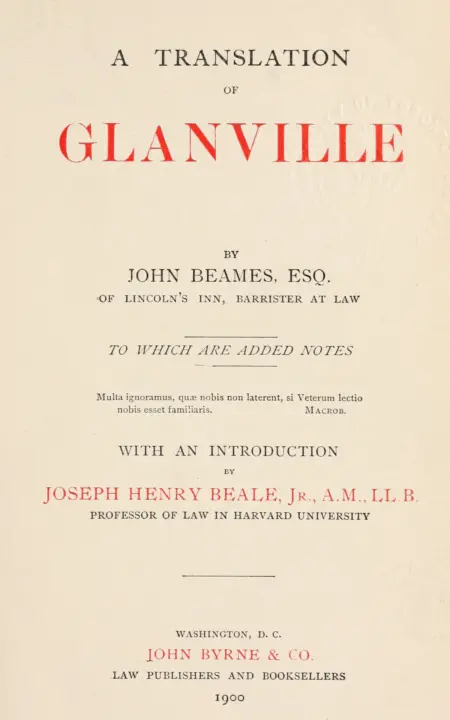
THE CLASSIC COLLECTION · 1900
"A translation of Glanville" by Ranulf de Glanville is a legal treatise written between 1187-1189. This groundbreaking work systematically codified English law for the first time, defining legal processes and introducing writs that remain influential today. Written for Henry II after years of chaos, it served as the foundation of English common law. The treatise consists of fourteen books covering jurisdictions and procedures in the King's Court, fundamentally transforming how justice was administered throughout the kingdom.
Introduction adapted from the source catalogue; source summaries may be automatically generated.
Free to read · English · 91,270 words · No account needed
MAKE TIME FOR A GOOD BOOK
On by default. Untick to stop anonymous reading totals. Each page counts after 10 seconds in view. How this works.
Anonymous counting is on unless you have switched it off.
[Footnote 1: Co. 8. Rep. pref.]
[Footnote 2: Madox’s Exch. 439.]
[Footnote 3: Ibid. 203.]
[Footnote 4: Ibid. 253.]
[Footnote 5: Hume’s Hist.]
[Footnote 6: Mad. Exch. 297.]
[Footnote 7: Ibid. 87.]
[Footnote 8: Hoveden, p. 600.]
[Footnote 9: Mad. Exch. 662.]
[Footnote 10: Hoveden, p. 600. n. 40.]
[Footnote 11: Mad. Exch. 24.]
[Footnote 12: Mad. Exch. 35.]
[Footnote 13: Ibid. 225.]
[Footnote 14: Leg. Anglo-Sax. p. 339.]
[Footnote 15: Hoveden, p. 622, 623. Note 10.]
[Footnote 16: Spelm. Gloss. ad voc. Justitia; and Plowden, 368. b.]
But, whether the same identical person successively occupied these various situations, and, at different periods of his life, filled the rather opposite and inconsistent characters of an able General and a profound Lawyer—a skilful Courtier and an enlightened Legislator, is a doubt which has been entertained by some very respectable Writers. Nor has it passed without a question, whether the present Treatise was really composed by the person whose name it bears. Lord Littleton, indeed, is inclined to infer, that it was not written by Glanville, but by some Clergyman under his direction.[17] These doubts may serve to evince the ingenuity of those who have suggested them, but they prove nothing. When the various situations Glanville is stated to have filled are represented as incompatible, and we start at beholding the grave Lawyer divest himself of his robes to girt on the armour of the soldier, we forget the manners of the age when Glanville florished. When we suppose, that because the work is composed in Latin, it was not written by a Layman, we beg the question: and, having assumed, that no Layman, whatever his parts, whatever his application, could have been sufficiently skilled to write such Latin as our Author has employed, we pay but a sorry compliment to the age, and rather too hastily conclude that we have proved, what, indeed, we have merely taken for granted. When, in fine, we infer, that the knowledge of Law displayed in the Work, and the labor consumed in composing it, are no less inconsistent with the high and elevated station of Glanville, than incompatible with his employments, we forget, that his rise was progressive, and that, as there are but few things to which a truly great mind is inadequate, the production of a small volume upon that Law which it was daily in the habit of dispensing, ought not, whatever the merit of the work may be, to be ranked amongst the number. It must not, however, be concealed, that Mr. Selden mentions a circumstance which, at the first glance, appears to go a great way in determining the question. “I know the authority of that Treatise,” says he, in speaking of the present work, “is suspected, and some of the best and ancientest copies having the name of E. de N. which I have heard from diligent searchers in this kind of Learning affirmed to have been sometimes E. de Narbrough, and not R. de Glanvilla, it hath been thought to be another’s work, and of later time. But as, on the other side, I dare not be confident that it is Glanville’s, so I make little question, that it is as ancient as his time, if not his work. The teste of the precedents of writs under his name, the language, especially the name of Justitia always for that which we now from ancient time called Justiciarius, (and Justitia was so used in writers under Henry the Second) and the Law delivered in it tasteth not of any later age.”[18] Though the latter part of this Extract may be reasonably thought to furnish a sufficient answer to the doubt expressed in the former part, the Translator cannot but observe upon the singularity, that none “of the best and ancientest copies” are forthcoming in support of the fact they are said to prove.
Your reading position is saved on this browser. Take it to another device with a library code. Reading pages adapt to text, rather than matching a printed edition.
BEHIND THE BOOK
This eBook is for the use of anyone anywhere in the United States and most other parts of the world at no cost and with almost no restrictions whatsoever. You may copy it, give it away or re-use it under the terms of the Project Gutenberg License included with this eBook or online at www.gutenberg.org. If you are not located in the United States, you will have to check the laws of the country where you are located before using this eBook. Read the source licence.
The original source file, including credits and licence, is retained by this library. Request an original-format copy at no charge. Please include the book title and Project Gutenberg identifier #71142.
KEEP YOUR CURIOSITY GOING
Cécile Tormay

Moritz Busch
John L. Ransom
Frances Wright
Cécile Tormay

Mabel Potter Daggett