THE CLASSIC COLLECTION✦An outlaw’s diary: the CommuneCLASSIC FREE BOOKS
An outlaw’s diary: the Commune
Cécile Tormay
THE CLASSIC COLLECTION · 1900
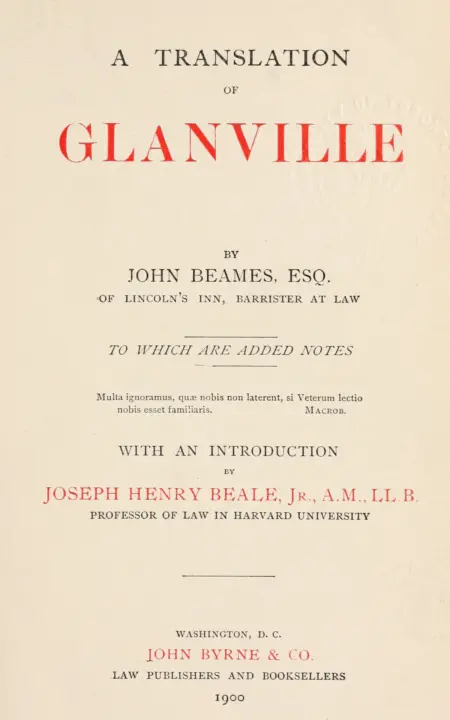
"A translation of Glanville" by Ranulf de Glanville is a legal treatise written between 1187-1189. This groundbreaking work systematically codified English law for the first time, defining legal processes and introducing writs that remain influential today. Written for Henry II after years of chaos, it served as the foundation of English common law. The treatise consists of fourteen books covering jurisdictions and procedures in the King's Court, fundamentally transforming how justice was administered throughout the kingdom.
Introduction adapted from the source catalogue; source summaries may be automatically generated.
Free to read · English · 91,270 words · No account needed
MAKE TIME FOR A GOOD BOOK
On by default. Untick to stop anonymous reading totals. Each page counts after 10 seconds in view. How this works.
Anonymous counting is on unless you have switched it off.
The law of personal property was little developed. Doctrines as to pledge and bailment, derived from the old Germanic law, were applied in the county courts; there, for instance, the absolute responsibility of the bailee was still enforced. Through the writ of detinue and the action on the case, the King’s courts were soon to take control of these subjects, and to establish the modern law of bailments and carriers.
Certain formal contracts were enforced by the King’s court. The writ of debt would lie as a result of a loan, a sale, or an obligation created by charter. Redress for breach of ordinary contracts could be obtained only in the ecclesiastical courts, which might deal with the sin of deceit. Not for three centuries did the King’s court work out a doctrine by which a party might be held to perform his simple contract.
No action of damages for tort would lie. There is as yet no trace of the process by which (working from appeals of felony to writ of trespass against the King’s peace and actions on the case) the King’s court would eventually work out the modern law of tort. So far as there was any remedy for torts it was in the inferior courts.
The King’s court could at this time punish all felonies except theft, jurisdiction over which it obtained by Magna Carta. It was a long time before it obtained exclusive jurisdiction over felony, or took control, as “custos morum,” of misdemeanors.
Such law, it may be admitted, was rude and unsatisfactory; but it was a long advance over what had gone before, and it had within itself the germ of the modern Common Law.
HARVARD UNIVERSITY,
October, 1900.
Of Ranulph de Glanville, the reputed Author of the following Treatise, Lord Coke speaks in terms of the highest encomium. He informs us, that Glanville was Chief Justice in the Reign of Henry the Second, that he wrote profoundly on part of the Laws of England, and that his Works were extant at that day. “And,” continues his Lordship, “in token of my thankfulness to that worthy Judge, whom I cite many times in these Reports, (as I have done in my former) for the fruit which I confess myself to have reaped out of the fair field of his Labors, I will for the honor of him and of his name and posterity, which remain to this day (as I have good cause to know) impart and publish, both to all future and succeeding Ages, what I found of great antiquity and of undoubted verity, the original whereof remaineth with me at this day, and followeth in these words: Ranulphus de Glanvilla, Justiciarius Angliæ, Fundator fuit domus de Butteley, in Comitatu Suffolciæ, quæ fundata erat anno Regis Henrici, filii Imperatricis, decimo septimo, et anno Domini 1171. quo anno Thomas Becket, Cantuariensis Archiepiscopus, erat occisus. Et dictus Ranulphus nascebatur in Villa de Stratford, in comitatu Suffolciæ, et habuit Manerium de Benhall, cum toto Dominio, e dono dicti Regis Henrici. Et duxit in uxorem quandam Bertam, filiam Domini Theobaldi de Valeymz, Senioris domini de Parham: qui Theobaldus per Chartam suam dedit dicto Ranulpho et Bertæ Uxori suæ totam terram de Brochous, cum pertinentiis, in qua domus de Butteley sita est, cum aliis terris et tenementis, in libero maritagio. Prædictus vero Ranulphus procreavit tres filias de dicta Berta (viz.) Matildam, Amabiliam, et Helewisam, quibus dedit terram suam ante progressum suum versus Terram Sanctam.” The document then proceeds with a minute accuracy to trace our Author’s Descendants, and finishes the sketch by informing us—“quod præfatus Ranulphus de Glanvilla fuit vir præclarissimus genere, utpote de nobili sanguine, vir insuper strenuissimus corpore, qui provectiori ætate, ad Terram sanctam properavit, et ibidem contra inimicos Crucis Christi strenuissime usque ad necem dimicavit.”[1] The paucity of these facts may be, in some measure, remedied, by consulting the Annals of our Second Henry, where the name of Glanville not unfrequently occurs. We hear of him in 1171, as Fermour of the Honor of Earl Conan:[2]—in 1172, as having the custody of that Honor, and the Fair of Hoiland;[3]—and in 1174, as still retaining the same Honor, and accounting for the Capture and Ransoms of Prisoners, &c. taken in War.[4] In the latter year he is said to have distinguished himself, as the General who took the King of Scotland Prisoner.[5] In 1175, he still retained the Honor of Earl Conan,[6] and filled the Office of Sheriff of Yorkshire.[7] In 1176, he was made a Justice of the King’s Court, and a Justice Itinerant.[8] In the same year, he accounted for Westmoreland by the hands of Reiner, his Dapifer or Steward, a privilege conceded to the great alone.[9] In 1180, he was made Chief Justiciary of all England, as we are informed by his cotemporary Roger Hoveden, whose words are too remarkable to be omitted. Henricus Rex Angliæ pater constituit Ranulphum de Glanvilla summum Justiciarium totius Angliæ, cujus sapientia conditæ sunt leges subscriptæ, quas Anglicanas vocamus.[10] The Chief Justiciary, presided in the Curia Regis next to the King, as Chief Judge in all civil and criminal questions; and governed the Realm like a Vice-Roy, when the King was beyond Sea, an event of frequent recurrence in that age. In fine, this officer was invested with a power that placed him far above every other subject. No sooner had Glanville arrived at this elevated post, than he exerted himself to restore and confirm many ancient Laws calculated for the good of the Realm.[11] How much to the satisfaction of Henry the Second Glanville filled this arduous situation, we may infer, from finding additional honors heaped upon him by that able and politic Prince. In 1183, our Author held the place of Dapifer to the King,[12] and, in the same year, he was appointed Fermour of Yorkshire:[13] situations, it is to be presumed, not incompatible with that of Chief Justiciary, which he appears to have retained, until the death of Henry the Second,[14] and that with undiminished honor, if we except the imputation cast upon him for condemning Sir Gilbert de Plumptun to death, but which seems to be refuted by the confidence continued to be reposed in him by the discerning Henry.[15] Immediately after the death of that Prince, he assumed the Order of the Cross, and perished fighting valiantly at the Siege of Acon in the year 1190.[16]
Your reading position is saved on this browser. Take it to another device with a library code. Reading pages adapt to text, rather than matching a printed edition.
BEHIND THE BOOK
This eBook is for the use of anyone anywhere in the United States and most other parts of the world at no cost and with almost no restrictions whatsoever. You may copy it, give it away or re-use it under the terms of the Project Gutenberg License included with this eBook or online at www.gutenberg.org. If you are not located in the United States, you will have to check the laws of the country where you are located before using this eBook. Read the source licence.
The original source file, including credits and licence, is retained by this library. Request an original-format copy at no charge. Please include the book title and Project Gutenberg identifier #71142.
KEEP YOUR CURIOSITY GOING
Cécile Tormay

Moritz Busch
John L. Ransom
Frances Wright
Cécile Tormay

Mabel Potter Daggett