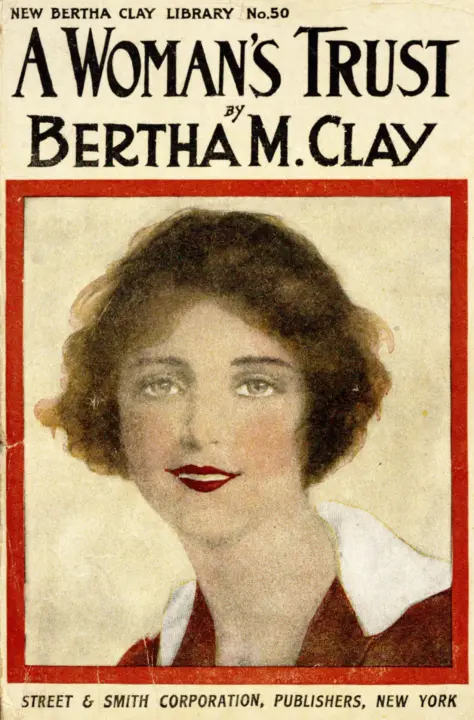
A woman’s trust; or, Lady Elaine’s martyrdom
Bertha M. Clay
THE CLASSIC COLLECTION · 1899
"A Tragedy of Love and Hate: or, A Woman's Vow" by Bertha M. Clay is a novel written in the late 19th century. The narrative appears to center around themes of love, betrayal, and murder, particularly focusing on the tragic demise of Lady Clarice Alden, whose death ignites a complex web of emotions and secrets among the characters involved. The opening of the story paints a serene and idyllic summer landscape before sharply contrasting it with the discovery of a woman's body in the river, setting the stage for tragedy. The prologue introduces readers to a picturesque scene in Holme Woods, only to reveal that Lady Clarice has been found drowned, later determined to be the victim of murder. As various characters react to her death, including her distraught husband Sir Ronald Alden and the loyal maid Mary Thorne, the mystery of her demise unfolds. The combination of a beautiful yet foreboding environment and the revelation of foul play lays a compelling foundation for the ensuing drama and the exploration of the human heart's complexities.
Introduction adapted from the source catalogue; source summaries may be automatically generated.
Free to read · English · 78,148 words · No account needed
MAKE TIME FOR A GOOD BOOK
On by default. Untick to stop anonymous reading totals. Each page counts after 10 seconds in view. How this works.
Anonymous counting is on unless you have switched it off.
He would have turned and fled, but the manhood within him rebelled against flight. He stood looking helplessly at her, too bewildered for words. When he was capable of coherent thought he saw how white her face grew. She rose and stood before him, like some bright, strange, frightened bird, dreading to stay, yet dreading to go.
And then the past months, with their untold agony, faded from him. He remembered nothing save that it was summer time and he loved her--save that for him it was heaven where she was, and a dreary blank where she was not.
“Hermione!” he cried, going up to her, and holding out his hand, all his proud resolves, all his hauteur, all his indignant anger melted into thin air.
She gave him no hand in return. The pale, sweet face was graver than he
had ever seen it before.
“I did not think to see you here, Sir Ronald,” she said, coldly.
He had only seen her once since the night when he had kissed her among the flowers, and everything save the memory of that night seemed to die from him.
“How cruel you have been to me, Hermione; how you lured me on to my ruin and my doom; how false you are despite the fairness of that most fair face! If you had stabbed me, and trampled my dead body under foot, you would have been less cruel. What did I ever do, Hermione, that I deserved so cruel a fate?”
She looked up at him proudly.
“You have no right to speak to me,” she said. “You are married, and the kindness or cruelty of no other woman but your wife should concern you. Then I have not been cruel to you, Ronald, and you know it.”
There was something inexpressibly sad and pitiful in the whole scene. These two, who loved each other so dearly, who in the whole world cared only for each other, parted more completely than if death had separated them.
“I know that you did me the greatest wrong woman could do to man,” he
replied.
“What was it?” she asked, the proud flush deepening on her face.
“You led me to believe you cared for me--you gave to me looks and words such as you gave to no other man--you let me kiss your lips and did not say me nay; then, when I had grown bold through your kindness, and prayed the prayer that for long months had been on my lips, you slew me with cruel, scornful words.”
“I do not understand you,” she said, quietly.
Your reading position is saved on this browser. Take it to another device with a library code. Reading pages adapt to text, rather than matching a printed edition.
Bertha M. Clay
BEHIND THE BOOK
This eBook is for the use of anyone anywhere in the United States and most other parts of the world at no cost and with almost no restrictions whatsoever. You may copy it, give it away or re-use it under the terms of the Project Gutenberg License included with this eBook or online at www.gutenberg.org. If you are not located in the United States, you will have to check the laws of the country where you are located before using this eBook. Read the source licence.
The original source file, including credits and licence, is retained by this library. Request an original-format copy at no charge. Please include the book title and Project Gutenberg identifier #71769.
KEEP YOUR CURIOSITY GOING
Coulson Kernahan

Maurice Baring
Frances Wright
Cécile Tormay

Frederic Jesup Stimson

W. H. P. (William Henry Pope) Jarvis