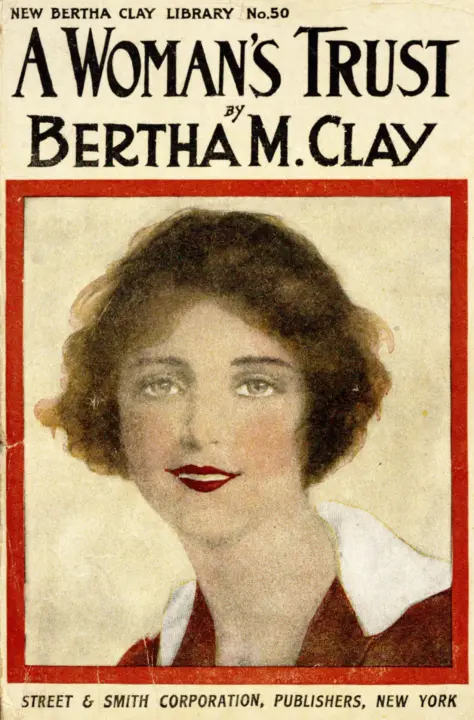
A woman’s trust; or, Lady Elaine’s martyrdom
Bertha M. Clay
THE CLASSIC COLLECTION · 1899
"A Tragedy of Love and Hate: or, A Woman's Vow" by Bertha M. Clay is a novel written in the late 19th century. The narrative appears to center around themes of love, betrayal, and murder, particularly focusing on the tragic demise of Lady Clarice Alden, whose death ignites a complex web of emotions and secrets among the characters involved. The opening of the story paints a serene and idyllic summer landscape before sharply contrasting it with the discovery of a woman's body in the river, setting the stage for tragedy. The prologue introduces readers to a picturesque scene in Holme Woods, only to reveal that Lady Clarice has been found drowned, later determined to be the victim of murder. As various characters react to her death, including her distraught husband Sir Ronald Alden and the loyal maid Mary Thorne, the mystery of her demise unfolds. The combination of a beautiful yet foreboding environment and the revelation of foul play lays a compelling foundation for the ensuing drama and the exploration of the human heart's complexities.
Introduction adapted from the source catalogue; source summaries may be automatically generated.
Free to read · English · 78,148 words · No account needed
MAKE TIME FOR A GOOD BOOK
On by default. Untick to stop anonymous reading totals. Each page counts after 10 seconds in view. How this works.
Anonymous counting is on unless you have switched it off.
Sir Ronald went gently to her and called her by name. Whatever her dream might be, it was so deep that she had not heard the sound of his footsteps or the rustling of the boughs.
“Clarice,” he said, and when she raised her head and saw him, the
change that came over her face was so sudden and so great it dazzled
him.
“You, Sir Ronald!” she said, and then he knew that she had been
dreaming of him.
He went nearer to her, and they strode side by side under the shade of
the old tree.
“Clarice,” he repeated, “there are tears in your eyes and on your lashes. You have been alone in this quiet place, weeping. What is wrong?”
“Nothing,” she replied; “but my thoughts were very sad ones, and tears are a luxury at times.”
“They should not be for you, for whom all things bright and beautiful must have been made. Tell me what those sad thoughts were.”
A mound of dead and dying leaves lay at her feet. Every vigorous breath of wind brought fresh leaves down, yellow and red. She pointed to them.
“Every autumn for the last four years I have watched the leaves of this tree fall,” she said, “and the same thoughts have always pursued me.”
“You will not tell me what they are?” he said.
“I cannot. Do you not know how impossible it is to put those thoughts into words that we hardly understand ourselves?”
“Clarice,” he said, gently, “do you know what I have sought you for?”
“No,” she replied, and he noticed something of dreaminess in her voice
and look.
“I came over to Mount Severn this evening especially to ask you to be
my wife.”
Something like a half-hysterical sob came from her lips.
“Your wife! But you say nothing of loving me.”
“Should I ask you to be my wife if I did not love you, Clarice?” he asked, carried away, despite himself, by the passion of her words and the love in her face. He never forgot her half-tearful joy.
“You love me, Ronald! Do not deceive me; do not tell me that unless it
is quite true.”
He could not have said what he intended to say had his life been the forfeit. He had meant to own to her that his love lay in ashes; but he could not hold those trembling hands in his, and look at those quivering lips, yet speak such words as must stab that tender heart.
“I do love you, Clarice. Why, how many years is it since we were children together, since we played at love and jealousy?”
Your reading position is saved on this browser. Take it to another device with a library code. Reading pages adapt to text, rather than matching a printed edition.
Bertha M. Clay
BEHIND THE BOOK
This eBook is for the use of anyone anywhere in the United States and most other parts of the world at no cost and with almost no restrictions whatsoever. You may copy it, give it away or re-use it under the terms of the Project Gutenberg License included with this eBook or online at www.gutenberg.org. If you are not located in the United States, you will have to check the laws of the country where you are located before using this eBook. Read the source licence.
The original source file, including credits and licence, is retained by this library. Request an original-format copy at no charge. Please include the book title and Project Gutenberg identifier #71769.
KEEP YOUR CURIOSITY GOING
Coulson Kernahan

Maurice Baring
Frances Wright
Cécile Tormay

Frederic Jesup Stimson

W. H. P. (William Henry Pope) Jarvis