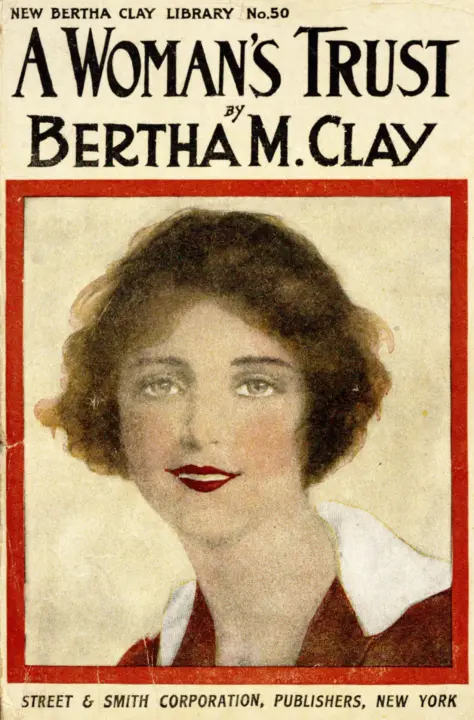
A woman’s trust; or, Lady Elaine’s martyrdom
Bertha M. Clay
THE CLASSIC COLLECTION · 1899
"A Tragedy of Love and Hate: or, A Woman's Vow" by Bertha M. Clay is a novel written in the late 19th century. The narrative appears to center around themes of love, betrayal, and murder, particularly focusing on the tragic demise of Lady Clarice Alden, whose death ignites a complex web of emotions and secrets among the characters involved. The opening of the story paints a serene and idyllic summer landscape before sharply contrasting it with the discovery of a woman's body in the river, setting the stage for tragedy. The prologue introduces readers to a picturesque scene in Holme Woods, only to reveal that Lady Clarice has been found drowned, later determined to be the victim of murder. As various characters react to her death, including her distraught husband Sir Ronald Alden and the loyal maid Mary Thorne, the mystery of her demise unfolds. The combination of a beautiful yet foreboding environment and the revelation of foul play lays a compelling foundation for the ensuing drama and the exploration of the human heart's complexities.
Introduction adapted from the source catalogue; source summaries may be automatically generated.
Free to read · English · 78,148 words · No account needed
MAKE TIME FOR A GOOD BOOK
On by default. Untick to stop anonymous reading totals. Each page counts after 10 seconds in view. How this works.
Anonymous counting is on unless you have switched it off.
Time did not bring comfort to Sir Ronald Alden; the blow he had received was too heavy and too cruel. He felt not only annoyed, but aggrieved, that Clarice knew his secret.
“Lady Hermione must have said something to her about it. Most probably all young ladies boast to each other how many men they cause to suffer; yet one would have thought her as far above that kind of feeling as the clouds are above the earth.”
It was some relief to him to know that no one else appeared to guess the story. The “Alden pride” was strong in him. It was hard enough to bear; it would have been doubly hard if the world had known it.
Lord and Lady Lorriston continued for some time to send him
invitations, to wonder that he did not call, to express that wonder to
him.
It so happened that an eminent writer paid a visit to Leeholme, one whose acquaintance all men were proud and honored to make. Lord Lorriston immediately issued invitations for a large dinner party.
“I consider myself a public benefactor,” he said, laughingly, “in giving men the opportunity of seeing that great genius of the age. Perhaps I have been mistaken over Sir Ronald. Send him cards; he will be sure to come.”
But, to his surprise, among all the letters of acceptance was a note from Sir Ronald, short and cold, declining, with thanks, the invitation, but giving no reason why.
Lord Lorriston handed it to his wife. They were at breakfast, and Lady Hermione, usually silent and grave, was with them.
“Sir Ronald declines, you see. What can be the matter with him? I have known him ever since he was a child, and he chooses to treat me with distant, scant courtesy. I cannot understand it.”
Suddenly an idea seemed to occur to him.
“Hermione,” he said, “have you given Sir Ronald any cause for his
strange conduct?”
She blushed crimson, and turned her face, lest he should read something she did not wish him to see.
“I do not know that I have given him any cause of offense,” she replied.
Lord Lorriston looked earnestly at his daughter, then said no more.
“I am very sorry,” said Lady Hermione. “There is no one I like better
than Sir Ronald.”
Lord Lorriston did not make any further attempt at continuing the
friendship of Sir Ronald.
“He evidently avoids me--wishes to cease all acquaintance--he has his reasons for it, even though I know nothing at all about them.”
And so, in course of time, the acquaintance gradually died out.
Your reading position is saved on this browser. Take it to another device with a library code. Reading pages adapt to text, rather than matching a printed edition.
Bertha M. Clay
BEHIND THE BOOK
This eBook is for the use of anyone anywhere in the United States and most other parts of the world at no cost and with almost no restrictions whatsoever. You may copy it, give it away or re-use it under the terms of the Project Gutenberg License included with this eBook or online at www.gutenberg.org. If you are not located in the United States, you will have to check the laws of the country where you are located before using this eBook. Read the source licence.
The original source file, including credits and licence, is retained by this library. Request an original-format copy at no charge. Please include the book title and Project Gutenberg identifier #71769.
KEEP YOUR CURIOSITY GOING
Coulson Kernahan

Maurice Baring
Frances Wright
Cécile Tormay

Frederic Jesup Stimson

W. H. P. (William Henry Pope) Jarvis