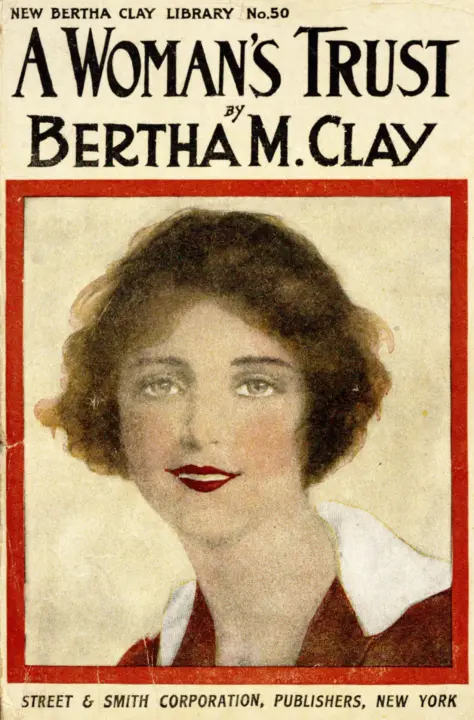
A woman’s trust; or, Lady Elaine’s martyrdom
Bertha M. Clay
THE CLASSIC COLLECTION · 1899
"A Tragedy of Love and Hate: or, A Woman's Vow" by Bertha M. Clay is a novel written in the late 19th century. The narrative appears to center around themes of love, betrayal, and murder, particularly focusing on the tragic demise of Lady Clarice Alden, whose death ignites a complex web of emotions and secrets among the characters involved. The opening of the story paints a serene and idyllic summer landscape before sharply contrasting it with the discovery of a woman's body in the river, setting the stage for tragedy. The prologue introduces readers to a picturesque scene in Holme Woods, only to reveal that Lady Clarice has been found drowned, later determined to be the victim of murder. As various characters react to her death, including her distraught husband Sir Ronald Alden and the loyal maid Mary Thorne, the mystery of her demise unfolds. The combination of a beautiful yet foreboding environment and the revelation of foul play lays a compelling foundation for the ensuing drama and the exploration of the human heart's complexities.
Introduction adapted from the source catalogue; source summaries may be automatically generated.
Free to read · English · 78,148 words · No account needed
MAKE TIME FOR A GOOD BOOK
On by default. Untick to stop anonymous reading totals. Each page counts after 10 seconds in view. How this works.
Anonymous counting is on unless you have switched it off.
“Your own design,” interrupted Sir Ronald.
“Ah, never mind; it is easy to design, but difficult to carry out. Now,
‘Sunshine.’”
For the first tableau represented a picture called “Sunshine,” Miss Severn standing in the middle of the stage, her golden hair falling like a bright, gleaming veil around her. Her dress was of some golden-hued fabric that resembled nothing so much as sunbeams. Flowers of every hue were heaped on her white breast and arms, and lay at her feet. The light, arranged so as to fall above, poured a flood of radiance on the brightest picture that was ever seen.
“It is simply perfect,” said Kenelm. “I should like all the world to see ‘Sunshine.’”
“But you must remember,” said Miss Severn, with a bright blush and a smile, “that every one would not see it with your eyes.”
It pierced her to the heart, knowing that she had never looked more beautiful, to see that Sir Ronald did not look at her, made no remark upon the beauty of the picture, neither praised nor suggested, but was simply indifferent. All Kenelm’s admiration was wasted after that.
The next tableau was “Evening,” a picture almost as beautiful; Isabel Gordon in a dark dress studded with stars, the light subdued and silvery as moonlight, her dark hair crowned with a wreath of stars, her dreamy, lovely Italian face inexpressibly tender and lovely in the glittering starlight.
Clarice noticed that Sir Ronald did admire Isabel Gordon. She overheard him say to Lady Hermione:
“If you had searched the world through, you could not have found a
lovelier ‘Evening.’”
“I think Clarice is the more beautiful of the two,” Lady Hermione
replied.
“I like the gleam of ‘starlight’ better than the glitter of ‘sunshine,’” he said, and Clarice Severn overheard the words.
“It will not be always,” she said to herself; “the time will come when he will love me best.”
“Those are two beautiful pictures,” said Kenelm; “but we must have variety. The next should be full of figures. What is it? A scene from ‘Henry VIII.’”
It was a simple little scene that Lady Hermione had read in some historical novel: Queen Anne Boleyn, dressed for some grand court ceremonial, was seated in an armchair waiting while a white ostrich plume was fastened in her dress. Her beautiful maid of honor, Jane Seymour, was standing behind the chair. The king, waiting half impatiently, half admiringly, for the queen, stood watching the little group. The attendant sewing on the plume let it fall. Jane Seymour raised it from the ground. Bluff Henry said with a smile:
“Never mind; keep it for your own adornment, Lady Jane.”
Your reading position is saved on this browser. Take it to another device with a library code. Reading pages adapt to text, rather than matching a printed edition.
Bertha M. Clay
BEHIND THE BOOK
This eBook is for the use of anyone anywhere in the United States and most other parts of the world at no cost and with almost no restrictions whatsoever. You may copy it, give it away or re-use it under the terms of the Project Gutenberg License included with this eBook or online at www.gutenberg.org. If you are not located in the United States, you will have to check the laws of the country where you are located before using this eBook. Read the source licence.
The original source file, including credits and licence, is retained by this library. Request an original-format copy at no charge. Please include the book title and Project Gutenberg identifier #71769.
KEEP YOUR CURIOSITY GOING
Coulson Kernahan

Maurice Baring
Frances Wright
Cécile Tormay

Frederic Jesup Stimson

W. H. P. (William Henry Pope) Jarvis