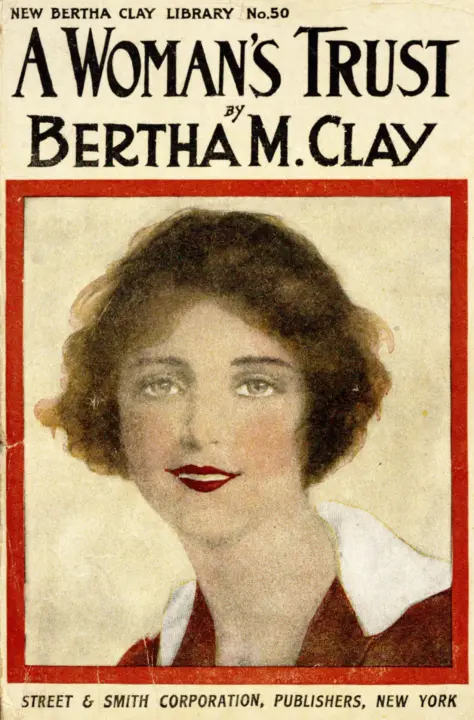
A woman’s trust; or, Lady Elaine’s martyrdom
Bertha M. Clay
THE CLASSIC COLLECTION · 1899
"A Tragedy of Love and Hate: or, A Woman's Vow" by Bertha M. Clay is a novel written in the late 19th century. The narrative appears to center around themes of love, betrayal, and murder, particularly focusing on the tragic demise of Lady Clarice Alden, whose death ignites a complex web of emotions and secrets among the characters involved. The opening of the story paints a serene and idyllic summer landscape before sharply contrasting it with the discovery of a woman's body in the river, setting the stage for tragedy. The prologue introduces readers to a picturesque scene in Holme Woods, only to reveal that Lady Clarice has been found drowned, later determined to be the victim of murder. As various characters react to her death, including her distraught husband Sir Ronald Alden and the loyal maid Mary Thorne, the mystery of her demise unfolds. The combination of a beautiful yet foreboding environment and the revelation of foul play lays a compelling foundation for the ensuing drama and the exploration of the human heart's complexities.
Introduction adapted from the source catalogue; source summaries may be automatically generated.
Free to read · English · 78,148 words · No account needed
MAKE TIME FOR A GOOD BOOK
On by default. Untick to stop anonymous reading totals. Each page counts after 10 seconds in view. How this works.
Anonymous counting is on unless you have switched it off.
“But, Ronald,” she said, “surely you are defending crime! Darling, you are speaking without weighing your words. You do not believe that any amount of provocation can excuse murder?”
As she asked the question a dead silence fell on them. The whisper of the winds, the music of the birds, the ripple of the fountains, seemed to grow strangely hushed, as though every sweet impulse of nature waited to hear what he would say.
“You do not answer me,” she said, “yet, Ronald, my question is so plain. Do you think anything, any provocation, can excuse murder?”
Again the strange silence--in after years it returned to her--and she knew it had been more eloquent than any words.
“I cannot answer you,” he replied, after a time. “I have thought of it, but my mind has never been quite clear. Yes, I think some provocation, some treachery so great as to excuse murder.”
“Oh, Ronald, that is a dangerous doctrine.”
“Suppose,” he said, “I had lived in India at the time of the mutiny, and I had found some black fiend with his hand on your throat, or with my baby’s golden head just cloven in twain, I would have slain him with less remorse than I crush this leaf between my fingers.”
“But that,” she argued, “would be self-defence, not murder. Murder seems to me to be the cowardly death that creeps in silence, in treachery, and darkness--that sends the victim’s soul, with one horrible pang, straight into the presence of its Maker! Oh, Ronald, why are we speaking of such things? Poor Clarice! it seems to me I have never realized her terrible fate until now.”
Sir Ronald rose from his seat.
“Look how we have saddened the children, Hermione. Here is Harry, grave as a judge, and little Clare getting ready to cry. My darling, let the dead past be. Let us live in the sunny present.”
“It was Kenelm’s fault,” she said, half apologetically, “not mine. How strangely we have been talking! Every morning and night, when the little ones say their prayers, I shall make them add: ‘Please, God, teach those who suffer to forget.’”
“Papa,” cried a childish voice, “you said I should ride to-day.”
“So I did, Harry. Now, Hermione, come out on the lawn, and see your son take his first lesson in horsemanship.”
The bell was rung, a few words said to the servant, and then a beautiful little pony was led on to the lawn. The children clapped their hands in glee. Sir Ronald bent down and kissed his wife.
Your reading position is saved on this browser. Take it to another device with a library code. Reading pages adapt to text, rather than matching a printed edition.
Bertha M. Clay
BEHIND THE BOOK
This eBook is for the use of anyone anywhere in the United States and most other parts of the world at no cost and with almost no restrictions whatsoever. You may copy it, give it away or re-use it under the terms of the Project Gutenberg License included with this eBook or online at www.gutenberg.org. If you are not located in the United States, you will have to check the laws of the country where you are located before using this eBook. Read the source licence.
The original source file, including credits and licence, is retained by this library. Request an original-format copy at no charge. Please include the book title and Project Gutenberg identifier #71769.
KEEP YOUR CURIOSITY GOING
Coulson Kernahan

Maurice Baring
Frances Wright
Cécile Tormay

Frederic Jesup Stimson

W. H. P. (William Henry Pope) Jarvis