THE CLASSIC COLLECTION✦An outlaw’s diary: the CommuneCLASSIC FREE BOOKS
An outlaw’s diary: the Commune
Cécile Tormay
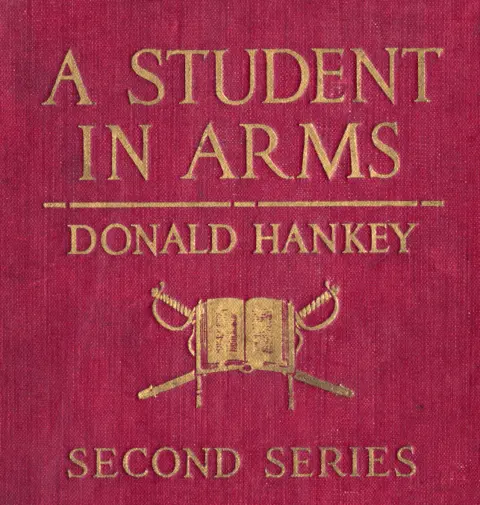
THE CLASSIC COLLECTION · 1916
"A Student in Arms: Second Series" by Donald Hankey is a collection of reflective writings and accounts, likely penned during the early 20th century amid World War I. This work explores the complexities of military life from the perspective of a soldier, delving into themes of camaraderie, the harsh realities of war, and the philosophical introspections that arise from such experiences. The main character, Donald Hankey, is depicted as a thoughtful and sensitive individual who grapples with the atrocities of war while seeking a deeper understanding of life and humanity. The opening of the book sets the tone by highlighting Hankey's personal history and the early influences that shaped him. It recounts his upbringing, emphasizing the tension between his natural proclivity for peace and the martial expectations placed upon him by his brothers and societal norms. As he progresses into military life, Hankey reflects on the dichotomy of bravery and vulnerability faced by soldiers, particularly as he approaches the front lines of battle. His observations reveal a keen awareness of the human condition, showcasing the camaraderie formed among soldiers amidst the chaos of war, while also foreshadowing the internal struggles they endure in the face of violence and loss. Through introspective narration, the stage is established for an exploration of the romantic and brutal nature of warfare.
Introduction adapted from the source catalogue; source summaries may be automatically generated.
Free to read · English · 31,272 words · No account needed
MAKE TIME FOR A GOOD BOOK
On by default. Untick to stop anonymous reading totals. Each page counts after 10 seconds in view. How this works.
Anonymous counting is on unless you have switched it off.
It is no good trying to fathom "things" to the bottom; they have not
got one.
Knowledge is always descriptive, and never fundamental. We can
describe the appearance and conditions of a process; but not the way
of it.
Agnosticism is a fundamental fact. It is the starting-point of the wise man who has discovered that it needs eternity to study infinity.
Agnosticism, however, is no excuse for indolence. Because we cannot know all, we need not therefore be totally ignorant.
The true wisdom is that in which all knowledge is subordinate to practical aims, and blended into a working philosophy of life.
The true wisdom is that it is not what a man does, or has, or says, that matters; but what he is.
This must be the aim of practical philosophy--to make a man be
something.
The world judges a man by his station, inherited or acquired. God judges by his character. To be our best we must share God's viewpoint.
To the world death is always a tragedy; to the Christian it is never a tragedy unless a man has been a contemptible character.
Religion is the widening of a man's horizon so as to include God.
It is in the nature of a speculation, but its returns are immediate.
True religion means betting one's life that there is a God.
Its immediate fruits are courage, stability, calm, unselfishness, friendship, generosity, humility, and hope.
Religion is the only possible basis of optimism.
Optimism is the essential condition of progress.
One is what one believes oneself to be. If one believes oneself to be an animal one becomes bestial; if one believes oneself spiritual one becomes Divine.
Faith is an effective force whose measure has never yet been taken.
Man is the creature of heredity and environment. He can only rise superior to circumstances by bringing God into environment of which he is conscious.
The recognition of God's presence upsets the balance of a man's environment, and means a new birth into a new life.
The faculties which perceive God increase with use like any other
perceptive faculties.
Belief in God may be an illusion; but it is an illusion that pays.
If belief in God is illusion, happy is he who is deluded! He gains this world and thinks he will gain the next.
The disbeliever loses this world, and risks losing the next.
To be the centre of one's universe is misery. To have one's universe centred in God is the peace that passeth understanding.
Greatness is founded on inward peace.
Energy is only effective when it springs from deep calm.
Your reading position is saved on this browser. Take it to another device with a library code. Reading pages adapt to text, rather than matching a printed edition.
BEHIND THE BOOK
This eBook is for the use of anyone anywhere in the United States and most other parts of the world at no cost and with almost no restrictions whatsoever. You may copy it, give it away or re-use it under the terms of the Project Gutenberg License included with this eBook or online at www.gutenberg.org. If you are not located in the United States, you will have to check the laws of the country where you are located before using this eBook. Read the source licence.
The original source file, including credits and licence, is retained by this library. Request an original-format copy at no charge. Please include the book title and Project Gutenberg identifier #14823.
KEEP YOUR CURIOSITY GOING
Cécile Tormay

Moritz Busch
John L. Ransom
Frances Wright
Cécile Tormay

Mabel Potter Daggett