
Recollections The Reminiscences of the Busy Life of One Who Has Played the Varied Parts of Sailor, Author & Lecturer
Frank Thomas Bullen
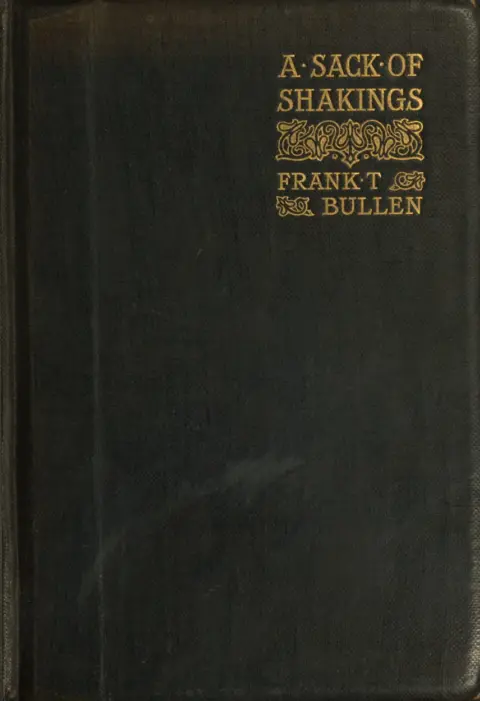
THE CLASSIC COLLECTION · 1901
"A Sack of Shakings" by Frank T. Bullen is a collection of essays written in the early 20th century. The essays draw on the author’s experiences at sea and explore various topics related to the ocean, its creatures, and maritime life. The opening portion introduces readers to an engaging narrative about a school of sperm whales, focusing on themes of family, survival, and the harsh realities of life beneath the waves. The beginning of the work captures a tranquil moment in the Pacific Ocean, where a troop of sperm whales enjoys a peaceful existence until they face an unexpected attack from whalers. As the scene unfolds, it vividly describes the majestic and delicate nature of these creatures, particularly the newly-born calf who becomes orphaned amidst the chaos of destruction. This opening sets the stage for a broader exploration of marine life, touched by the balance between the beauty of nature and the cruelty of survival at sea. Bullen’s descriptive style effectively immerses the reader in the ocean's depths, hinting at the complexities of the ecosystems and the challenges faced by its inhabitants.
Introduction adapted from the source catalogue; source summaries may be automatically generated.
Free to read · English · 103,431 words · No account needed
MAKE TIME FOR A GOOD BOOK
On by default. Untick to stop anonymous reading totals. Each page counts after 10 seconds in view. How this works.
Anonymous counting is on unless you have switched it off.
High above all the riot rose the wail of Paddy Finn as above, until the din grew so great that I fled dismayed, in mortal terror lest I should be brought into the quarrel somehow. It was well that I did so, for presently there was what sailors call a regular “plug-mush,” a free fight wherein the guiding principle is “wherever you see a head, hit it.” The battle was brief if fierce, and its results were so far good that uproarious laughter soon took the place of the pandemonium that had so recently reigned. Happily I had not brought the dinner in when the riot began, so that still there was some comfort left. Making haste I supplied the food, and soon they were all busy with it, their dinner hour being nearly gone. The punishment of the miscreant was unavoidably deferred for want of time to look for him, for he had vanished like a dream. But while we ate a sudden storm of bad language rose on deck. Hurrying out to see what fresh calamity had befallen we found the nigger cook flinging himself about in a frenzy of rage, while half-way up the main-stay, well out of everybody’s reach, sat Jocko with a fowl that he had snatched out of the galley while the cook’s back was turned, and was now carefully tearing into fragments. Rushing to the stay, the men shook it till the whole mainmast vibrated, but the motion didn’t appear to trouble the monkey. Holding the fowl tightly in one hand he bounded up into the main-top and thence to the mizen-topmast stay, where for the time he had to be left in peace.
As soon as knock-off time came a hunt was organised. It was a very exciting affair while it lasted, but not only were the men tired, but that monkey could spring across open spaces like a bird, and catching him was an impossible task. The attempt was soon given up, therefore, and the rest of the evening after supper devoted to repairing damages. For the next three days she was a lively ship. That imp of darkness was like the devil, he was everywhere. Like a streak of grey lightning he would slide down a stay, snatch up something just laid down, and away aloft again before the robbed one had realised what had happened. All sorts of traps were laid for him, but he was far too wise to be taken in any trap that ever was devised. I went in terror of him night and day, for I feared that now he was free he would certainly not omit to repay me for his broken pate. And yet it was I who caught him. For the moment I had forgotten all about him, when coming from aloft and dropping lightly with my bare feet upon the bottom of one of the upturned boats on the roof of our house, I saw something stirring in the folds of the main-topmast staysail that was lying there loosely huddled together. Leaping upon the heap of canvas I screamed for help, bringing half-a-dozen men to the spot in a twinkling. Not without some severe bites, the rascal was secured, and by means of a stout belt round his waist effectually prevented from getting adrift again. I looked to see him summarily put to death, but no one seemed to think his atrocious behaviour merited any worse punishment than a sound thrashing except the cook and steward, and they being our natural enemies were of course unheeded. The fact is Jocko had, after his first performance, confined his attentions to the cabin and galley, where he had done desperate damage and made the two darkies lead a most miserable life. This conduct of his I believe saved his life, as those two functionaries were cordially detested by the men for many reasons. At any rate he was spared, and for some time led a melancholy life chained up on the forecastle head during the day, and underneath it at night. Meantime we had sailed from Bombay and arrived at Conconada, where the second mate bought a monkey, a pretty tame little fellow that hadn’t a bit of vice in him. He was so docile that when we got to sea again he was allowed to have the run of the ship. Petted by everybody, he never got into any mischief, but often used to come forward and sit at a safe distance from Jocko, making queer grimaces and chatterings at him, but always mighty careful not to get too near. Jocko never responded, but sat stolidly like a monkey of wood until the little fellow strolled away, when he would spring up and tear at his chain, making a guttural noise that sounded as much like an Arab cursing as anything ever I heard. So little Tip went on his pleasant way, only meeting with one small mishap for a long time. He was sitting on deck one sunny afternoon with his back against the coamings of the after-hatch, his little round head just visible above its edge. One of the long-legged raw-boned roosters we had got in Conconada was prowling near on the never-ending quest for grub. Stalking over the hatch he suddenly caught sight of this queer little grey knob sticking up. He stiffened himself, craned his neck forward, and then drawing well back dealt it a peck like a miniature pick-axe falling. Well, that little monkey was more astonished than ever I saw an animal in my life. He fairly screamed with rage while the rooster stood as if petrified with astonishment at the strange result of his investigations.
Your reading position is saved on this browser. Take it to another device with a library code. Reading pages adapt to text, rather than matching a printed edition.
Frank Thomas Bullen

Frank Thomas Bullen

Frank Thomas Bullen

Frank Thomas Bullen
BEHIND THE BOOK
This eBook is for the use of anyone anywhere in the United States and most other parts of the world at no cost and with almost no restrictions whatsoever. You may copy it, give it away or re-use it under the terms of the Project Gutenberg License included with this eBook or online at www.gutenberg.org. If you are not located in the United States, you will have to check the laws of the country where you are located before using this eBook. Read the source licence.
The original source file, including credits and licence, is retained by this library. Request an original-format copy at no charge. Please include the book title and Project Gutenberg identifier #63559.
KEEP YOUR CURIOSITY GOING

David Patterson (Spirit) Hatch

David Patterson (Spirit) Hatch

David Patterson (Spirit) Hatch

Ralph Waldo Emerson

Maurice Baring

Oscar Wilde & James McNeill Whistler