
Recollections The Reminiscences of the Busy Life of One Who Has Played the Varied Parts of Sailor, Author & Lecturer
Frank Thomas Bullen
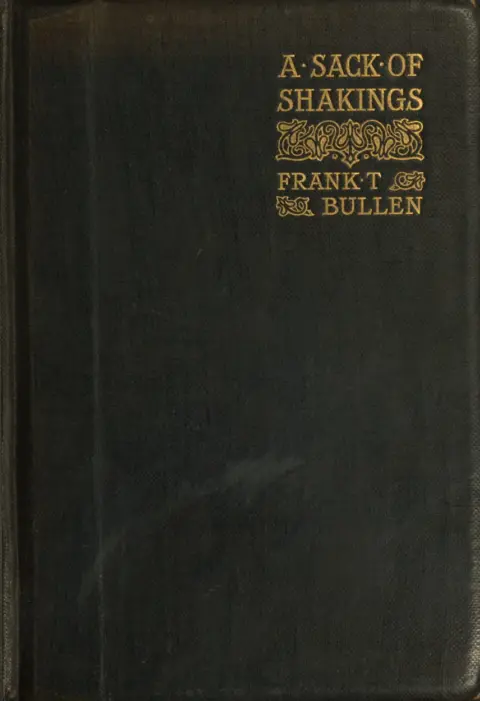
THE CLASSIC COLLECTION · 1901
"A Sack of Shakings" by Frank T. Bullen is a collection of essays written in the early 20th century. The essays draw on the author’s experiences at sea and explore various topics related to the ocean, its creatures, and maritime life. The opening portion introduces readers to an engaging narrative about a school of sperm whales, focusing on themes of family, survival, and the harsh realities of life beneath the waves. The beginning of the work captures a tranquil moment in the Pacific Ocean, where a troop of sperm whales enjoys a peaceful existence until they face an unexpected attack from whalers. As the scene unfolds, it vividly describes the majestic and delicate nature of these creatures, particularly the newly-born calf who becomes orphaned amidst the chaos of destruction. This opening sets the stage for a broader exploration of marine life, touched by the balance between the beauty of nature and the cruelty of survival at sea. Bullen’s descriptive style effectively immerses the reader in the ocean's depths, hinting at the complexities of the ecosystems and the challenges faced by its inhabitants.
Introduction adapted from the source catalogue; source summaries may be automatically generated.
Free to read · English · 103,431 words · No account needed
MAKE TIME FOR A GOOD BOOK
On by default. Untick to stop anonymous reading totals. Each page counts after 10 seconds in view. How this works.
Anonymous counting is on unless you have switched it off.
For the first time that voyage an attempt was made to confine a portion of our farm-stock within a pen, instead of allowing them to roam at their own sweet will about the decks. For the skipper still cherished the idea that milk for tea and coffee might be obtained from the two goats that would be palatable, if only their habit of promiscuous grazing could be stopped. So the carpenter rigged up a tiny corral beneath the fo’c’s’le deck, and there, in penitential gloom, the goats were confined and fed, like all the rest of the animals, on last voyage’s biscuit and weevily pease. Under these depressing conditions there was, of course, only one thing left for self-respecting goats to do--refuse to secrete any more milk. They promptly did so; so promptly, in fact, that on the second morning the utmost energies of the steward only sufficed to squeeze out from the sardonic pair about half-a-dozen teaspoonfuls of doubtful-looking fluid. This sealed their fate, for we had far too much stock on board to waste any portion of our provender upon non-producers, and the fiat went forth--the drones must die. Some suggestion was made by a member of the after guard as to the possibility of the crew not objecting to goat as a change of diet; but with all the skipper’s boldness, he did not venture to make the attempt. The goats were slain, their hides were saved for chafing gear, sheaths for knives, &c., but, with the exception of a portion that was boiled down with much disgust by the cook and given to the fowls, most of the flesh was flung overboard. Then general complaints arose that while musk was a pleasant perfume taken in moderation, a little of it went a very long way, and that two musk deer might be relied upon to provide as much scent in one day as would suffice all hands for a year. I do not know how it was done, but two days after the demise of the goats the deer also vanished. Still we could not be said to enjoy much room to move about on deck yet. We had 200 fowls and forty ducks roaming at large, and although many of the former idiotic birds tried their wings, with the result of finding the outside of the ship a brief and uncertain abiding-place, the state of the ship’s decks was still utterly abominable. A week of uninterrupted fine weather under the blazing sun of the Bay of Bengal had made every one but the skipper heartily sick of sea-farming, and consequently it was with many pleasurable anticipations that we noted the first increase in the wind that necessitated a reduction of sail. It made the fellows quite gay to think of the clearance that would presently take place. The breeze freshened steadily all night, and in the morning it was blowing a moderate gale, with an ugly cross sea, which, with the Belle’s well-known clumsiness, she was allowing to break aboard in all directions. By four bells there were many gaps in our company of fowls. Such a state of affairs robbed them of the tiny modicum of gumption they had ever possessed, and every little breaking sea that lolloped inboard drove some of them, with strident outcry, to seek refuge overboard. Presently came what we had been expecting all the morning--one huge mass of water extending from the break of the poop to the forecastle, which filled the decks rail high, fore and aft. Proceedings were exceedingly animated for a time. The ducks took very kindly to the new arrangement at first, sailing joyously about, and tasting the bitter brine as if they rather liked the flavour. But they were vastly puzzled by the incomprehensible motions of the whole mass of water under them; it was a phenomenon transcending all their previous aquatic experiences. The fowls gave the whole thing up, floating languidly about like worn-out feather brooms upon the seething flood of water, and hardly retaining enough energy to struggle when the men, splashing about like a crack team in a water-polo match, snatched at them and conveyed them in heaps to a place of security under the forecastle. That day’s breeze got rid of quite two-thirds of our feathered friends for us, what with the number that had flown or been washed overboard and those unfortunates who had died in wet heaps under the forecastle. The old man was much annoyed, and could by no means understand the unwonted cheerfulness of everybody else. But, economical to the last, he ordered the steward to slay as many of the survivors each day as would give every man one body apiece for dinner, in lieu of the usual rations of salt beef or pork. This royal command gave all hands great satisfaction, for it is a superstition on board ship that to feed upon chicken is the height of epicurean luxury. Dinner-time, therefore, was awaited with considerable impatience; in fact, a good deal of sleep was lost by the watch below over the prospect of such an unusual luxury. I went to the galley as usual, my mouth watering like the rest, but when I saw the dirty little Maltese cook harpooning the carcasses out of the coppers, my appetite began to fail me. He carefully counted into my kid one corpse to each man, and I silently bore them into the forecastle to the midst of the gaping crowd. Ah me! how was their joy turned into sorrow, their sorrow into rage, by the rapidest of transitions. She was a hungry ship at the best of times, but when things had been at their worst they had never quite reached the present sad level. It is hardly possible to imagine what that feast looked like. An East Indian jungle fowl is by no means a fleshy bird when at its best, but these poor wretches had been living upon what little flesh they wore when they came on board for about ten days, the scanty ration of paddy and broken biscuit having been insufficient to keep them alive. And then they had been scalded wholesale, the feathers roughly wiped off them, and plunged into a copper of furiously bubbling seawater, where they had remained until the wooden-headed Maltese judged it time to fish them out and send them to be eaten. They were just like ladies’ bustles covered with old parchment, and I have serious doubts whether more than half of them were drawn. I dare not attempt to reproduce the comments of my starving shipmates, unless I gave a row of dashes which would be suggestive but not enlightening. Old Nat the Yankee, who was the doyen of the forecastle, was the first to recover sufficiently from the shock to formulate a definite plan of action. “In my ’pinion,” he said, “thishyer’s ’bout reached th’ bottom notch. I kin stan’ bein’ starved; in these yer limejuicers a feller’s got ter stan’ that, but I be ’tarnally dod-gasted ef I kin see bein’ starved ’n’ insulted at the same time by the notion ov bein’ bloated with lugsury. I’m goin’ ter take thishyer kid full o’ bramley-kites aft an’ ask th’ ole man ef he don’t think it’s ’bout time somethin’ wuz said an’ done by th’ croo ov this hooker.” There was no dissentient voice heard, and solemnly as a funeral procession, Nat leading the way with the corpuses delicti, the whole watch tramped aft. I need not dwell upon the interview. Sufficient that there was a good deal of animated conversation, and much jeering on the skipper’s part at the well-known cussedness of sailors, who, as everybody knows (or think they know), will growl if fed on all the delicacies of the season served up on 18-carat plate. But we got no more poultry, thank Heaven. And I do not think the officers regretted the fact that before we got clear of the bay the last of that sad crowd of feathered bipeds had ceased to worry any of us, but had wisely given up the attempt to struggle against such a combination of trying circumstances.
Your reading position is saved on this browser. Take it to another device with a library code. Reading pages adapt to text, rather than matching a printed edition.
Frank Thomas Bullen

Frank Thomas Bullen

Frank Thomas Bullen

Frank Thomas Bullen
BEHIND THE BOOK
This eBook is for the use of anyone anywhere in the United States and most other parts of the world at no cost and with almost no restrictions whatsoever. You may copy it, give it away or re-use it under the terms of the Project Gutenberg License included with this eBook or online at www.gutenberg.org. If you are not located in the United States, you will have to check the laws of the country where you are located before using this eBook. Read the source licence.
The original source file, including credits and licence, is retained by this library. Request an original-format copy at no charge. Please include the book title and Project Gutenberg identifier #63559.
KEEP YOUR CURIOSITY GOING

David Patterson (Spirit) Hatch

David Patterson (Spirit) Hatch

David Patterson (Spirit) Hatch

Ralph Waldo Emerson

Maurice Baring

Oscar Wilde & James McNeill Whistler